Volume: 16 Issue: 4 August 2018
FULL TEXT
The use of inhibitors of mammalian target of rapamycin is associated with adverse pulmonary effects. Although sirolimus-related pneumonitis has been well described, reports on pneumonitis with everolimus are scarce. We report a case of everolimus-induced pneumonitis in a renal transplant recipient 5 years after initiation of everolimus treatment, and we also review the literature regarding everolimus-induced pneumonitis in renal transplant patients.
Key words : Kidney, Transplant, Everolimus, Pneumonitis
Introduction
Pulmonary toxicity is a well-recognized adverse event of sirolimus, an inhibitor of mammalian target of rapamycin (mTOR), in transplant recipients. In recent years, pulmonary adverse effects also have been seen in patients treated with everolimus, a biochemical agent homologous with sirolimus. Pneumonitis is an unusual but potentially severe adverse event. The most common sign of pneumonitis is shortness of breath, which may be accompanied by a dry cough. Although pneumonitis usually develops within 1 year, especially within the first 3 months after initiation of mTOR inhibitors,1-3 late occurrences have also been reported with sirolimus but rarely with everolimus.4 In this report, we describe an unusual case of late-occurring pneumonitis 5 years after start of everolimus.
Case Report
A 66-year-old man received a kidney transplant from a living-unrelated donor in February 2006 for end-stage renal disease secondary to hypertensive nephropathy. His immunosuppressive treatment regimen consisted of prednisolone, mycophenolate mofetil, and tacrolimus until June 2007. A renal biopsy was performed in June 2007 because of increased creatinine levels, revealing a chronic allograft nephropathy, after which the patient was switched from tacrolimus to everolimus. His creatinine levels subsequently remained stable at 2 mg/dL, and no proteinuria was detected. In September 2012, he presented to the outpatient clinic with shortness of breath, dry cough, and pleuritic chest pain. He was afebrile.
On physical examination, he presented with bilaterally fine basal crackles on auscultation. Laboratory findings were as follows: white blood cell count of 5300/μL, platelet count of 301 000/μL, hemoglobin level of 10.5 g/L, C-reactive protein level of 78 mg/dL, serum urea nitrogen level of 45 mg/dL, creatinine level of 2.1 mg/dL, total protein level of 6.9 g/dL, albumin level of 4.4 g/dL, total cholesterol level of 189 mg/dL, triglyceride level of 130 mg/dL, and everolimus blood level of 4.7 ng/mL (therapeutic range, 3-8 ng/mL). The patient’s first chest radiography revealed no sign of pulmonary infiltration; however, he was started on empiric oral moxifloxacin therapy (400 mg/d) for possible community-acquired pneumonia. Despite treatment, his symptoms progressed and he developed hypoxemia, necessitating hospitalization. On day 7, a noncontrast computed tomography scan of the chest showed multifocal “ground-glass” opacities in both lower lobes of the lungs (Figure 1A).
Antibiotic treatment was broadened to piperacillin/tazobactam and sulfamethoxazole/trimethoprim for suspected Pneumonia jiroveci infection. Pulmonary embolism was excluded with a normal ventilation perfusion scintigraphy. Cytomegalovirus antigenemia and polymerase chain reaction assays were negative, and Mycoplasma, Chlamydophila, and Legionella organism infections also were excluded with microbiologic assays. In addition, the patient’s galactomannan assay was negative. Bronchoscopy and bronchoalveolar lavage were performed. Bronchoalveolar lavage analyses for bacteria, fungi, and Mycobacterium tuberculosis were also negative. On cytologic examination, there were no malignant cells with a predominance of lymphocytes. After exclusion of possible infectious and malignant causes, a diagnosis of mTOR inhibitor-associated pneumonitis was considered, and everolimus therapy was switched to tacrolimus. Although the patient had been scheduled for open lung biopsy, the procedure was cancelled because his pulmonary symptoms improved gradually over 5 days after stopping everolimus. Repeated chest computed tomography scans showed improvement in the multifocal infiltrations, with complete resolution 1 month after cessation of everolimus (Figure 1B). His creatinine level was stable at 2.0 mg/dL, with tacrolimus level of 5.6 ng/dL. No episodes of acute rejection or any other complication occurred during follow-up.
Discussion
Everolimus is an oral mTOR inhibitor that belongs to a group of proliferation signal inhibitors, including sirolimus. These compounds have antiproliferative and antifibrotic properties and are used for immunosuppressive therapy in patients with solid-organ transplant. mTOR inhibitors are especially preferred in cases of BK virus nephropathy, Cytomegalovirus infections, posttransplant malignancy, and severe calcineurin inhibitor-related adverse events. Everolimus use has recently increased where calcineurin inhibitor-free immunosuppression is preferred.
The most common adverse effects of mTOR inhibitors are dyslipidemia, proteinuria, edema, and pneumonitis. The latter is the most important and life-threatening adverse effect of mTOR inhibitors. The frequency of pneumonitis ranges between 1.3% and 12.7% in renal transplant recipients5,6 and seems to be similar for both mTOR inhibitors, namely everolimus and sirolimus.
Table 1 summarizes the literature, including detailed prescribed case or case series with pneumonitis developed after everolimus treatment in renal transplant recipients.2,4,6-11 In the literature, there are also several studies that evaluated the efficacy and effects of everolimus treatment in renal transplant recipients.12-15 Although these studies rarely reported pneumonitis as an adverse event, patients’ characteristics and details on pulmonary findings were not described. Therefore, we did not include these articles in Table 1.
The time from initiation of everolimus treatment to the development of pulmonary symptoms in renal transplant patients has ranged from 1 to 80 weeks.2,6,10 Pneumonitis may develop as soon as 5 days after start of everolimus.10 In our review of the literature, the longest period of time had been 528 days (reported by Rodriguez-Moreno and associates). According to data from a literature review that analyzed sirolimus-associated pneumonitis, the duration of treatment time with sirolimus until disease ranged from 1 to 51 months.1 To our knowledge, the 62 months in our patient is the longest time reported in literature for the development of pneumonitis among patients on mTOR inhibitor treatment.
Pneumonitis induced by mTOR inhibitors is characterized by bilateral interstitial pulmonary infiltrates with general symptoms such as dyspnea, fever, dry cough, and malaise. The diagnosis is based on exclusion of infection (bacterial, viral, and fungal) with development of lung symptoms and radiologic findings after mTOR inhibitor exposure. Pneumonitis induced by mTOR inhibitors may present with a heterogeneous clinical picture. Thus, patients generally require bronchoalveolar lavage for differential diagnosis. Bronchoalveolar lavage fluid cytologic analysis would reveal excessive counts of lymphocytes, predominantly CD8-positive lymphocytes.
Although cause of everolimus-induced pneumonitis has remained unclear and speculative, bronchoalveolar lavage fluid examination findings obtained from previous case reports have exhibited features compatible with hypersensitivity pneumonitis. Dose-dependent toxicity was another suggested cause for mTOR-induced pneumonitis. High trough blood levels of sirolimus were found to be related to the development of pneumonitis in renal and/or pancreatic transplant patients.1 Similarly pneumonitis was observed at 22.6 ng/mL blood level of everolimus (therapeutic range, 8-10 ng/mL) in a heart transplant recipient.16 However, many reports showed that pneumonitis was not clearly dependent on the dose or blood levels.4,6
Because mTOR inhibitors are approved for treatment of malignancies (renal cell cancer, lung cancer), oncologists and urologists also have focused on pneumonitis related to mTOR inhibitors. In data obtained from the RECORD-1 (Renal Cell Cancer Treatment With Oral RAD001 Given Daily) trial and its subgroup analysis, which showed the efficacy of everolimus in patients with advanced renal cell carcinoma, the rate of pneumonitis ranged from 8% to 25%.17,18 In these studies, pneumonitis was graded into 4 stages: grade 1 (being asymptomatic), grade 2 (not interfering with daily living), grade 3 (interfering with daily living or oxygen indicated), and grade 4 (life-threatening). In addition, computed tomography scan findings classified nonspecific areas to extensive bilateral attenuation of “ground-glass” appearance. These studies found no relation between radiologic pattern and severity of lung symptoms. Although there were no specific findings associated with everolimus-induced pneumonitis, in generally, lower lobes of lungs were mostly involved, as in our case.
Discontinuation of everolimus is recommended for treatment of everolimus-related pneumonitis. In severe cases or in cases with advanced lung fibrosis, high-dose steroid treatment can be indicated. Mild cases can be treated with a transient increase in steroid dose without everolimus discontinuation.11 In our patient, we chose to discontinue everolimus treatment without steroid therapy to avoid steroid-induced adverse effects.
In conclusion, everolimus-associated pneumonitis should always be included in differential diagnosis when transplant patients on everolimus present with pulmonary symptoms. As in our patient, pneumonitis related to everolimus could develop even 5 years after treatment. For patients with pneumonitis, withdrawal of everolimus should be considered immediately.
References:
- Weiner SM, Sellin L, Vonend O, et al. Pneumonitis associated with
sirolimus: clinical characteristics, risk factors and outcome--a
single-centre experience and review of the literature. Nephrol Dial
Transplant. 2007;22(12):3631-3637.
CrossRef - PubMed - Rodríguez-Moreno A, Ridao N, García-Ledesma P, et al. Sirolimus and
everolimus induced pneumonitis in adult renal allograft recipients:
experience in a center. Transplant Proc. 2009;41(6):2163-2165.
CrossRef - PubMed - Champion L, Stern M, Israël-Biet D, et al. Brief communication:
sirolimus-associated pneumonitis: 24 cases in renal transplant recipients.
Ann Intern Med. 2006;144(7):505-509. d
CrossRef - PubMed - Errasti P, Izquierdo D, Martín P, et al. Pneumonitis associated with
mammalian target of rapamycin inhibitors in renal transplant recipients: a
single-center experience. Transplant Proc. 2010;42(8):3053-3054.
CrossRef - PubMed - Cotovio P, Neves M, Santos L, Macário F, Alves R, Mota A. Conversion to
everolimus in kidney transplant recipients: to believe or not believe?
Transplant Proc. 2012;44(10):2966-70.
CrossRef - PubMed - Baas MC, Struijk GH, Moes DJ, et al. Interstitial pneumonitis caused by
everolimus: a case-cohort study in renal transplant recipients. Transpl Int.
2014;27(5):428-436.
CrossRef - PubMed - Keller F, Wiesner S, Bunjes D, Hartmann B, Schmitt M. Safety and
efficacy of everolimus after kidney and hematopoietic stem cell
transplantation. Ann Transplant. 2012;17(4):52-58.
CrossRef - PubMed - Alexandru S, Ortiz A, Baldovi S, et al. Severe everolimus-associated
pneumonitis in a renal transplant recipient. Nephrol Dial Transplant.
2008;23(10):3353-3355.
CrossRef - PubMed - Kurnatowska I, Piotrowski WJ, Masajtis-Zagajewska A, Marczak J,
Wągrowska-Danilewicz M, Nowicki M. Everolimus-related pulmonary toxicity in
a kidney transplant recipient—diagnosis and management. NDT Plus.
2010;3(2):181-184.
CrossRef - Sułkowska K, Palczewski P, Miszewska-Szyszkowska D, Durlik M,
Gołębiowski M, Małkowski P. Early everolimus-induced pneumonitis in a renal
transplant recipient: A case report. Ann Transplant. 2012;17(4):144-148.
CrossRef - PubMed - Carreño CA, Gadea M. Case report of a kidney transplant recipient
converted to everolimus due to malignancy: resolution of bronchiolitis
obliterans organizing pneumonia without everolimus discontinuation.
Transplant Proc. 2007;39(3):594-595.
CrossRef - PubMed - Cotovio P, Neves M, Santos L, Macário F, Alves R, Mota A. Conversion to
everolimus in kidney transplant recipients: to believe or not believe?
Transplant Proc. 2012;44(10):2966-2970.
CrossRef - PubMed - Sánchez-Fructuoso AI, Ruiz JC, Pérez-Flores I, Gómez Alamillo C, Calvo
Romero N, Arias M. Comparative analysis of adverse events requiring
suspension of mTOR inhibitors: everolimus versus sirolimus. Transplant Proc.
2010;42(8):3050-3052.
CrossRef - PubMed - Sola E, Lopez V, Gutierrez C, et al. Late conversion to mammalian target
of rapamycin inhibitor/proliferation signal inhibitors in kidney transplant
patients: clinical experience in the last 5 years. Transplant Proc.
2010;42(8):2859-2860.
CrossRef - PubMed - Bertolini L, Vaglio A, Bignardi L, et al. Subclinical interstitial lung
abnormalities in stable renal allograft recipients in the era of modern
immunosuppression. Transplant Proc. 2011;43(7):2617-2623.
CrossRef - PubMed - David S, Kümpers P, Shin H, Haller H, Fliser D. Everolimus-associated
interstitial pneumonitis in a patient with a heart transplant. Nephrol Dial
Transplant. 2007;22(11):3363-3364.
CrossRef - PubMed - Motzer RJ, Escudier B, Oudard S, et al. Efficacy of everolimus in
advanced renal cell carcinoma: a double-blind, randomised,
placebo-controlled phase III trial. Lancet. 2008;372(9637):449-456.
CrossRef - PubMed - Tsukamoto T, Shinohara N, Tsuchiya N, et al. Phase III trial of
everolimus in metastatic renal cell carcinoma: subgroup analysis of Japanese
patients from RECORD-1. Jpn J Clin Oncol. 2011;41(1):17-24.
CrossRef - PubMed

Volume : 16
Issue : 4
Pages : 491 - 494
DOI : 10.6002/ect.2015.0257
From the 1Department of Internal Medicine, Division of Nephrology;
the 2Department of Pulmonary Medicine; and the 3Department
of Radiology, Marmara University School of Medicine, Istanbul, Turkey
Acknowledgements: The authors declare that they have no sources of
funding for this study, and they have no conflicts of interest to declare.
Corresponding author: Arzu Velioglu, Marmara Universitesi Pendik Egitim
ve Arastirma Hastanesi, Nefroloji Bilim Dali, Ust Kaynarca - Pendik, Istanbul,
Turkey
Phone: + 90 532 608 2474
Fax: + 90 216 625 4545
E-mail: arzuvelioglu@gmail.com
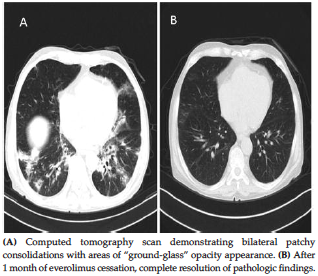
Figure 1. Patient’s Radiologic Findings
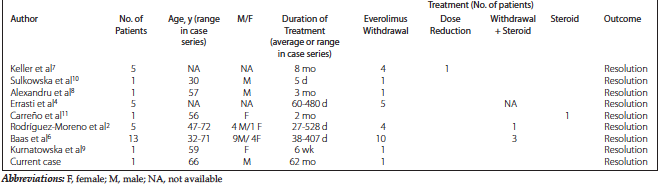
Table 1. Summary of Published Reports of Everolimus-Associated Pneumonitis