Volume: 24 Issue: 7 July 2026
FULL TEXT
Obstetrical and Perinatal Outcomes of Posttransplant Pregnancy in Kidney and Liver Transplant Recipients
Objectives: Pregnancy after transplant still confers increased risks of various complications. This study analyzed obstetrical and perinatal outcomes of posttransplant pregnancy in kidney and liver transplant recipients.
Materials and Methods: We included kidney and liver transplant recipients with posttransplant pregnancy who were followed in our institution from 2011 to 2025. Patients were monitored simultaneously in the transplant outpatient clinic and obstetrics and gynecology clinics. We retrospectively analyzed the obstetrical complications, perinatal outcomes, and the effect of pregnancy on allograft function.
Results: We analyzed 18 kidney and 13 liver transplant recipients with posttransplant pregnancy. Mean mater-nal age of kidney transplant recipients was 31.1 years at the birth of the child. In the kidney transplant group, 7 patients (35%) delivered live birth at term, 7 patients (35%) experienced pregnancy complications of ges-tational hypertension or preeclampsia, and 1 patient experienced graft rejection during the postpartum period. In the liver transplant group, 8 patients (61.5%) delivered live birth at term. One patient had intrahepatic cholestasis of pregnancy, 1 patient had preterm pre-mature rupture of membranes, 1 patient had preec-lampsia, and 1 patient had gestational diabetes. There were no graft rejections in the liver transplant group. Mean maternal age and rate of nulliparity were higher in the kidney transplant versus the liver transplant group (P = .032 and P = .013, respectively). No significant differences were shown for gestational age at delivery, preterm birth rate, birth weights of the newborns, and rates of neonatal intensive care unit hospitalizations.
Conclusions: Pregnancy after solid-organ transplant is associated with potential risks for the mother, newborn, and the allograft. We observed higher rates of adverse obstetrical outcomes in the kidney transplant group versus the liver transplant group. We believe that a multidisciplinary approach during the antenatal and postpartum periods is essential to improve outcomes and minimize complications.
Key words : Kidney transplantation, Liver transplantation, Obstetrical outcomes, Pregnancy
Introduction
Pregnancy following solid-organ transplant was first reported in 1963.1 Subsequently, thousands of such pregnancies were reported worldwide.2,3 It is known that, among female patients with end-stage renal disease undergoing dialysis, pregnancy is rare and associated with increased maternal and fetal complications.4 The rapid improvement in a woman’s quality of life and the endocrine system after transplant facilitates the restoration of fertility. However, the rates of conception and successful pregnancy are much lower than in the general population. Also, despite growing evidence and advances in the field of transplantation, pregnancies among transplant recipients still confer increased risk for various complications regarding both obstetrical/perinatal outcomes and maternal health.
The aim of our study was to evaluate maternal, obstetrical, and perinatal outcomes among pregnancies complicated by kidney transplant (KT) and/or liver transplant (LT). We also aimed to compare the KT group and the LT group in terms of perinatal outcomes and donor organ functions.
Materials and Methods
This retrospective study analyzed posttransplant pregnancy among female recipients of solid-organ transplant for the period from January 2011 to April 2025 who were seen at the Baskent University Hospital (Ankara, Türkiye). All included patients had received solid-organ transplant at the Baskent University Hospital, and their antenatal follow-ups, deliveries, and postpartum visits and consultations were performed in our center. Maternal characteristics and obstetrical and perinatal outcomes were retrieved from the electronic database of the hospital and the registry of the Perinatology Department. Neonatal outcomes and data on postnatal follow-up were collected from registries of the Departments of Neonatology, Pediatric Cardiology, and Medical Genetics and the Transplantation Unit. We cross-checked the databases to ensure the coherence of our data.
We analyzed our cohort in terms of maternal age, gravida, parity, mode of conception, maternal history of chronic illnesses, gestational age, and neonatal weight at birth. We calculated the rate of preterm birth and neonatal intensive care unit (NICU) hospitalization. We divided our study population into 2 groups: KT recipients and LT recipients. We compared the variables between the 2 groups.
We also aimed to analyze the renal and liver function tests among the KT recipients and the LT recipients. To this end, we retrieved the results for serum creatinine (mL/dL), glomerular filtration rate (GFR, in mL/min/1.73 m2), alanine aminotransferase (ALT, in U/L), and aspartate aminotransferase (AST, in U/L). We aimed to compare the function of the donor organ among 3 different time periods: before pregnancy, during the second trimester of pregnancy, and 4 to 6 weeks postpartum among respective groups.
All participants provided written informed consent for fetal and neonatal cardiac and/or genetic assessments. This study was approved by the Baskent University Institutional Review Board (project No. KA25/447) and supported by the Baskent University Research Fund.
We used SPSS software (version 25.0; IBM) for all statistical analyses. We defined categorical variables as frequency (with percentage). We presented con-tinuous variables as median values (with range) or mean values (±SD). We compared variables with a normal distribution with the t test and compared continuous variables with the Mann-Whitney U test. For categorical variables, we used the χ2 or the Fisher exact test (when χ2 test assumptions do not hold due to low expected cell counts). To analyze whether there was a change in kidney and liver function tests among respective donors before pregnancy, during pregnancy, and postnatal, we used the Friedman test. The Wilcoxon test was performed to test the sig-nificance of pairwise differences using Bonferroni correction to adjust multiple comparisons. P < .05 was considered statistically significant.
Results
During the study period, 35 patients with a history of organ transplant had experienced pregnancy and were followed up in our center. Among this group, 20 patients had KT, 13 patients had LT, 1 patient had combined KT-LT, and 1 patient had cornea transplant. The combined KT-LT case and the corneal transplant case were excluded from statistical analyses. One patient in the KT group experienced an aborted pregnancy at 14 weeks of gestation, and this case was excluded. Another patient in the KT group experienced twin gestation and delivered 2 healthy newborns at 36 weeks of gestation, and this case was excluded. Therefore, we based our investigation on 18 patients in the KT group and 13 patients in the LT group.
Maternal and obstetrical characteristics of the KT and LT groups are shown in Table 1. Maternal age was significantly higher in the KT group (P = .032). The rate of nulliparity was also significantly higher among the KT group (P = .013).
Median values for gestational age at birth were 36 weeks in the KT group and 37 weeks in the LT group (P = .337). Despite being higher among the LT group, the birth weights of the newborns were not significantly different (P = .484).
Preterm birth rate was 61.1% in the KT group and 38.5% in the LT group, but this difference was not significant (P = .213). Preterm birth rate was 51.6% among all transplant recipients. Those rates were parallel with the rates of NICU hospitalizations, which were also similar between the 2 groups (P = .547). In the KT group, 3 newborns had neonatal jaundice, 2 newborns experienced transient tachypnea (born at 34 and 35 weeks of gestation, respectively), and 1 newborn required endotracheal intubation and mechanical ventilation (born at 32 weeks of gestation with the indication of severe preeclampsia). The LT group had 4 newborns with transient tachypnea.
There were 3 patients in the KT group (16.6%) and 2 patients in the LT group (15.3%) whose pregnancies were conceived through in vitro fertilization.
For all patients in the KT group, the pregnancy outcome was cesarean section delivery. Indications for cesarean section delivery in the KT group were 5 cases of acute fetal distress, 2 cases of breech presentation, and 11 cases of elective cesarean section delivery. The LT group had 1 case of vaginal delivery. Indications for cesarean section delivery in the LT group were 2 cases of acute fetal distress, 2 cases of malpresentation, and 8 cases of elective cesarean section delivery.
Among the KT group, 3 patients experienced gestational hypertension as a pregnancy complication. We observed mild preeclampsia in 2 patients and severe preeclampsia affecting donor kidney function in 2 patients. There were no cases of graft rejection during pregnancy, but 1 patient was diagnosed with allograft rejection during the postpartum period and required subsequent hemodialysis.
In the LT group, 1 patient developed intrahepatic cholestasis of pregnancy, 1 patient had gestational diabetes (which was treated with insulin), 1 patient had preterm premature rupture of membranes during 32 weeks of gestation, and 1 patient had mild preeclampsia.
The change in renal function tests among KT recipients is shown in Table 2. Serum creatinine values and GFR values before pregnancy and after pregnancy were similar (P = .177 and P = .327, respectively). Significant differences were shown in serum creatinine and GFR before pregnancy versus during pregnancy (P = .006) and during pregnancy versus after pregnancy (P < .001).
Changes in liver function tests among LT recipients are listed in Table 3. Serum ALT and AST values before pregnancy versus after pregnancy were similar (P = .05 and P = .35, respectively). Also, ALT and AST levels were similar when levels were com-pared before pregnancy versus during pregnancy (P = .272 vs P = .146). Significant differences were shown in ALT and AST levels during pregnancy versus after pregnancy (P = .07 and P = .003, respectively).
Discussion
In this study, we analyzed the perinatal outcomes of KT recipients and LT recipients. The first pregnancy to occur in a KT recipient was reported in 1963 by Murray and colleagues,1 and the first case report of pregnancy after LT was published in 1978.5,6 The experience at our centers has shown that, despite the advances in the field of transplantation and the increasing number of pregnancies among transplant recipients, the risk of an adverse pregnancy outcome remains increased, especially after KT.
The rate of preterm birth was 65% in the KT group, with a median gestational age at birth of 36 weeks. In a recent study, Barros and colleagues reported a similar rate of preterm birth at 68.8%.7 In another recent study from China, the authors reported a rate of preterm birth as high as 79.8%, which they attributed to the increased rates of cesarean section deliveries in this group.8 In contrast, in a study from the United Kingdom, the rate of preterm birth was 52%.9
The preterm birth rate was 38.5% among LT recipients in our study, which was lower than the preterm birth rate in the KT cohort, but this difference was not significant (P = .213). Our findings align with previously published studies. In a recent review by Katz-Greenberg and colleagues, the authors noted that, compared with other solid-organ transplants, posttransplant pregnancies of LT recipients are characterized by higher median gestational ages and higher neonatal birth weights. The authors suggested this observation could be related to lower immuno-suppressive doses, a lower incidence of hypertension before transplant, and better renal function.10 We found that maternal age and nulliparity rates were significantly higher in the KT group (P = .032 and P = .013, respectively). We believe that higher mater-nal age and nulliparity may have contributed to increased pregnancy complications such as gesta-tional hypertension and preeclampsia. The birth weights of newborns and preterm birth rates were similar between groups, although this observation may be due to the small sample size in both the KT group and LT group. An increased risk of low birth weight has been reported in pregnancies following organ transplant. It has been proposed that fetal growth restriction may be linked to underlying maternal disease or the immunosuppression therapy itself. Preterm birth is also more common, especially among patients who require prolonged high-dose corticosteroid therapy.5,6,11
The rate of cesarean section delivery as a preg-nancy outcome was high in both the KT and LT groups in our cohort. After solid-organ transplant, the pregnancy outcome can be delivery at term if there are no pregnancy complications. Cesarean section delivery is generally reserved for obstetrical indications. That said, the rate of cesarean section delivery rate is higher among solid-organ transplant recipients. This higher rate of cesarean section delivery was explained by the higher rate of obstetrical complications.6
In our cohort, no graft rejections occurred during pregnancy in both KT recipients and LT recipients. However, 1 patient was diagnosed with organ dysfunction after delivery. Renal function is not expected to be affected by pregnancy if the graft has remained stable before pregnancy.12,13 However, in cases with preexisting renal dysfunction, there may be further failure, and graft function in such cases may not return to antenatal levels.11 Al Duraihimh and colleagues have reported that patients with baseline serum creatine >150 μmol/L (1.695 mg/dL) showed increased risk of allograft dysfunction associated with pregnancy.14 Biopsy-proven acute rejection complicates 2% to 4% of pregnancies.5 Long-term graft survival is not affected by pregnancy.11,13
Pregnancies following solid-organ transplant do not seem to diminish patient survival or graft survival.15 Similarly, Basaran and colleagues reported that among patients with good graft function and in the absence of hypertension, pregnancy did not affect graft function or patient survival.16 Liver transplants have a lower incidence of graft dysfunction 2 years postpartum than other solid-organ transplants.5 Posttransplant pregnancy is often accompanied by increased liver enzymes without jaundice, and such cases are usually treated with augmentation of baseline immunosuppressants and/or a bolus course of steroids.17 Liver failure during pregnancy can be associated with noncompliance with medications, acute cellular rejection, recurrence of hepatitis C, or autoimmune hepatitis.6,18
In our study population, no congenital anomalies were shown in the newborns among both the KT group and LT group. We also did not find any chromosomal/genetic abnormality. The incidence of major structural malformations in pregnancies after solid-organ transplant is calculated to be around 4% to 5%,13 and this rate is similar to the background risk among the general population, which is 3% to 5%. There is no specific pattern of congenital anomalies after in utero exposure to a conventional immuno-suppressant. Of note, animal studies have not found any carcinogenic effect.6,19
The key strengths of our study were the single-center experience and the uniform data focused on a specific population of KT and LT recipients. The main limitations of our study were the relatively small number of cases and the retrospective design.
Conclusions
Despite recent advances in solid-organ transplant, KT and LT recipients with posttransplant pregnancy comprise a specific group of patients who require a multidisciplinary approach and special follow-up. We observed increased rates of obstetrical and perinatal complications concerning preterm birth, low birth weight, and NICU hospitalization rates in both KT and LT recipients.
References:
- Murray JE, Reid DE, Harrison JH, Merrill JP. Successful pregnancies after human renal transplantation. N Engl J Med. 1963;269(7):341-343. doi:10.1056/NEJM196308152690704
CrossRef - PubMed - Shah S, Venkatesan RL, Gupta A, et al. Pregnancy outcomes in women with kidney transplant: metaanalysis and systematic review. BMC Nephrol. 2019;20(1):24. doi:10.1186/s12882-019-1213-5a
CrossRef - PubMed - Valentin N, Guerrido I, Rozenshteyn F, et al. Pregnancy outcomes after liver transplantation: a systematic review and meta-analysis. Am J Gastroenterol. 2021;116(3):491-504. doi:10.14309/ajg.0000000000001105
CrossRef - PubMed - Eroglu D, Lembet A, Ozdemir FN, et al. Pregnancy during hemodialysis: perinatal outcome in our cases. Transplant Proc. 2004;36(1):53-55. doi:10.1016/j.transproceed.2003.11.002
CrossRef - PubMed - Armenti VT, Daller JA, Constantinescu S, et al. Report from the National Transplantation Pregnancy Registry: outcomes of pregnancy after transplantation. Clin Transpl. 2006:57-70.
CrossRef - PubMed - Mastrobattista JM, Gomez-Lobo V; Society for Maternal-Fetal Medicine. Pregnancy after solid organ transplantation. Obstet Gynecol. 2008;112(4):919-932. doi:10.1097/AOG.0b013e318187d00c
CrossRef - PubMed - Barros T, Braga J, Correia A, Correia S, Martins S, Braga A. Pregnancy in kidney transplantation women: perinatal outcomes and impact on kidney function. J Matern Fetal Neonatal Med. 2022;35(26):10355-10361. doi:10.1080/14767058.2022.2128650
CrossRef - PubMed - Zhang Y, Zhang L, Xia W, Fang L, Zhu T. Maternal and infant outcomes of pregnancy after kidney transplantation: a retrospective cohort study. Arch Gynecol Obstet. 2025;311(5):1305-1313. doi:10.1007/s00404-025-07947-2
CrossRef - PubMed - Bramham K, Nelson-Piercy C, Gao H, et al. Pregnancy in renal transplant recipients: a UK national cohort study. Clin J Am Soc Nephrol. 2013;8(2):290-298. doi:10.2215/CJN.06170612
CrossRef - PubMed - Katz-Greenberg G, Afshar Y, Bonn J, et al.; American Society of Transplantation Women’s Health Community of Practice Reproductive Health, Contraception and Pregnancy after Transplantation and Living Donation Controversies Conference Participants. Pregnancy after solid organ transplantation: review of the evidence and recommendations. Transplantation. 2025;109(9):1483-1494. doi:10.1097/TP.0000000000005341
CrossRef - PubMed - Sibanda N, Briggs JD, Davison JM, Johnson RJ, Rudge CJ. Pregnancy after organ transplantation: a report from the UK Transplant Pregnancy Registry. Transplantation. 2007;83(10):1301-1307. doi:10.1097/01.tp.0000263357.44975.d0
CrossRef - PubMed - Naqvi R, Noor H, Ambareen S, et al. Outcome of pregnancy in renal allograft recipients: SIUT experience. Transplant Proc. 2006;38(7):2001-2002. doi:10.1016/j.transproceed.2006.06.020
CrossRef - PubMed - Armenti VT, Radomski JS, Moritz MJ, et al. Report from the National Transplantation Pregnancy Registry (NTPR): outcomes of pregnancy after transplantation. Clin Transpl. 2005:69-83.
CrossRef - PubMed - Al Duraihimh H, Ghamdi G, Moussa D, et al. Outcome of 234 pregnancies in 140 renal transplant recipients from five Middle Eastern countries. Transplantation. 2008;85(6):840-843. doi:10.1097/TP.0b013e318166ac45
CrossRef - PubMed - Ehrich JH, Loirat C, Davison JM, et al. Repeated successful pregnancies after kidney transplantation in 102 women (Report by the EDTA Registry). Nephrol Dial Transplant. 1996;11(7):1314-1317.
CrossRef - PubMed - Basaran O, Emiroglu R, Secme S, Moray G, Haberal M. Pregnancy and renal
transplantation. Transplant Proc. 2004;36(1):122-124. doi:10.1016/j.transproceed.2003.11.011
CrossRef - PubMed - Jain AB, Reyes J, Marcos A, et al. Pregnancy after liver transplantation with tacrolimus immunosuppression: a single center’s experience update at 13 years. Transplantation. 2003;76(5):827-832. doi:10.1097/01.TP.0000084823.89528.89
CrossRef - PubMed - Nagy S, Bush MC, Berkowitz R, Fishbein TM, Gomez-Lobo V. Pregnancy outcome in liver transplant recipients. Obstet Gynecol. 2003;102(1):121-128. doi:10.1016/s0029-7844(03)00369-7
CrossRef - PubMed - Albengres E, Le Louet H, Tillement JP. Immunosuppressive drugs and pregnancy: experimental and clinical data. Transplant Proc. 1997;29(5):2461-2466. doi:10.1016/s0041-1345(97)00450-8
CrossRef - PubMed

Volume : 24
Issue : 7
Pages : 553 - 557
DOI : 10.6002/ect.2025.0311
From the 1Department of Obstetrics and Gynecology, and the 2Department of General Surgery and Transplantation, Baskent University, Ankara, Türkiye
Acknowledgements: This study was supported by Baskent University Research Fund. Other than described, the authors have not received any funding or grants in support of the presented research or for the preparation of this work and have no declarations of potential conflicts of interest.
Corresponding author: Murat Aykut Özek, Division of Perinatology, Department of Obstetrics and Gynecology, Baskent University Faculty of Medicine, Ankara, Türkiye
Phone: +90 23 03 4455734
E-mail: aykut.spm@gmail.com
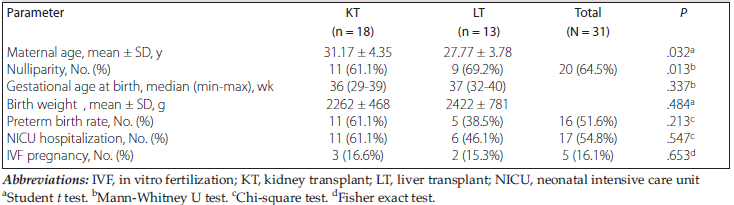
Table 1. Comparison of Maternal and Obstetrical Characteristics of the Study Cohort

Table 2. Changes in Renal Function Tests Among Kidney Transplant Recipients

Table 3. Changes in Liver Function Tests Among Liver Transplant Recipients