Volume: 24 Issue: 5 May 2026
FULL TEXT
Twenty-Year Follow-up After Combined Heart and Kidney Transplant: A Case Report
Combined heart and kidney transplant is a rare but valuable treatment option for selected patients with end-stage cardiac and renal failure. We present the long-term outcome of a 27-year-old man with pulmonary stenosis previously treated with valvuloplasty in 1998, who subsequently developed end-stage renal disease secondary to glomerulonephritis and prog-ressive dilated cardiomyopathy with intolerance to hemodialysis. In 2006, he received a combined heart and kidney transplant using organs from a 52-year-old deceased male donor. Cold ischemia time was 6.5 hours, HLA matching was 3/6, induction immunosuppression consisted of anti-thymocyte globulin, and maintenance therapy included tacrolimus, mycophenolate mofetil, and prednisolone; tacrolimus was replaced with sirolimus at the end of the first posttransplant year to minimize nephrotoxicity and reduce the risk of cardiac allograft vasculopathy. The postoperative course was uneventful, with extubation on day 1, transfer to the ward on day 4, and discharge on day 14. During the 20-year follow-up period, 19 endomyocardial biopsies were performed, with only 1 episode of cardiac rejection, which occurred in the second posttransplant year and was successfully controlled by intensification of mycophenolate mofetil therapy. No kidney allograft rejection occurred, and kidney graft biopsy was not required. At the most recent follow-up, approximately 20 years after transplant, left ventricular ejection fraction was 40%, tricuspid annular plane systolic excursion was 15 mm, serum creatinine was 1.2 mg/dL, and the urine protein/creatinine ratio was 0.35. This case demonstrates that combined heart and kidney transplant can provide durable long-term survival with preserved renal graft function and limited cardiac rejection risk in carefully selected patients.
Key words : Combined heart and kidney transplantation, Dilated cardiomyopathy, End-stage renal disease, Heart transplantation, Kidney transplantation
Introduction
Combined heart and kidney transplant (CHKT) is a rare but valuable therapeutic option for selected patients with end-stage cardiac and renal failure. In appropriately selected recipients, CHKT has been associated with favorable long-term survival, a lower rejection risk, and acceptable graft outcomes. Chronic kidney disease in patients with an established indication for heart transplant represents a major comorbidity and may adversely affect outcomes if isolated heart transplant is performed. Published series have suggested that CHKT is a safe and effective strategy in selected recipients.1-3 Herein, we present the 20-year follow-up of a patient who underwent CHKT for dilated cardiomyopathy and end-stage renal disease secondary to glomerulonephritis.
Case Report
A 27-year-old man with a history of pulmonary stenosis had undergone valvuloplasty in 1998. In 2003, he had been diagnosed with chronic kidney failure secondary to glomerulonephritis, and hemodialysis was initiated. During follow-up, he also developed progressive dilated cardiomyopathy. In 2005, his left ventricular ejection fraction had declined from 35% to 24%, and he had been hospitalized 3 times to treat acute pulmonary edema. Coronary angiography at that time had revealed normal coronary arteries, a pulmonary capillary wedge pressure of 16 mm Hg, a pulmonary artery pressure of 38/16 mm Hg, and a value of 1 for the ratio of pulmonary blood flow versus systemic blood flow.
As heart failure progressed, the patient had be-come intolerant to hemodialysis. Severe hypotension, marked pulmonary congestion on imaging, and inability to perform effective ultrafiltration were observed during dialysis sessions. Because of wor-sening heart failure and intolerance to hemodialysis, the patient was scheduled for CHKT.
In 2006, he underwent CHKT using organs from a 52-year-old deceased male donor. Cold ischemia time was 6.5 hours, and HLA matching was 3/6. Induction immunosuppression consisted of anti-thymocyte globulin. Maintenance immunosuppres-sion therapy included tacrolimus, mycophenolate mofetil, and prednisolone. At the end of the first posttransplant year, tacrolimus was replaced with sirolimus to minimize nephrotoxicity and to reduce the risk of cardiac allograft vasculopathy. No peri-operative complications occurred, and no infectious episode was recorded during follow-up.
For the 2006 CHKT surgery, the patient was extubated on postoperative day 1, transferred to the ward on postoperative day 4, and discharged on postoperative day 14. No rejection was detected on the predischarge endomyocardial biopsy. Echocardiog-raphy performed on postoperative day 14 demon-strated a left ventricular ejection fraction of 52%.
Long-term cardiac follow-up included serial echocardiography and endomyocardial biopsies. A total of 19 endomyocardial biopsies were performed during the 20-year follow-up period. Only 1 episode of early cardiac rejection had been detected, which was in the second posttransplant year and was successfully controlled by intensification of mycop-henolate mofetil therapy. Left ventricular ejection fraction had gradually declined in recent years, measuring 45%, 43%, 42%, 45%, and 40% during the last 5 years of follow-up, respectively; tricuspid annular plane systolic excursion was 15 mm at the most recent assessment (Figure 1).
Renal graft follow-up included serial laboratory analyses and Doppler ultrasonography. Early postoperative Doppler ultrasonography showed normal renal perfusion. Subsequent renal color Doppler ultrasonography demonstrated preserved blood flow and normal resistance index values. No episode of kidney allograft rejection occurred during follow-up, and kidney graft biopsy was not required. Serial serum creatinine values had remained relatively stable during long-term follow-up, with mild fluctuations and a gradual increase in recent years, measuring 1.28, 1.39, 1.25, 1.30, and 1.20 mg/dL, respectively, during the last 5 years of follow-up; the urine protein/creatinine ratio was 0.35 at the most recent assessment (Figure 2).
Discussion
Chronic kidney disease in candidates for heart transplant is an important determinant of postop-erative morbidity and mortality. In patients with advanced renal dysfunction, isolated heart transplant may not provide optimal long-term results; however, CHKT may offer better overall outcomes in selected recipients. Previous studies have demonstrated encouraging long-term survival after CHKT and have supported its safety and efficacy as a treatment strategy.4-6
Weingarten and colleagues reported that long-term mortality in patients undergoing CHKT was lower versus selected patients undergoing isolated heart transplant.5 Similarly, analyses by Awad and colleagues6 and Ruzza and colleagues4 have shown that CHKT can be performed with acceptable long-term graft and patient outcomes. In this context, the present case is notable for very long-term survival after CHKT, with preserved renal graft function and limited cardiac rejection risk.
Another important aspect of our case is the stable renal graft course (Figure 3). No kidney allograft rejection occurred, kidney biopsy was never required, and renal function remained preserved at long-term follow-up. In addition, the cardiac course was favorable, with only 1 rejection episode during follow-up, which was successfully managed medically. The conversion from tacrolimus to sirolimus at the end of the first posttransplant year may also have contri-buted to long-term preservation of renal function and reduction of cardiac allograft vasculopathy risk.
The most remarkable feature of this case is the
20-year survival after CHKT, achieved without major perioperative complications, infectious episodes, or significant graft dysfunction. This finding supports the view that CHKT can provide durable long-term benefits in carefully selected patients when perfor-med within a multidisciplinary framework and followed by close long-term surveillance.
The limitations of this report are inherent to its design as a single case. Therefore, the findings cannot be generalized to all transplant recipients. Nevertheless, long-term case-based observations remain valuable in rare procedures such as CHKT, particularly when accompanied by extended follow-up data.
Conclusions
This case demonstrates that CHKT can provide durable long-term survival with preserved renal graft function and limited cardiac rejection risk in carefully selected patients. Our study also highlights the importance of multidisciplinary evaluation, individualized immunosuppressive management, and close long-term follow-up to achieve favorable outcomes after CHKT.
References:
- Sampaio NZ, Faleiro MD, Vieira LVDS, et al. Simultaneous heart and kidney transplantation: A systematic review and proportional meta-analysis of its characteristics and long-term variables. Transpl Int. 2024;37:12750. doi:10.3389/ti.2024.12750
CrossRef - PubMed - Ohira S, Okumura K, Pan S, et al. Outcomes of combined heart and kidney transplantation under the new heart allocation policy: a United Organ Network for Organ Sharing database analysis. Circ Heart Fail. 2023;16(4):e010059. doi:10.1161/CIRCHEARTFAILURE.122.010059
CrossRef - PubMed - Castillo-Lugo JA, Brinker KR. An overview of combined heart and kidney transplantation. Curr Opin Cardiol. 1999;14(2):121-125. doi:10.1097/00001573-199903000-00008
CrossRef - PubMed - Ruzza A, Czer LS, Trento A, Esmailian F. Combined heart and kidney transplantation: what is the appropriate surgical sequence? Interact Cardiovasc Thorac Surg. 2013;17(2):416-418. doi:10.1093/icvts/ivt172
CrossRef - PubMed - Weingarten N, Iyengar A, Herbst DA, et al. Heart-kidney transplant versus heart transplant in the obese: a propensity-matched analysis. Eur J Cardiothorac Surg. 2022;63(1):ezac563. doi:10.1093/ejcts/ezac563
CrossRef - PubMed - Awad MA, Czer LSC, Emerson D, et al. Combined heart and kidney transplantation: clinical experience in 100 consecutive patients. J Am Heart Assoc. 2019;8(4):e010570. doi:10.1161/JAHA.118.010570
CrossRef - PubMed

Volume : 24
Issue : 5
Pages : 428 - 431
DOI : 10.6002/ect.2026.0088
From the 1Department of General Surgery, the 2Department of Cardiology, the 3Department of Cardiovascular Surgery, the 4Department of Nephrology, and the 5Department of Anesthesiology, Baskent University, Ankara, Türkiye
Acknowledgements: The authors have not received any funding or grants in support of the presented research or for the preparation of this work and have no declarations of potential conflicts of interest.
Corresponding author: Mehmet Haberal, Baskent University Faculty of Medicine, Department of General Surgery, Ankara, Türkiye
E-mail: rectorate@baskent.edu.tr
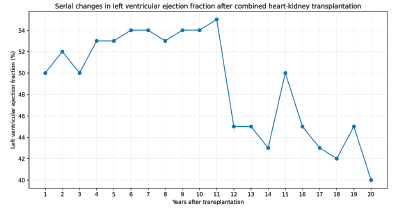
Figure 1.Serial Changes in Left Ventricular Ejection Fraction During 20 Years of Follow-Up After Combined Heart and Kidney Transplant
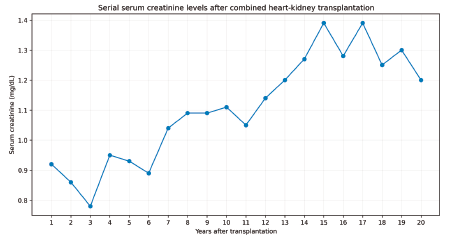
Figure 2.Serial Changes in Serum Creatinine During 20 Years of Follow-Up After Combined Heart and Kidney Transplant
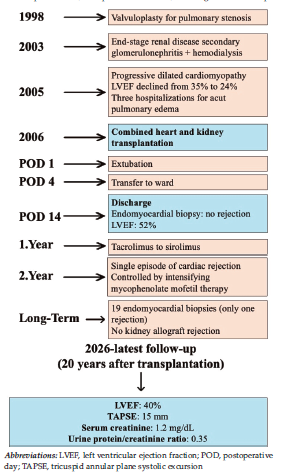
Figure 3.Clinical Timeline of Combined Heart and Kidney Transplant: the Pretransplant Course, Postoperative Milestones, and Long-Term Follow-Up