Volume: 23 Issue: 11 November 2025
FULL TEXT
Sotorasib is a targeted therapy approved for the treatment of KRAS G12C-mutated non–small cell lung cancer and is known to induce cytochrome P450 3A4 and potentially modulate P-glycoprotein activity. Tacrolimus and everolimus, essential components of maintenance immunosuppression in kidney transplant recipients, depend on these pathways for metabolism. Although a significant interaction between sotorasib and these agents has been suggested in lung transplantation, such an interaction has not previously been described in kidney transplant recipients. We present a case of a kidney transplant recipient who experienced marked reductions in tacrolimus and everolimus trough concentrations shortly after initiation of sotorasib therapy. The temporal association, exclusion of alternative explanations, and known pharmacologic properties of sotorasib support a probable drug-drug interaction. This observation highlights an important and previously unreported risk for transplant recipients receiving sotorasib. Because calcineurin inhibitors and mechanistic target of rapamycin inhibitors have narrow therapeutic windows, even modest reductions in exposure may predispose to acute rejection. Transplant clinicians should closely monitor drug levels and coordinate care with oncology teams when initiating sotorasib to maintain adequate immunosuppression and protect graft function.
Key words : Drug interactions, Everolimus, Kidney transplantation, Sotorasib, Tacrolimus
Introduction
Kidney transplant is the most effective therapeutic modality for improvement of survival and quality of life in patients with chronic kidney disease.1,2 In Türkiye, by the end of 2023, there were 89527 patients receiving kidney replacement therapy, and transplants accounted for approximately 25% of treatment modalities.3 Tacrolimus was discovered in 1984 and approved by the US Food and Drug Administration in 1997. By binding to FK-binding protein, tacrolimus inhibits calcineurin activity, thereby blocking T-lymphocyte activation and proliferation.4 In kidney transplantation, tacrolimus remains a crucial tool for maintenance immunosup-pression and is often com-bined with mechanistic target of rapamycin (mTOR) inhibitors such as everolimus.5 Everolimus, an oral mTOR inhibitor, is also widely used in solid-organ transplant to prevent rejection. Both tacrolimus and everolimus are metabolized by CYP3A4 and are substrates of P-glycoprotein (P-gp).6-8
Sotorasib is a targeted therapy drug approved for the treatment of non-small cell lung cancer that harbors KRAS G12C mutations. Sotorasib is primarily metabolized by nonenzymatic conjugation and CYP3A enzymes. Clinical pharmacokinetic studies have shown that coadministration of sotorasib reduces the maximum plasma concentration and area under the curve of midazolam, a CYP3A4 substrate, by 48% and 53%, respectively, indicating that sotorasib acts as a CYP3A4 inducer.9,10 To date, only a single case report has described profound reductions in tacrolimus and everolimus levels in a lung transplant recipient receiving sotorasib.11 Such an interaction has not previously been reported in kidney transplantation. Here, we present the first case of a kidney transplant recipient in whom concomitant sotorasib therapy led to marked reductions in tacrolimus and everolimus levels.
Case Report
A 55-year-old male patient underwent living donor kidney transplant from his brother in 2008 and was maintained on long-term immunosuppression therapy with tacrolimus (Prograf, Astellas Pharma), everolimus (Certican, Novartis Pharma), and pred-nisolone (Deltacortril, Pfizer). For several years, his blood trough levels had remained stable for tacroli-mus at a range of 5 to 6 ng/mL and everolimus at approximately 6 ng/mL. In early 2023, he was diag-nosed with stage IV KRAS G12C-mutated lung adenocarcinoma. After 13 cycles of chemotherapy and radiotherapy, sotorasib 960 mg/day was initiated. At a routine follow-up approximately 5 months later, his blood trough levels had decreased to 1 ng/mL for tacrolimus and to 1.5 ng/mL for everolimus, despite unchanged dosing and confirmed adherence. The patient reported no recent dietary modifications, no use of grapefruit juice, and no use of any herbal or dietary products known to interact with cytochrome P450 enzymes. The patient had no gastrointestinal, hepatic, or metabolic comorbidities that could affect drug absorption or metabolism. Liver function tests were within reference ranges, and no clinical signs of malabsorption were present.
Given the temporal association and the exclusion of alternative causes, increased clearance due to sotorasib-mediated CYP3A4 induction and/or P-gp modulation was suspected. The interaction was evaluated using the Drug Interaction Probability Scale, yielding a score of 8/10, consistent with a “probable” interaction. The doses and trough con-centrations before and after sotorasib are sum-marized in Figure 1.
Discussion
Our case report described a kidney transplant reci-pient on stable tacrolimus and everolimus therapy who experienced profound reductions in drug levels following initiation of sotorasib for metastatic lung adenocarcinoma. This observation strongly suggested a clinically significant drug-drug interaction. Our findings paralleled those of Liaigre and colleagues, who reported a lung transplant recipient who requ-ired up-titration of tacrolimus and everolimus doses up to 3-fold to maintain therapeutic levels after starting sotorasib.11
The strength of the causal association in our case was evaluated with the Drug Interaction Probability Scale, a validated tool that assigns weighted scores based on temporal sequence, exclusion of alternative causes, pharmacokinetic evidence, and supporting literature. Scores range from ≤0 (doubtful) to 9-10 (highly probable).12 Our patient’s score of 8 was consistent with a probable interaction between sotorasib and tacrolimus/everolimus. This structured approach reinforces the likelihood of a causal relationship beyond simple temporal association.
Mechanistically, sotorasib is known to induce CYP2B6, CYP2C8, and CYP2C9, with strong evidence to support CYP3A4 induction.9 Reductions of 48% in maximum plasma concentration and 53% in area under the curve for midazolam, a CYP3A4 probe substrate, highlighted the clinical relevance of this effect.10 Tacrolimus and everolimus are well-recog-nized CYP3A4 and P-gp substrates; thus, the blood levels of these 2 agents are highly vulnerable to changes in CYP3A activity. Sotorasib has also been shown to alter digoxin pharmacokinetics, suggesting modulation of P-gp transport.10 Taken together, both pathways could contribute to the observed reductions in drug exposure.
From a clinical standpoint, these findings are particularly significant. Calcineurin inhibitors and mTOR inhibitors have narrow therapeutic indexes, and even modest reductions in trough concentrations can predispose a transplant recipient to acute rejection or graft dysfunction. Our findings are consistent with prior transplant literature that has emphasized the effect of both pharmacologic and dietary interactions on immunosuppressant exposure (for example, grapefruit juice precipitating everolimus toxicity in a renal transplant recipient).13 Such reports underscore the broader principle that unanticipated interactions can critically affect transplant outcomes.
Our patient represents the first reported case of such an interaction in kidney transplant. In contrast to well-established interactions with rifampicin (CYP3A induction) or azole antifungals (CYP3A inhibition), sotorasib is a relatively novel targeted therapy and may not be immediately recognized as a potent inducer in clinical practice. Given the rising incidence of malignancies in renal transplant recipients, including lung cancer, transplant physi-cians are likely to encounter similar scenarios with increasing frequency.
Therefore, patients initiating sotorasib should undergo intensive therapeutic drug monitoring of calcineurin inhibitors and mTOR inhibitors. Blood levels should be checked weekly, and early dose adjustments may be necessary to maintain thera-peutic exposure. Close coordination between transplant and oncology teams is essential to balance oncologic efficacy with graft protection. Ultimately, early recognition of such interactions has the potential to prevent rejection and preserve long-term graft function.
In our patient, tacrolimus blood levels dropped from a range of 5 to 6 ng/mL to 1 ng/mL, and everolimus blood levels dropped from 6 ng/mL to 1.5 ng/mL following sotorasib initiation, despite confirmed patient adherence and the absence of confounding factor. To our knowledge, this is the first report of such a profound interaction in a kidney transplant recipient. These findings underscore the necessity of vigilant therapeutic drug monitoring in transplant patients receiving sotorasib. Given the heightened malignancy risk in renal transplant recipients, oncologic therapies must be carefully balanced against the risk of graft rejection caused by subtherapeutic immunosuppression.
The main limitation of this report is that it describes a single case without formal pharmacokinetic or pharmacogenetic assessment; however, the strong temporal correlation and reproducibility upon dose adjustment support the plausibility of this interaction.
Conclusions
This case represents the first report of a clinically significant interaction between sotorasib and tacrolimus-everolimus in a kidney transplant recipient. Close monitoring of calcineurin levels and mTOR inhibitor levels is essential in patients initiating targeted anticancer therapies with potential for CYP3A4 or P-gp modulation. Early recognition of such interactions is critical to prevent rejection and preserve graft function.
References:
- Tonelli M, Wiebe N, Knoll G, et al. Systematic review: kidney transplantation compared with dialysis in clinically relevant outcomes. Am J Transplant. 2011;11(10):2093-2109. doi:10.1111/j.1600-6143.2011.03686.x
CrossRef - PubMed - Sözen H, Kozan R, Hüseyn B, Fidan K, Dalgiç A. Renal transplantation in pediatric patients: surgical outcomes of 15 years of single-center experience. Exp Clin Transplant. 2025;23(7):460-465. doi:0.6002/ect.2025.0066
CrossRef - PubMed - Seyahi N, Kocyigit İ, Eren N, et al. Current status of kidney replacement therapy in Türkiye: a summary of 2023 Turkish Society of Nephrology Registry Report. Turk J Nephrol. 2025;34(2):141-148. doi:10.5152/turkjnephrol.2025.24978
CrossRef - PubMed:
- Ong SC, Gaston RS. Thirty years of tacrolimus in clinical practice. Transplantation. 2021;105(3):484-495. doi:10.1097/TP.0000000000003350
CrossRef - PubMed - Shrestha BM. Two decades of tacrolimus in renal transplant: basic science and clinical evidences. Exp Clin Transplant. 2017;15(1):1-9. doi:10.6002/ect.2016.0157
CrossRef - PubMed - Vincenti F. Tacrolimus (FK 506) in kidney transplantation: five-year survival results of the U.S. multicenter, randomized, comparative trial. Transplant Proc. 2001;33(1-2):1019-2100. doi:10.1016/s0041-1345(00)02312-5
CrossRef - PubMed - Mayer AD, Dmitrewski J, Squifflet JP, et al. Multicenter randomized trial comparing tacrolimus (FK506) and cyclosporine in the prevention of renal allograft rejection: a report of the European Tacrolimus Multicenter Renal Study Group. Transplantation. 1997;64(3):436-443. doi:10.1097/00007890-199708150-00012
CrossRef - PubMed - Jensik SC. Tacrolimus (FK 506) in kidney transplantation: three-year survival results of the US multicenter, randomized, comparative trial. FK 506 Kidney Transplant Study Group. Transplant Proc. 1998;30(4):1216-1218. doi:10.1016/s0041-1345(98)00216-4
CrossRef - PubMed - Higgins JP, Carlisle JW, Moniri NH, Gupta S, Oduah EI, Leal T. Sotorasib for the treatment of locally advanced/metastatic non-small cell lung cancer. Future Oncol. 2025;21(1):63-71. doi:10.1080/14796694.2024.2430172
CrossRef - PubMed - Lee A. Sotorasib: a review in KRAS G12C mutation-positive non-small cell lung cancer. Target Oncol. 2022;17(6):727-733. doi:10.1007/s11523-022-00922-w. Published correction appears in Target Oncol. 2023;18(1):177.
CrossRef - PubMed:
- Liaigre L, Perrier Q, Orhon P, et al. Sotorasib associated with tacrolimus and everolimus: a significant drug interaction in lung transplant patients. Transpl Immunol. 2022;74:101678. doi:10.1016/j.trim.2022.101678
CrossRef - PubMed:
- Horn JR, Hansten PD, Chan LN. Proposal for a new tool to evaluate drug interaction cases. Ann Pharmacother. 2007;41(4):674-680. doi:10.1345/aph.1H423
CrossRef - PubMed - Barbari A, Maawad M, Kfoury Kassouf H, Kamel G. Mammalian target of rapamycin inhibitors and nephrotoxicity: fact or fiction. Exp Clin Transplant. 2015;13(5):377-386. doi:10.6002/ect.2015.0193
CrossRef - PubMed

Volume : 23
Issue : 11
Pages : 748 - 751
DOI : 10.6002/ect.2025.0228
From the Ankara Etlik City Hospital, Department of Internal Medicine, Division of Nephrology, Ankara, Türkiye
Acknowledgements: The authors have not received any funding or grants in support of the presented research or for the preparation of this work and have no declarations of potential conflicts of interest.
Corresponding author: Neriman Sila Koç, Ankara Etlik City Hospital, Department of Internal Medicine, Division of Nephrology, Varlik, Halil Sezai Erkut Cd. No:5, 06170 Yenimahalle, Ankara, Türkiye
Phone: +90 554 738 9345 E-mail: silacank@hotmail.com
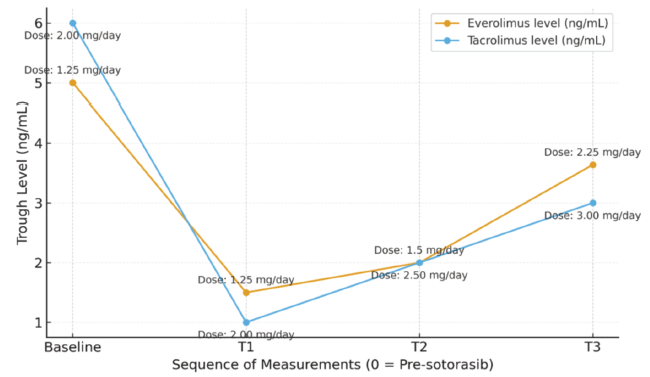
Figure 1. Trough Levels of Tacrolimus and Everolimus Before and After Initiation of Sotorasib, With Sequential Dose Adjustments