Volume: 22 Issue: 2 February 2024
FULL TEXT
Laparoscopic Nephrectomy Via the Retroperitoneal Approach for Autosomal Dominant Polycystic Kidney Disease After Renal Transplant: A Case Report
We report a case of laparoscopic nephrectomy via the retroperitoneal approach for autosomal dominant polycystic kidney disease after renal transplant. A 54-year-old male patient with end-stage renal failure because of autosomal dominant polycystic kidney disease underwent a living donor renal transplant and right nephrectomy via open surgery through a median abdominal incision 5 years previously. However, the left kidney gradually became enlarged. We performed laparoscopic left nephrectomy via the retroperitoneal approach. After dissecting the renal vessels, we performed cyst puncture and aspiration to decrease the kidney volume. The patient’s symptoms improved after operation. Laparoscopic nephrectomy for enlarged kidneys with multiple cysts can be safely performed, and the retroperitoneal approach can be preferred if the patient has a history of abdominal surgery or an enlarged polycystic kidney.
Key words : Kidney transplant, Living donor renal transplant, Polycystic kidney
Introduction
Autosomal dominant polycystic kidney disease (ADPKD) is a progressive disorder characterized by multiple bilateral cysts of the renal parenchyma.1 Cysts will progressively develop and eventually replace the renal parenchyma, resulting in worsening renal function.2 In ADPKD, most kidneys shrink after renal transplant (RT), which improves the symptoms and complications caused by the disease.3 However, rare cases of enlarged kidneys have required nephrectomy after RT.4,5
Herein, we report a case of laparoscopic nephrec-tomy (LN) via the retroperitoneal approach for ADPKD after RT because of kidney enlargement with abdominal pain.
Case Report
A 54-year-old male patient with end-stage kidney disease because of ADPKD underwent living donor RT from his 73-year-old mother 5 years previously. Right nephrectomy via open surgery through a median abdominal incision was performed to secure space for RT. The patient was started on mycophenolate mofetil, tacrolimus, and methylprednisolone after RT for induction immunosuppression. After RT, he exhibited slightly poor renal function with a serum creatinine level of 1.5 mg/dL and estimated glomerular filtration rate of 30 mL/min/1.73 cm2.
Five years after RT, the patient presented to our emergency department with abdominal pain. Abdominal computed tomography (CT) showed an enlarged left kidney compared with pretransplant (Figure 1). Because we considered that the patient’s abdominal pain was because of renal enlargement, we determined that left nephrectomy was necessary to improve symptoms. Contrast-enhanced CT showed that the renal artery was deviated medially, and the left kidney had protruded ventral to the renal artery (Figure 1a) and beyond the midline to the contralateral side (Figure 1b). Because of the CT findings and the previous open surgery, LN via the retroperitoneal approach was planned.
After the patient was placed in an extended flank position, an incision was made under the tip of the twelfth rib in the midaxillary line. The retroperitoneal cavity was dilated with a retroperitoneal balloon. A 12-mm camera port and 3 other ports were introduced under view. The psoas muscle and gonadal vein were identified, and dissection was made along the gonadal vein to reach the renal hilum. The renal vessels were horizontally disposed because of kidney enlargement, taking an inward direction (Figure 2). The renal vessels were ligated with hemoclips. The lower area and anterior face of the kidney were released, and the ureter was clipped and cut. The kidney was completely freed, leaving the adrenal gland. The cysts werethen cut with a pair of scissors and aspirated with a suction tube to reduce the renal volume. Intraoperatively, 1800 mL of cyst contents were aspirated. The incision where the camera port was introduced was extended to 10 cm, and the kidney was removed. The ope-ration took 5 hours, with 40 mL of blood loss.
The kidney specimen weighed 1700 g. Pathological findings showed no evidence of malignancy or infection (Figure 3). The postoperative course was good, and the patient showed improved symptoms.
Discussion
The volume of polycystic kidney with ADPKD has been shown to decrease after RT.3 Reduced kidney volume is associated with better renal function after RT. However, it remains unclear which factors influence the decrease of kidney volume after RT.3 In our case, inadequate renal function after RT from an elderly female donor may have resulted in increased renal volume after RT. However, increased renal volume after RT is rare, and the cause remains unclear. Although the main indication to perform nephrectomy after RT is pain or cyst infection, the rate of such cases is low.4,5
Previously, open nephrectomy surgeries have been used for patients with ADPKD; however, the use of LN has been increasing.6-8 In their meta-analysis comparing open nephrectomy and LN for patients with ADPKD, Guo and colleagues confirmed that LN was a safe and feasible alternative to open nephrectomy, with reduced blood loss and length of hospital stay and lower overall complication rate.6 However, LN was associated with a significantly longer operation time compared with open nephrec-tomy. Chen and colleagues reported that LN for ADPKD reduced blood loss and length of hospital stay compared with open nephrectomy and that both procedures had similar operation times and complication rates.7 Nevertheless, a larger kidney size may pose technical challenges because of space constraints in the abdomen and because of the difficulty in approaching the renal vessels.
Several studies have reported use of the retro-peritoneal approach in LN for ADPKD.9-11 Aside from the operation time, the retroperitoneal approach has comparable surgical outcomes to the transperitoneal approach.10 Because of the narrow operating cavity, the retroperitoneal approach is more difficult and has a longer learning curve than the transperitoneal approach.10 However, the retroperitoneal approach has several advantages. Compared with the trans-peritoneal approach, the retroperitoneal approach does not require bowel manipulation, decreasing the risk of visceral complications. Desai and colleagues reported a trend toward a shorter return of bowel function with the retroperitoneal approach compared with the transperitoneal approach.11 Hence, the retroperitoneal approach can be preferred for ADPKD patients with history of abdominal surgery and risk of intra-abdominal adhesions.9 In addition, the retro-peritoneal approach provides quicker and easier access to the renal vessels than the transperitoneal approach. Because of the unusual anatomic location of the renal vessels and other structures (ie, with renal vessels horizontally disposed, as in our case), anatomic anomalies should be confirmed by preoperative contrast-enhanced CT.
In LN for ADPKD, a reduction of kidney volume is required to allow removal of the kidney through a smaller incision. Puncture and aspiration of large cysts are the standard method of reducing kidney volume.9,10 If en bloc extraction is difficult because of many small cysts or large kidney, the kidney should be morcellated into several fractions using cold scissors through the incision.9 The incision made to remove the kidney can be kept minimal in LN for ADPKD, and the risk of postoperative wound-related complications can be reduced. In the transperitoneal approach, if access to renal vessels is difficult because of a large kidney, cyst puncture is required before processing renal vessels, but there is a risk of injuring other organs and hemorrhage.10 In contrast, in the retroperitoneal approach, access to the renal vessels is easy, and cyst puncture is not needed to reach the renal vessels, as in our case. Therefore, the retroperitoneal approach should be chosen when LN is performed for enlarged polycystic kidneys.
Conclusions
Laparoscopic nephrectomy for ADPKD is more difficult to perform through the retroperitoneal approach than through the transperitoneal approach because of issues in securing the field of vision. However, the retroperitoneal approach can be preferred for ADPKD patients with history of abdominal surgery or enlarged polycystic kidneys with sufficient preoperative imaging evaluation and consideration of the surgical approach.
References:
- Gabow PA. Autosomal dominant polycystic kidney disease. N Engl J Med. 1993;329(5):332-342. doi:10.1056/NEJM199307293290508
CrossRef - PubMed - Torres VE, Harris PC, Pirson Y. Autosomal dominant polycystic kidney disease. Lancet. 2007;369(9569):1287-1301. doi:10.1016/S0140-6736(07)60601-1
CrossRef - PubMed - Jung Y, Irazabal MV, Chebib FT, et al. Volume regression of native polycystic kidneys after renal transplantation. Nephrol Dial Transplant. 2016;31(1):73-79. doi:10.1093/ndt/gfv227
CrossRef - PubMed - Casteleijn NF, Geertsema P, Koorevaar IW, et al. The need for routine native nephrectomy in the workup for kidney transplantation in autosomal dominant polycystic kidney disease patients. Urol Int. 2023;107(2):148-156. doi:10.1159/000525575
CrossRef - PubMed - Prudhomme T, Boissier R, Hevia V, et al. Native nephrectomy and arterial embolization of native kidney in autosomal dominant polycystic kidney disease patients: indications, timing and postoperative outcomes. Minerva Urol Nephrol. 2023;75(1):17-30. doi:10.23736/S2724-6051.22.04972-2
CrossRef - PubMed - Guo P, Xu W, Li H, Ren T, Ni S, Ren M. Laparoscopic nephrectomy versus open nephrectomy for patients with autosomal dominant polycystic kidney disease: a systematic review and meta-analysis. PLoS One. 2015;10(6):e0129317. doi:10.1371/journal.pone.0129317
CrossRef - PubMed - Chen K, Tan YG, Tan D, Pek G, Huang HH, Sim SPA. Predictors and outcomes of laparoscopic nephrectomy in autosomal dominant polycystic kidney disease. Investig Clin Urol. 2018;59(4):238-245. doi:10.4111/icu.2018.59.4.238
CrossRef - PubMed - Thomas MN, Datta RR, Wahba R, et al. Introduction of laparoscopic nephrectomy for autosomal dominant polycystic kidney disease as the standard procedure. Langenbecks Arch Surg. 2023;408(1):8. doi:10.1007/s00423-022-02737-9
CrossRef - PubMed - Wyler SF, Bachmann A, Ruszat R, et al. Retroperitoneoscopic nephrectomy for autosomal dominant polycystic kidney disease: initial experience. Urol Int. 2007;79(2):137-141. doi:10.1159/000106327
CrossRef - PubMed - Benoit T, Peyronnet B, Roumiguie M, et al. Laparoscopic nephrectomy for polycystic kidney: comparison of the transperitoneal and retroperitoneal approaches. World J Urol. 2016;34(7):901-906. doi:10.1007/s00345-015-1739-5
CrossRef - PubMed - Desai MR, Nandkishore SK, Ganpule A, Thimmegowda M. Pretransplant laparoscopic nephrectomy in adult polycystic kidney disease: a single centre experience. BJU Int. 2008;101(1):94-97. doi:10.1111/j.1464-410X.2007.07229.x
CrossRef - PubMed

Volume : 22
Issue : 2
Pages : 156 - 159
DOI : 10.6002/ect.2024.0020
From the 1Department of Urology, Wakayama Medical University; and the 2Department of Urology, Japanese Red Cross Wakayama Medical Center, Wakayama, Japan
Acknowledgements: The authors have not received any funding or grants in support of the presented research or for the preparation of this work and have no declarations of potential conflicts of interest.
Corresponding author: Kazuro Kikkawa, Department of Urology, Japanese Red Cross Wakayama Medical Center, 4-20 Komatsubaradori, Wakayama, 640-8558, Japan
Phone: +81 73 4224171
E-mail: kzrkikkawa@gmail.com
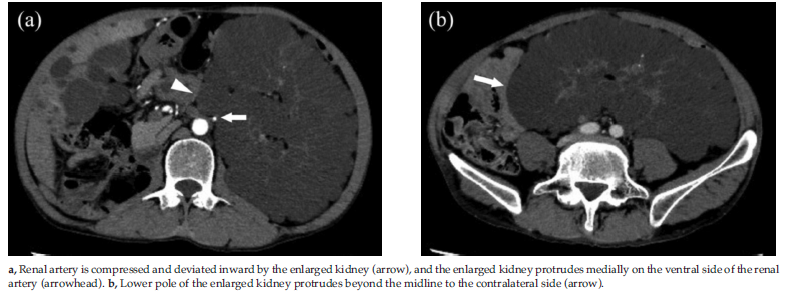
Figure 1.Preoperative Contrast-Enhanced Computed Tomography of Enlarged Left Kidney
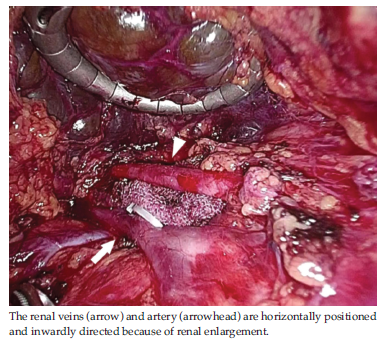
Figure 2.Intraoperative Findings of Left Nephrectomy
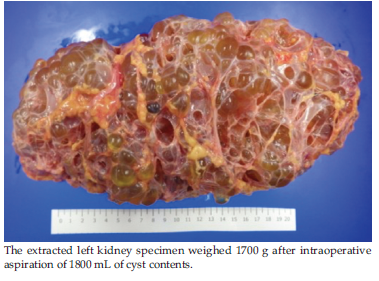
Figure 3.Left Kidney Specimen