Volume: 17 Issue: 1 February 2019
FULL TEXT
Progressive multifocal leukoencephalopathy (PML) is a debilitating and often fatal viral disease of the central nervous system. A 39-year-old male kidney transplant recipient presented to our hospital with weakness of the left arm and leg, his immunosuppressive regimen consisted of tacrolimus, mycophenolate sodium, and meprednisone. Magnetic resonance imaging of the brain revealed hypercellularity in neural tissue and a lesion affecting the right ventral and lateral areas of the thalamus and the posterior limb of the internal capsule. The cerebrospinal fluid tested negative for bacteria, fungi, and acid-fast bacilli; cytology revealed no malignant cells. The clinical presentation, brain imaging, biopsy results showing a demyelinating process, and absence of atypical proliferation all suggested that the first diagnosis to be ruled out was PML. The weakness resolved after withdrawal of tacrolimus and mycophenolate sodium. On day 250 after presentation, no further neurologic deterioration was evident, and renal function was stable. The diagnosis of PML may not always be straightforward. Polymerase chain reaction for detecting John Cunningham virus was not available at our center or in the region. However, a negative result using polymerase chain reaction does not rule out PML.
Key words : Immunosuppressive agents, Leukodystrophy, Mycophenolic acid, Posterior encephalopathy syndrome, Transplantation immunology
Introduction
Progressive multifocal leukoencephalopathy (PML) is a debilitating and often fatal viral disease of the central nervous system characterized by demyelination of the cerebral white matter via John Cunningham virus–mediated lysis of infected oligodendrocytes.1,2 Patients who have undergone an organ transplant and/or who have solid-tumor malignancies, sarcoidosis, an autoimmune disorder, or a congenital immune deficiency, account for < 10% of all reported PML cases.2
Case Report
A 39-year-old male patient presented to our hospital with weakness of the left arm and leg. He had received a kidney from a related living donor 5 years previously. He had earlier tested positive for Cytomegalovirus, herpes zoster virus, and varicella zoster virus. Induction therapy comprised 2 doses of basiliximab (20 mg each on days 0 and 4), and his immunosuppressive regimen consisted of tacrolimus to a trough level of 5 to 8 ng/mL, mycophenolate sodium (1440 mg/d), and meprednisone (4 mg/d). His physical condition and renal function had been good since transplant. At presentation, he was negative for human immunodeficiency virus. Magnetic resonance imaging of the brain with T1, T2, and fluid-attenuated inversion recovery and diffusion sequences revealed hypercellularity in neural tissue and a lesion affecting the right ventral and lateral areas of the thalamus and the posterior limb of the internal capsule. Also, increased blood flow in the thalamic lesion was observed. The findings were highly suggestive of lymphoma or cerebral toxoplasmosis (Figure 1). The immunosuppressive agents were withdrawn, with the exception of meprednisone given at 4 mg/day. The cerebrospinal fluid tested negative for bacteria, fungi, and acid-fast bacilli; cytology revealed no malignant cells. A stereotactic brain biopsy was performed, and histopathologic analysis showed that the white matter exhibited a high histiocyte count. The cells were primarily perivenular, CD68-positive, and periodic acid–Schiff positive and featured foamy cytoplasm and lymphoid infiltrates. Luxol fast blue staining revealed that demyelination was complete; periodic acid-Schiff, Grocott, and Ziehl Neelsen staining showed that the patient was negative for mycobacteria, fungi, and Toxoplasma gondii.
The immunohistochemical expression of CD3, CD20, CD45, and Ki-67 was studied; the CD20 test was negative, and the Ki-67 expression level was quite low, thus ruling out lymphoma. The clinical presentation, brain imaging, biopsy results showing a demyelinating process, and absence of atypical proliferation all suggested that the first diagnosis to be ruled out was PML. The weakness resolved after withdrawal of tacrolimus and mycophenolate sodium. The patient continued on meprednisone dosed at 4 mg/day. On day 250 after presentation, no further neurologic deterioration was evident, and renal function was stable.
Discussion
In our patient, initial findings suggested lymphoma or toxoplasmosis. After excluding these conditions and mycobacteria and fungi, the differential diagnosis included posterior reversible encephalopathy syndrome (PRES) and PML. First described in 1996 by Hinchey and associates, PRES commonly presents as edema in the white matter of posterior portions of the brain hemispheres, especially bilaterally in the parieto-occipital regions.3 The clinical signs and symptoms of PRES are altered alertness, headache, drowsiness, seizures, vomiting, confusion, and abnormalities of visual perception; its causes include acute high blood pressure, renal decompensation, fluid retention, and treatment with immunosuppressive drugs.3,4 Calcineurin inhibitors, such as tacrolimus, have been associated with PRES in patients who have received various types of transplants.4,5
Our patient’s signs and symptoms, imaging findings, and brain biopsy were suggestive of PML. The diagnosis of PML may not always be straightforward. In this case, unfortunately, polymerase chain reaction for detecting John Cunningham virus was not available at our center or in the region. However, a negative result using polymerase chain reaction does not rule out PML.6 The possible association between mycophenolate mofetil and PML has been described in the literature, and conversely, cases of PML in patients who did not receive mycophenolate mofetil are very rare.7,8 The survival rate of transplant recipients diagnosed with PML is low, and cessation of immunosuppressive therapy (the standard treatment) may compromise graft survival.6 Thus, patient outcomes depend on the ability of the immune system to respond to John Cunningham virus.2 The outcomes of PML range from stabilization or even remission, to brain herniation or even death.6 It is significant that our patient maintained stable graft function.
References:
- Weissert R. Progressive multifocal leukoencephalopathy. J Neuroimmunol.
2011;231(1-2):73-77.
CrossRef - PubMed - Pavlovic D, Patera AC, Nyberg F, Gerber M, Liu M, Progressive Multifocal
Leukoencephalopathy Consortium. Progressive multifocal leukoencephalopathy:
current treatment options and future perspectives. Ther Adv Neurol Disord.
2015;8(6):255-273.
CrossRef - PubMed - Hinchey J, Chaves C, Appignani B, et al. A reversible posterior
leukoencephalopathy syndrome. N Engl J Med. 1996;334(8):494-500.
CrossRef - PubMed - Chen S, Hu J, Xu L, Brandon D, Yu J, Zhang J. Posterior reversible
encephalopathy syndrome after transplantation: a review. Mol Neurobiol.
2016;53(10):6897-6909.
CrossRef - PubMed - Song T, Rao Z, Tan Q, et al. Calcineurin inhibitors associated posterior
reversible encephalopathy syndrome in solid organ transplantation: report of
2 cases and literature review. Medicine (Baltimore). 2016;95(14):e3173.
CrossRef - PubMed - Manfro RC, Vedolin L, Cantarelli M, Oppitz P, Antunes CM, Rieder CRM.
Progressive multifocal leukoencephalopathy in a kidney transplant recipient
after conversion to mycophenolic acid therapy. Transpl Infect Dis.
2009;11(2):189-190.
CrossRef - PubMed - Neff RT, Hurst FP, Falta EM, et al. Progressive multifocal
leukoencephalopathy and use of mycophenolate mofetil after kidney
transplantation. Transplantation. 2008;86(10):1474-1478.
CrossRef - PubMed - Ohara H, Kataoka H, Nakamichi K, Saijo M, Ueno S. Favorable outcome
after withdrawal of immunosuppressant therapy in progressive multifocal
leukoencephalopathy after renal transplantation: case report and literature
review. J Neurol Sci. 2014;341(1-2):144-146.
CrossRef - PubMed

Volume : 17
Issue : 1
Pages : 108 - 110
DOI : 10.6002/ect.2016.0165
From the 1Renal Transplantation, Hospital de Alta Complejidad JD
Perón, Formosa, Argentina; and the 2Foundation for Research and
Assistance in Kidney Disease (FINAER), Buenos Aires, Argentina
Acknowledgements: This study was performed without any grants or
financial support, and the authors have no conflicts of interest or financial
interests to declare.
Corresponding author: Javier Roberti, Palestina 525, C1182ADA Buenos
Aires, Argentina
Phone/Fax: +54 11 4864 0707
E-mail: javierroberti@gmail.com
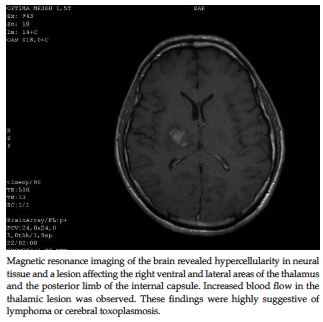
Figure 1. Magnetic Resonance Imaging of the Brain Showing a Lesion in the Right Ventral and Lateral Areas of the Thalamus