Volume: 17 Issue: 1 February 2019
FULL TEXT
Verticillium species is a filamentous fungus that inhabits decaying vegetation and soil. It is known to cause disease in plants. Four cases of human infections have been reported previously in nontransplant patients. Here, we report the first case of Verticillium species skin infection in a transplant patient who was successfully treated with fluconazole monotherapy.
Key words : Diabetes mellitus, Fluconazole, Human subject
Introduction
Patients who receive solid-organ transplants are prone to have infections with opportunistic pathogens. Verticillium is a fungus rarely associated with human disease.1-5 Here, we report a case of skin and soft tissue infection in a patient who had received a renal transplant.
Case Report
The patient was a 45-year-old female patient who underwent living-donor related kidney transplant from her son. No induction immunosuppression was used, and maintenance therapy included tacrolimus, mycophenolate mofetil, and prednisolone. She showed excellent graft function, with serum creatinine level of around 60 μg and estimated glomerular filtration rate of > 60 mL/min. No graft rejection was shown. Tacrolimus level was kept between 4 and 6 ng/mL at 3 months after transplant.
Sixteen months after transplant, she presented with an unrelenting skin lesion that had started 12 months after transplant. This lesion had started after minor trauma to the left medial malleolus. The patient was from southern Saudi Arabia where she visited farms after that trauma. The lesion grew gradually in size, with occasional oozing of pus. The patient reported no pain or itching regarding the lesion (Figure 1). The patient denied fever, night sweats, and weight loss. The patient had diabetes mellitus, and her HbA1C was 8.7%. She was on the following medications: tacrolimus (5 mg twice daily), mycophenolate mofetil (750 mg twice daily), single-strength trimethoprim-sulfamethoxazole (1 tablet/day), labetalol (100 mg twice daily), insulin, and ferrous sulfate.
Physical examination of the patient was negative for lymphadenopathy and organomegaly. The left medial malleolus showed a nodule, 1.5 cm in diameter, with shiny smooth purple surface. There was mild surrounding erythema (Figure 1). A puncture on the periphery of the lesion was oozing pus. Swabs from the pus were sent twice for smear tests, with both showing yeast-like organisms. The specimen was sent for culture, which resulted in fungal colony growth 7 days later and which was subsequently identified as Verticillium species 10 days after culture. No other organisms were isolated. A biopsy of the lesion was done, with tissue culture also resulting in Verticillium growth. Tissue histology showed acute and chronic inflammatory changes (Figure 2A), and special stains revealed numerous fungal organisms with spores and hyphae-like elements (Figure 2B).
The patient was started on fluconazole (100 mg daily by mouth). Follow-up 12 days later showed a marked decrease in the lesion size. The lesion completely disappeared 3 weeks after starting treatment. A 3-year follow-up showed no recurrence.
Discussion
Verticillium is a widely distributed filamentous fungus that inhabits decaying vegetation and soil. Verticillium is a major plant pathogen, with 5 known plant pathogenic species: V. longisporum, V. albo-atrum, V. nigrescens, V. tricorpus, and V. dahliae. Verticillium has been linked to cauliflower vascular wilt disease6 and to diseases in tomato, cotton, and olive plants.7 Verticillium has also been reported to cause disease in fish8 and snakes9 and is known to be parasitic to other fungi10 and to insects.
In humans, it is considered to be nonpathogenic. In previous reports, Verticillium spores have been linked with occupational obstructive respiratory symptoms1 and with asthma.2 A case of peritonitis due to Verticillium species in a 33-year-old farmer on continuous ambulatory peritoneal dialysis has also been reported.3 Other reports have implicated Verticillium species in stromal keratitis in a 50-year-old immunocompetent man4 and presented a case of soft tissue infection from Verticillium species in a patient with juvenile diabetes mellitus.5 Verticillium species has also been reported to cause endophthalmitis following cataract surgery.11
Here, we report a patient with Verticillium species infection involving skin and soft tissue who presented with symptoms after living-donor related renal transplant. The infection was confirmed by microbiology and histology and responded well to fluconazole. Rare species of fungal infection should be considered in the differential diagnosis of skin lesions, especially in immunosuppressed patients. Infection from Verticillium species showed response to fluconazole monotherapy in our patient. In 2 of the previously reported patients, along with fluconazole, flucytosine was given in one case and topical amphotericin B in the other (keratitis). Voriconazole has been used to treat endophthalmitis.11 In our patient, fluconazole monotherapy seemed to be effective for the skin infection due to Verticillium species.
References:
- Darke CS, Knowelden J, Lacey J, Milford Ward A. Respiratory disease of workers harvesting grain. Thorax. 1976;31(3):294-302.
CrossRef - PubMed - Senkpiel K, Kurowski V, Ohgke H. [Indoor air studies of mould fungus contamination of homes of selected patients with bronchial asthma (with special regard to evaluation problems)]. Zentralbl Hyg Umweltmed. 1996;198(3):191-203.
PubMed - Amici G, Grandesso S, Mottola A, et al. Verticillium peritonitis in a patient on peritoneal dialysis. Am J Nephrol. 1994;14:216-219.
CrossRef - PubMed - Shin JY, Kim HM, Hong JW. Keratitis caused by Verticillium species. Cornea. 2002;21(2):240-242.
CrossRef - PubMed - Das DK, Grover RK, Chachra KL, Bhatt NC, Misra B. Fine needle aspiration cytology diagnosis of a fungal lesion of the Verticillium species. A case report. Acta Cytol. 1997;41(2):577-582.
CrossRef - PubMed - Debode J, Spiessens K, De Rooster L, Hofte M. Verticillium wilt of cauliflower in Belgium. Meded Rijksuniv Gent Fak Landbouwkd Toegep Biol Wet. 2002;67(2):241-249.
PubMed - Sanei SJ, Okhoavat SM, Hedjaroude GA, Saremi H, Javan-Nikkhah M. Olive verticillium wilt or dieback of olive in Iran. Commun Agric Appl Biol Sci. 2004;69(4):433-442.
PubMed - Aho R, Koski P, Salonen A, Rintamaki P. Fungal swimbladder infection in farmed Baltic salmon (Salmo salar L.) caused by Verticillium lecanii. Mycoses. 1988;31(4):208-212.
CrossRef - PubMed - Miller DL, Radi ZA, Stiver SL, Thornhill TD. Cutaneous and pulmonary mycosis in green anacondas (Euncecte murinus). J Zoo Wildl Med. 2004; 35(4):557-561.
CrossRef - PubMed - Miller DL, Radi ZA, Stiver SL, Thornhill TD, Mendoza CG. Verticillium disease or “dry bubble” of cultivated mushrooms: the Agaricus bisporus lectin recognizes and binds the Verticillium fungicola cell wall glucogalactomannan. Can J Microbiol. 2004;50:729-735.
CrossRef - PubMed - Nehemy MB, Vasconcelos-Santos DV, Torqueti-Costa L, Magalhaes EP. Chronic endophthalmitis due to Verticillium species after cataract surgery treated with pars planta vitrectomy and oral and intravitreal voriconazole. Retina. 2009;26(2):225-227.
CrossRef - PubMed

Volume : 17
Issue : 1
Pages : 105 - 107
DOI : 10.6002/ect.2016.0144
From the 1Department of Medicine, the 2Department of
Surgery, and the 3Department of Pathology, King Faisal Specialist
Hospital and Research Center, Jeddah, Kingdom of Saudi Arabia
Acknowledgements: The authors declare that they have no sources of
funding for this study,and they have no conflicts of interest to declare.
Corresponding author: Saeed M. G. Al-Ghamdi, Department of Medicine, King
Faisal Specialist Hospital & Research Center-Jeddah, PO Box 40047, Jeddah 21499,
Kingdom of Saudi
Arabia
Phone: +966 2 667 7777
E-mail: smghamdi@kfshrc.edu.sa
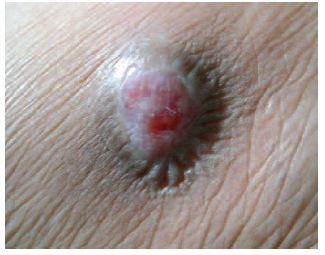
Figure 1. Verticillium Species Infection Involving the Skin, Showing Oozing Nodule
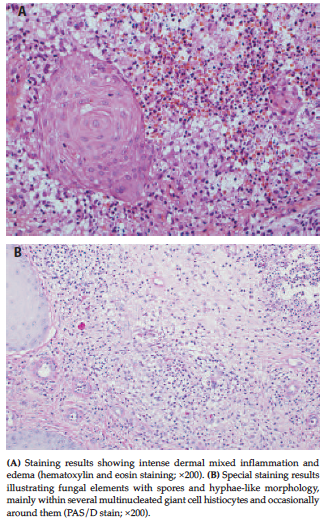
Figure 2. Skin Biopsy Results Illustrating Intense Dermal Mixed Inflammation and Edema and Fungal Elements With Spores