Volume: 14 Issue: 3 June 2016
FULL TEXT
To Dr. Haberal:
Children with neuroblastoma often need an autologous bone marrow transplant (BMT). Many children are multiply treated with chemotherapy and/or radiation therapy, and a minimum stem cell dose is not achieved with conventional methods.1 Regarding this, 2 previously published studies present interesting data on the use of plerixafor in children with solid tumors; we would like to share our experiences with neuroblastoma.2,3
Three children with a neuroblastoma underwent an autologous BMT at our center. One child was mobilized with Cyclophosphamide (1.5 g/m2 + G-CSF). The second child was initially mobilized with same chemomobilization. However, the prerecovery CD34 count remained at 2 and 3 cells/μL. Then, plerixafor (240 μg/kg) was added. The third child was expected to be a poor mobilizer because of multiple lines of chemotherapies. Therefore, plerixafor was administered preemptively. Plerixafor was administered subcutaneously approximately 11 hours before the stem cell apheresis in all children. Leukapheresis was performed using 3 times the patient’s total blood volume through a dual-lumen central catheter. Table 1 summarizes the stem cell mobilization and outcome of these children.
Plerixafor has not been universally effective in yielding high stem cell doses in a single recovery.2-4 Total stem cells recovered for our children were just sufficient for us to proceed with BMT. We are a price sensitive country, and because we were not planning tandem BMT, we did not attempt a second recovery in these children.
Son and associates have documented high rates of nightmares and visual hallucinations generally on third day of collection, which lasted for 1 week to 1 month.3 This has not been confirmed by others.2,4 Both our children received just 1 dose of plerixafor, and we did not observe any significant adverse effects. It is possible that multiple doses may lead to these kinds of above-mentioned adverse effects. One large pediatric study has documented safety of plerixafor in children.4
In India, a generic version Mozifor is licensed for use, which costs about USD $1230. A second recovery with conventional methods at our center will cost approximately USD $750 (which may not collect sufficient stem cells). The cost of autologous BMT at our center for neuroblastoma is approximately USD $12 300. Plerixafor actually presents a pharmacoeconomic case for its use as it may avoid failed stem cell recovery, avoids multiple recovery (thereby reducing hospital stay and costs), and most importantly, it allows a child to undergo autologous BMT that cannot be performed unless adequate stem cell dose is obtained.
We conclude that plerixafor in combination with G-CSF is safe and effective for stem cell mobilization in children with neuroblastoma. Holistically, it actually may be cost effective.
References:
- Gertz MA. Current status of stem cell mobilization. Br J Haematol.
2010;150(6):647-662.
CrossRef - PubMed - Patel B, Pearson H, Zacharoulis S. Mobilisation of haematopoietic stem
cells in paediatric patients, prior to autologous transplantation following
administration of plerixafor and G-CSF. Pediatr Blood Cancer.
2015;62(8):1477-1480.
CrossRef - PubMed - Son MH, Kang ES, Kim DH, et al. Efficacy and toxicity of plerixafor for
peripheral blood stem cell mobilization in children with high-risk
neuroblastoma. Pediatr Blood Cancer. 2013;60(8):E57-E59.
CrossRef - PubMed - Maschan AA, Balashov DN, Kurnikova EE, et al. Efficacy of plerixafor in
children with malignant tumors failing to mobilize a sufficient number of
hematopoietic progenitors with G-CSF. Bone Marrow Transplant.
2015;50(8):1089-1091.
CrossRef - PubMed

Volume : 14
Issue : 3
Pages : 358 - 359
DOI : 10.6002/ect.2016.0003
From the 1Division of Hematology & Bone Marrow Transplantation;
the 2Transfusion Medicine and the Division of 3Laboratory
Medicine, Max Superspeciality Hospital, Patparganj, New Delhi 110092
Acknowledgements: The authors declare no conflicts of interest, and no
funding was received during the duration of this project.
Corresponding author: Dr. Rahul Naithani, Division of Hematology & Bone
Marrow Transplantation, Max Superspeciality Hospital, Delhi 110092
Phone: +91 88 0017 5901
Fax: +91 11 2223 5563
E-mail: dr_rahul6@hotmail.com
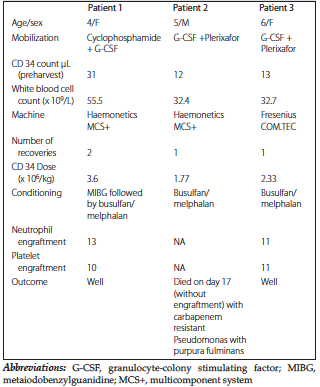
Table 1. Summary of Stem Cell Mobilization and Outcome