Volume: 14 Issue: 3 June 2016
FULL TEXT
Objectives: Hand-assisted laparoscopic donor nephrectomy is performed in many centers for donor nephrectomy. A midline incision for hand-assisted port placement is generally used but produces an unsightly scar. In this study, patients who had hand-assisted laparoscopic donor nephrectomy with low transverse incision were compared with those who received a midline incision.
Materials and Methods: Our study group included patients who received hand-assisted laparoscopic donor nephrectomy from February 2012 to December 2014 at Korea University Anam Hospital. We retrospectively compared outcomes of these patients based on midline incision (45 patients) versus low transverse incision (17 patients). Risk factors, including age, sex, body mass index, creatinine level, glomerular filtration rate of allograft, side of graft kidney, number of renal arteries, duration of surgical procedure, and warm ischemic time, were compared between the midline and low transverse incision groups.
Results: When we compared the midline versus low transverse incision groups, duration of surgical procedure (P = .043), postoperative day 3 glomerular filtration rate (P = .017), and postoperative day 3 pain score (P = .049) were significantly higher in the low transverse incision group versus the midline incision group. Postoperative day 3 results for duration of hospitalization (P = .030) and pain score (P = .021) were also significantly higher in the low transverse versus midline incision groups when we focused on patients with left nephrectomy.
Conclusions: Hand-assisted laparoscopic donor nephrectomy with low transverse incision is more painful and necessitates a longer hospital stay and longer surgical procedure. Despite these disadvantages, hand-assisted laparoscopic donor nephrectomy with low transverse incision can offer a better cosmetic outcome with no definitive differences regarding renal function compared with a midline incision. Surgeons should consider these aspects when deciding on the best method for donor nephrectomy.
Key words : Hand-assisted laparoscopic surgery, Donor nephrectomy, Kidney transplant
Introduction
Laparoscopic living-donor nephrectomy was introduced in 19951 and since then has become widely adopted. The many advantages compared with open donor nephrectomy include shorter hospital stay, less need for postoperative analgesic medication, and improved cosmetic outcomes.2 The paramount benefit is the increased numbers of organ donations compared with open donor nephrectomy.3
In 1998, hand-assisted laparoscopic donor nephrectomy (HALDN) was introduced.4 Hand-assisted laparoscopic donor nephrectomy combines a laparoscopic technique with quicker and safer organ retrieval offered by a one-hand assist through a small incision. The use of a surgeon’s hand in handling the tissue helps preserve tactile sensation, allowing tissue planes to be more easily defined using the intraperitoneal hand for retraction.5 Furthermore, the surgeon can control urgent bleeding by hand compression without deleterious short- or long-term influences on graft function.
These advantages have driven the widespread acceptance and the use of HALDN.6 The technique is almost always done using a periumbilical midline incision for hand-assisted port placement, which results in an unsightly scar over the abdominal midline. An alternate approach, the low transverse incision, has been used less frequently.
In this study, outcomes of HALDN using midline and low transverse incisions for hand-assisted port placement were compared.
Materials and Methods
Informed consent was obtained from all individual participants included in the study. The study was conducted according to the guidelines of the Declaration of Helsinki, and the study protocol was approved before the beginning of the study by our Ethics Committee. The study was a retrospective review of 62 patients who underwent HALDN at our institution from February 2012 to December 2014: forty-five patients received HALDN using midline incision for hand-assisted port placement and 17 patients received HALDN using low transverse incision for hand-assisted port placement. All patients had undergone left nephrectomy, except in cases of multiple vessels on the left kidney or when a noticeably higher left renal estimated glomerular filtration rate was detected before the procedure. All nephrectomies were planned and conducted by 1 surgeon. After every nephrectomy, the same protocol was followed for patient care. The position of the hand-assisted port was the sole difference between the 2 groups.
Hand-assisted laparoscopic donor nephrectomy using low transverse incision is conducted as follows. The patient is placed under general anesthesia, in a full left or right lateral decubitus position as the operating side on a flexed operating table. For insertion of the first trocar, the visceral injury is prevented by the use of the open Hasson technique. Two 12-mm ports and one 5-mm port are used for the left nephrectomy, and an additional 5-mm port is used for liver traction in cases of right nephrectomy. The first 12-mm port is inserted just below the subcostal margin in the midclavicular line; it serves as a working port or a camera port. The second 12-mm port is placed lateral to the umbilicus. A 5-mm trocar is inserted along the midaxillary line between the costal margin and the iliac crest.
Hand-assisted laparoscopic donor nephrectomy with midline incision for hand-assisted port placement involves the port positioned in the upper umbilical region for left nephrectomy and the right para median region for right nephrectomy. Hand-assisted laparoscopic donor nephrectomy with low transverse incision for hand-assisted port placement involves positioning the port slightly right or left of the Pfannenstiel incision line. Ureter dissection is performed through the hand-assisted port opening and under direct vision to minimize any ureteral damage. Positioning of the trocar site and surgeon are depicted in Figures 1 and 2.
We analyzed the following data: patient demographics, demographics related to the surgical procedure, and postoperative courses. Patient demographics included age, sex, body mass index, preoperative creatinine level, glomerular filtration rate of graft kidney, side of graft kidney, and number of renal arteries. Demographic data related to the surgical procedure included conversion rate, duration of procedure, and warm ischemic time. Postoperative data included postoperative graft function measured by creatinine level and glomerular filtration rate, length of hospital stay after the surgical procedure, and pain.
We compared data using the Mann-Whitney test to analyze significant differences. All statistical analyses were performed using SPSS version 20.0.0 for Macintosh (SPSS: An IBM Company, IBM Corporation, Armonk, NY, USA), with P < .05 considered significant.
Results
Demographic data of the 62 patients who underwent HALDN from February 2012 to December 2014 are shown in Table 1. Mean ages of patients who had midline incision and low transverse incision were 43.42 ± 9.95 years and 39.77 ± 10.71 years. There were no significant differences between the 2 incision groups regarding sex (P = .941), body mass index (P = .559), serum creatinine level (P = .517), glomerular filtration rate (P = .752), and number of renal arteries (P = .136). The prevalence of right nephrectomy in the midline incision group was statistically greater than in the low transverse incision group (P < .001; Table 1).
Regarding other risk factors between the 2 incision groups when we included both sides, duration of the surgical procedure with low transverse incision (101.41 ± 37.41 min) was longer than with midline incision (84.48 ± 24.95 min), with statistical significance (P = .043). Glomerular filtration rate and pain score at postoperative day 3 for patients who had low transverse incision (71.05 ± 13.12 mL/min/1.73 m² and 3.29 ± 0.98) were significantly greater (P = .017 and P = .049) than were the results for the patients who had a midline incision (62.91 ± 10.97 mL/min/1.73 m² and 2.08 ± 0.81). When we compared results for left nephrectomy only, length of postoperative hospital stay (5.51 ± 1.31 d for midline incision and 6.44 ± 1.01 d for low transverse incision) and pain score at postoperative day 3 (2.79 ± 0.83 for midline incision and 3.66 ± 1.00 for low transverse incision) were significantly different between incision groups (P = .030 and P = .021; Table 2).
However, when we analyzed the effects of warm ischemic time and postoperative renal function on long-term results, there were no differences between the incision groups. During, and 6 months after, the surgical procedure, no related complications were shown, such as postoperative bleeding, abscess, wound problem, incisional hernia, and renal dysfunction. No patients had open donor conversion from HALDN.
Discussion
For right HALDN, the standing surgeon and hand-assisted port are located on the same side of the patient (left decubitus position) for both midline and low transverse incisions (Figure 1). There are no greatly apparent technical differences between the 2 incision types. However, for left HALDN, the standing surgeon and hand-assisted port are located on the same side of the patient (right decubitus position) for midline incisions (Figure 2A) but on the same and opposite sides alternatively for low transverse incisions (Figure 2B). For left HALDN with low transverse incision, the hand motion in the hand-assisted port is difficult and the surgeon has to stand in a curved position because of the opposite placement between the standing surgeon and the hand-assisted port. Therefore, this procedure is more difficult than a right nephrectomy involving low transverse incisions. In our study, low transverse incisions were predominantly performed at our center for right HALDN (80%).
Left HALDN using low transverse incisions has some limitations. There were no statistical differences regarding surgical procedure duration and warm ischemic times. However, for patients who received a low transverse incision, the length of surgical procedure was longer, although without statistical significance. The reason is that, according to the change of hand-assist port placement and the difficulty of hand motion in hand-assisted port placement, the surgeon must to move to the opposite side during some portions of the procedure, such as for dissection of the upper medial sides of the left kidney. This problem can be overcome by the presence of a skillful assistant. During upper medial side dissection, the assistant positioned opposite the surgeon can use the main working port and easily approach the upper medial side of the kidney.
Low transverse incisions are more painful to patients and necessitate a longer hospital stay. With midline incisions, skin, fat, fascia of rectus sheath, and peritoneum are injured when the abdomen is opened. The low transverse incision also requires cutting of muscle. On postoperative day 3, patients felt more severe pain with low transverse incisions procedures, resulting in longer hospital stays.
Despite these limitations, the use of low transverse incisions confers obvious advantages over midline incisions. The latter leaves an unsightly scar on the central region of the abdomen. This cosmetic problem could be overcome by use of low transverse incisions. The result would be an improved patient quality of life and, most importantly, increased kidney transplants because of increased rates of living donations.7 In addition, formation of an incisional hernia is the most common reason for HALDN reoperation.8 In this situation, the incidence of incisional hernia could be decreased, which is another advantage of low transverse incisions.
Low transverse incisions are much safer than midline incisions for the occurrence of incisional hernia.9
Conclusions
Hand-assisted laparoscopic donor nephrectomy with low transverse incision is more painful, necessitating longer hospital stays, and is a longer procedure. Despite these disadvantages, HALDN with low transverse incision can offer a better cosmetic outcome with no definitive differences in renal function compared with a midline incision. Surgeons should base their decision on which method to use with these considerations.
References:
- Ratner LE, Ciseck LJ, Moore RG, Cigarroa FG, Kaufman HS, Kavoussi LR.
Laparoscopic live donor nephrectomy. Transplantation. 1995;60(9):1047-1049.
PubMed - Tooher RL, Rao MM, Scott DF, et al. A systematic review of laparoscopic
live-donor nephrectomy. Transplantation. 2004;78(3):404-414.
CrossRef - PubMed - Schweitzer EJ, Wilson J, Jacobs S, et al. Increased rates of donation
with laparoscopic donor nephrectomy. Ann Surg. 2000;232(3):392-400.
CrossRef - PubMed - Wolf JS, Jr., Tchetgen MB, Merion RM. Hand-assisted laparoscopic live
donor nephrectomy. Urology. 1998;52(5):885-887.
CrossRef - PubMed - Slakey DP, Wood JC, Hender D, Thomas R, Cheng S. Laparoscopic living
donor nephrectomy: advantages of the hand-assisted method. Transplantation.
1999;68(4):581-583.
CrossRef - PubMed - Wright AD, Will TA, Holt DR, Turk TM, Perry KT. Laparoscopic living
donor nephrectomy: a look at current trends and practice patterns at major
transplant centers across the United States. J Urol. 2008;179(4):1488-1492.
CrossRef - PubMed - Kokkinos C, Nanidis T, Antcliffe D, Darzi AW, Tekkis P, Papalois V.
Comparison of laparoscopic versus hand-assisted live donor nephrectomy.
Transplantation. 2007;83(1):41-47.
CrossRef - PubMed - Weitz J, Koch M, Mehrabi A, et al. Living-donor kidney transplantation:
risks of the donor--benefits of the recipient. Clin Transplant. 2006; 20
Suppl 17: 13-16.
CrossRef - PubMed - Le Huu Nho R, Mege D, Ouaissi M, Sielezneff I, Sastre B. Incidence and
prevention of ventral incisional hernia. J Visc Surg. 2012;149(5
Suppl):e3-14.
CrossRef - PubMed

Volume : 14
Issue : 3
Pages : 282 - 286
DOI : 10.6002/ect.2015.0220
From the 1Department of Surgery, University of Ulsan Medical
College and Asan Medical Center, Seoul, Korea; and the 2Department of
Surgery and the 3Department of Internal Medicine, Korea University
Anam Hospital, Korea University College of Medicine, Seoul, Korea
Acknowledgements: The authors have no conflicts of interest to disclose
and had no funding to support this study.
Corresponding author: Cheol Woong Jung, Department of Surgery, Korea
University Anam Hospital, Korea University College of Medicine, Inchon-ro 73,
Seoungbuk-gu, Seoul, Korea 136-705
Phone: +82 2 920 6385
E-mail: cwjung@korea.ac.kr
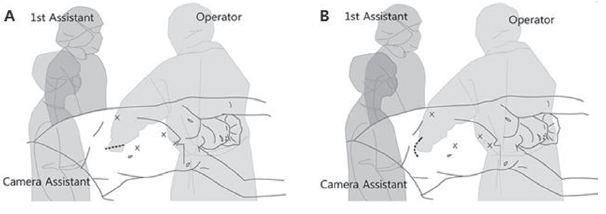
Figure 1. Hand-assisted Laparoscopic Right Donor Nephrectomy (A) Vertical Incision (B) Low Transverse Incision for Hand-assisted Port Placement
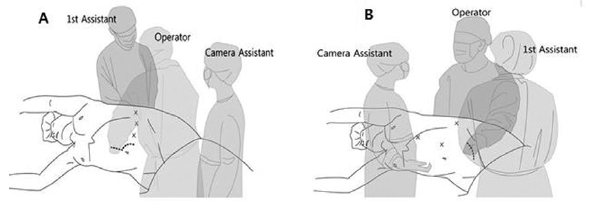
Figure 2. Hand-assisted Laparoscopic Left Donor Nephrectomy (A) Midline Incision (B) Low Transverse Incision for Hand-assisted Port Placement
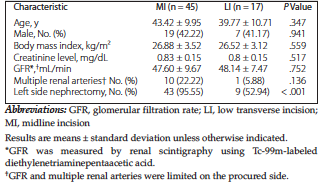
Table 1. Baseline Characteristics of Patients Who Received Hand-Assisted Laparoscopic Donor Nephrectomy
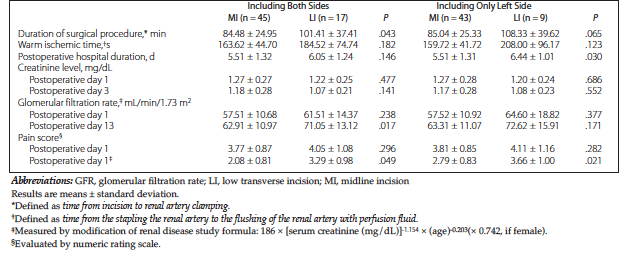
Table 2. Comparison of Clinical Outcomes Between Patients Who Received Midline Incision Versus Low Transverse Incision in Hand-Assisted Laparoscopic Donor Nephrectomy