Volume: 13 Issue: 6 December 2015
FULL TEXT
Key words : Diet, Donor selection, Glomerular filtration rate, Tissue and organ procurement, Transplant
Dear Editor:
Living kidneys donors are required to have a minimum glomerular filtration rate (GFR) of at least 80 mL/min before donation at most kidney transplant centers in the United States.1 However, the correct estimation of GFR in potential donors could be challenging. The gold standard radioisotope methods (eg, [125I] iothalamate) are costly and are not available at many transplant centers. The serum creatinine based prediction formulas like Modification of Diet in Renal Disease (MDRD) and Cockroft-Gault formula are not validated in potential healthy donors and may underestimate GFR in them. The 24-hour urine creatinine clearance (24-hour urine CrCl) is widely used to measure GFR in potential kidney donors,1 but besides problems with proper collection, one of the major limitations of the 24-hour urine CrCl is its dependence on muscle mass and dietary protein intake.2 The increase in dietary protein is reported to increase the 24-hour urine CrCl in healthy individuals,2 but may not in those with reduced renal functional reserve.3,4 Consequently, potential healthy donors with low protein intake may have erroneously low 24-hour urine CrCl that may normalize with adequate protein intake. We report a kidney donor candidate, who had persistently low 24-hour urine CrCl identified because of low dietary protein intake. However, after protein intake was optimized, her GFR normalized, and she could donate a kidney.
A 42-year-old white female was evaluated at our transplant center for kidney donor evaluation. Her medical history was not significant. On her initial evaluation, her blood pressure was 129/67 mm Hg and her body mass index was 22.5 kg/m2. The rest of her physical examination was normal. Her laboratory data included serum creatinine 0.8 mg/dL, blood urea nitrogen 9 mg/dL, and fasting plasma glucose 65 mg/dL. Her other blood tests including lipid profile, liver function tests, complete blood count and coagulation studies, hepatitis serology, and human immunodeficiency virus test, were unremarkable. Her urinalysis was normal, and her 24-hour urine collection revealed 136 mg of protein, but low 24-hour urine CrCl of 54 mL/min. Because other methods of GFR measurement like radioisotope GFR scan, inulin clearance, and cystatin C clearance are not available at our center, we repeated the 24-hour urine CrCl on 2 more occasions (second and third measurements) a week apart, which also consistently showed low GFR (Table 1). On dietary assessment, the patient’s daily protein intake was found to be low (0.6-0.7 g/kg/d). She was advised to increase her protein intake to about 1 gram/kg/day, which is consistent with the average American dietary protein intake.5 The subsequent 24-hour urine CrCl a week after increased protein intake showed a GFR of 110 mL/min (Table 1). The patient was deemed suitable for kidney donation. One year after nephrectomy, the patient’s serum creatinine is stable at 1.1 mg/dL with no proteinuria.
Lack of measurement of GFR by more accurate methods like radioisotope scan or inulin clearance is a limitation of our observation. However, our case shows that 24-hour urine CrCl may underestimate the true GFR in potential living kidney donors with low protein intake but otherwise with no chronic kidney disease. The optimization of protein intake may improve the GFR as estimated by the 24-hour urine CrCl in these donors, making them eligible to donate a kidney.
References:
- Mandelbrot DA, Pavlakis M. Living donor practices in the United States.
Adv Chronic Kidney Dis. 2012;19(4):212-219.
CrossRef - PubMed - Lew SW, Bosch JP. Effect of diet on creatinine clearance and excretion
in young and elderly healthy subjects and in patients with renal disease. J
Am Soc Nephrol. 1991;2(4):856-865.
PubMed - Bosch JP, Saccaggi A, Lauer A, Ronco C, Belledonne M, Glabman S. Renal
functional reserve in humans. Effect of protein intake on glomerular
filtration rate. Am J Med. 1983;75(6):943-950.
CrossRef - PubMed - Rodríguez-Iturbe B, Herrera J, Marín C, Mañalich R. Tubular stress test
detects subclinical reduction in renal functioning mass. Kidney Int.
2001;59(3):1094-1102.
CrossRef - PubMed - Fulgoni VL 3rd. Current protein intake in America: analysis of the
National Health and Nutrition Examination Survey, 2003-2004. Am J Clin Nutr.
2008;87(5):1554S-1557S.
PubMed

Volume : 13
Issue : 6
Pages : 609 - 610
DOI : 10.6002/ect.2015.0060
From the 1John C. McDonald Regional Transplant Center,
Willis-Knighton Medical Center and the Division of Nephrology, Department of
Medicine, Louisiana State University Health Sciences Center-Shreveport,
Shreveport, LA, USA; the 2Department of Internal Medicine, Baylor
University Medical Center, Dallas, TX, USA
Acknowledgements: The authors declare that they have no sources of
funding for this study, and they have no conflicts of interest to declare.
Neeraj Singh, Mohammad Kazem Fallahzadeh, and Kenneth Abreo participated in
research design, writing of the article, performance of the research, and
analysis of data.
Corresponding author: Neeraj Singh, MD, Division of Nephrology,
Department of Medicine, Louisiana State University Health Sciences
Center-Shreveport, 1501 Kings Highway, Shreveport, Louisiana, USA, 71103
Phone: +1 318 212 8386
Phone: +1 318 212 8511
E-mail: nsingh1@lsuhsc.edu.
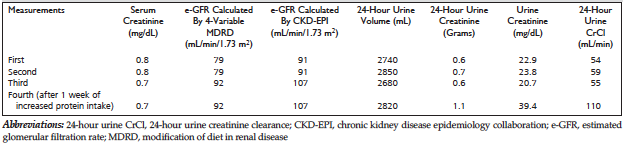
Table 1. Kidney Function Evaluation in Our Living Donor Before and After Increased Dietary Protein Intake