Volume: 13 Issue: 6 December 2015
FULL TEXT
Posttransplant lymphoproliferative disorder is a serious complication during a solid-organ transplant. A 28-year-old Asiatic man developed a cerebral lesion that was considered an abscess, while undergoing a kidney transplant. The lesion diameter did not go down with antibiotic therapy, so he underwent a complete surgical mass excision. Pathology showed a B-cell lymphoma. The Epstein-Barr virus-DNA by polymerase chain reaction in plasma was negative. He began chemotherapy with methotrexate and rituximab, and radiation therapy. He had to be restarted on regular hemodialysis 1 year after surgery. Three years after receiving the diagnosis, he was alive and had not developed any other posttransplant lymphoproliferative disorder. This report presents case of a patient who developed primary central nervous system B-cell lymphoma, 2 years after undergoing a kidney transplant. A combination of chemotherapy and radiotherapy is the best option for treatment of brain posttransplant lymphoproliferative disorder.
Key words : Abscess, Solid-organ transplant, Cerebral lymphoma
Introduction
Posttransplant lymphoproliferative disorder (PTLD) is a serious complication during a solid-organ transplant. Compared with other patients receiving solid-organ transplants, patients receiving kidney transplants develop PTLD at substantially lower rates. The incidence ranges from 1% after a renal transplant to as much as 20% in small bowel recipients, and it is higher in children than it is in adults.1
Case Report
A 28-year-old Asiatic man developed primary brain B-cell lymphoma after undergoing a kidney transplant. The patient received a kidney transplant when he was 26 years old for Alport syndrome. His renal allograft function was good: his creatinine level was approximately 176.80 μmol/L. Induction therapy for immunosuppression consisted of myco-phenolate mofetil, tacrolimus, methylprednisolone, and basiliximab. Subsequent maintenance immuno-suppression therapy consisted of mycophenolate mofetil, tacrolimus, and methylprednisolone. Allograft function was excellent after the operation.
Two years after the transplant, he developed persistent headache, diplopia, dysarthria, and superior arm weakness. On emergency admission, the patient had a Glasgow Coma Scale of 15, tem-perature of 38.7°C, blood pressure of 164/110 mm Hg, and a heart rate of 88 beats/min examinations of his cardiovascular and abdominal systems were normal. Radiograph of the chest showed no abnormalities (eg, pulmonary edema, pleural effusion, or cardiomegaly). It was after a T1-weighted, nuclear magnetic resonance image with intravenous gadolinium administration of his brain, that showed a hypointense and heterogeneously enhanced mass in the tempofrontal region (Figure 1).
The medium diameter of the lesion measured 37 mm, and was surrounded significantly by perifocal edema. During a magnetic resonance spectroscopy study, his lactate level moderately increased, and his choline and creatine peaks declined. Laboratory findings showed a higher serum creatinine concentration at 282.88 μmol/L, a moderately leukocytosis (13 000 white blood cells with 90% neutrophils) and normochromic, normocytic anemia, and has lactate dehydrogenase was increased moderately (3.92 μkat/L). The lesion was thought to be cerebral abscess. Therefore, antibiotic therapy was begun with metronidazole 500 mg 3 times daily, meropenem 1 gram 3 times daily; for cerebral edema. Betamethasone and mannitol were administered 4 times daily. Furthermore levetiracetam was given.
He stopped taking tacrolimus and reduced his intake of mycophenolate mofetil. The diameter of the lesion did not go down and patient’s neurologic signs did not disappear. Therefore, he underwent a total mass excision through a left frontoparietal craniotomy. Pathological examination showed a non-Hodgkin B-cell lymphoma. In situ hybridization for Epstein-Barr virus showed that his small nuclear RNA was negative. The Epstein-Barr virus-DNA by polymerase chain reaction in plasma was negative. The patient’s neurologic status began to improve. He began chemotherapy with methotrexate and rituximab, and radiation therapy. In the post-operative systemic evaluation with whole body CT scan; a bone marrow biopsy failed to identify other organ involvement. After discontinuing his immuno-suppression therapy with tacrolimus, he had good renal function. After being discharged from our hospital, his transplanted kidney function decreased gradually, with overt proteinuria. Unfortunately, he was restarted on regular hemodialysis 1 year after surgery. On April 2014, (3 years after surgery) he is still alive and has not developed any other PTLD.
Discussion
Central nervous system complications after under-going a kidney transplant encompass several opportunistic infections, vascular complications, metabolic derangements, and neoplasms. Sakhuja and associates2 investigated 792 renal transplant patients in India and found that 10% of them developed central nervous system (CNS) complications, with a mortality rate of 60.8%. Central nervous system infections were most common, whereas CNS lymphomas were rare.2 A similar trend was shown in a study by Ram and associates.3 It was necessary to detect the Epstein-Barr virus-encoded small RNA (EBER) by in situ hybridization and to measure the Epstein-Barr virus-DNA by PCR in plasma or culture viruses from body fluid to support the diagnosis of Epstein-Barr virus-associated PTLD.4 Posttransplant lymphoproliferative disorder should be categorized further according to the classification schemes of B-cell or T-cell lymphoma, typically by immunohistochemical studies. Differentiating T-cell from B-cell PTLD is essential. Typically, T-cell PTLD develops much later than B-cell PTLD after transplant, and also its prognosis is poorer.5 There is no definitive treatment for CNS-PTLD, which is a rare type of PTLD. The major treatment of CNS-PTLD is reducing or discontinuing the immunosuppressive therapy. Other treatments include chemotherapy and radiotherapy.6 Posttransplant lymphoproliferative disorder has been reported to achieve remission in approximately 50% of cases with immunosuppression reduction alone.7,8 High-dose methotrexate yields positive results in many cases of brain PTLD.9 In a review of 12 cases of CNS PTLD,10 most tumors involved the supratentorial cerebral parenchyma, and the latency from transplant to lymphoma onset varied from 3 to 131 months (mean, 31 mo). Five of 12 patients died, and only 4 achieved complete remission at follow-up.
In conclusion, we present a case of a patient who developed primary CNS B-cell lymphoma 2 years after undergoing a kidney transplant. Therefore, early diagnosis and treatment should not be delayed. Although biopsy is the standard for pathologic confirmation, magnetic resonance imaging, in particular magnetic resonance spectroscopy, also can play a significant role in the differential diagnosis. A combination of chemotherapy and radiotherapy is currently the best option for brain PTLD treatment.
References:
- Taylor AL, Marcus R, Bradley JA. Post-transplant lymphoproliferative
disorders (PTLD) after solid organ transplantation. Crit Rev Oncol Hematol.
2005;56(1):155-167.
CrossRef - PubMed - Sakhuja V, Sud K, Kalra OP, et al. Central nervous system complications
in renal transplant recipients in a tropical environment. J Neurol Sci.
2001;183(1):89-93.
CrossRef - PubMed - Ram Prasad KS, Date A, Chandi SM, et al. Central nervous system disease
in renal transplant recipients. Nephron. 1987;46(4):395-396.
CrossRef - PubMed - Morgans AK, Reshef R, Tsai DE. Posttransplant lymphoproliferative
disorder following kidney transplant. Am J Kidney Dis. 2010;55(1):168-180.
CrossRef - PubMed - Su IC, Lien HC, Chen CM. Primary brain T-cell lymphoma after kidney
transplantation: a case report. Surg Neurol. 2006;66(suppl 2):S60-S63.
CrossRef - PubMed - Cavaliere R, Petroni G, Lopes MB, Schiff D; and the International
Primary Central Nervous System Lymphoma Collaborative Group. Primary central
nervous system post-transplantation lymphoproliferative disorder: an
International Primary Central Nervous System Lymphoma Collaborative Group
Report. Cancer. 2010;116(4):863-870.
CrossRef - PubMed - Lim WH, Russ GR, Coates PT. Review of Epstein-Barr virus and
post-transplant lymphoproliferative disorder post-solid organ
transplantation. Nephrology (Carlton). 2006;11(4):355-366.
CrossRef - PubMed - Rees L, Thomas A, Amlot PL. Disappearance of an Epstein-Barr
virus-positive post-transplant plasmacytoma with reduction of
immunosuppression. Lancet. 1998;352(9130):789.
CrossRef - PubMed - Nabors LB, Palmer CA, Julian BA, Przekwas AM, Kew CE. Isolated central
nervous system posttransplant lymphoproliferative disorder treated with
high-dose intravenous methotrexate. Am J Transplant. 2009;9(5):1243-1248.
CrossRef - PubMed - Castellano-Sanchez AA, Li S, Qian J, Lagoo A, Weir E, Brat DJ. Primary
central nervous system posttransplant lymphoproliferative disorders. Am J
Clin Pathol. 2004;121(2):246-253.
CrossRef - PubMed

Volume : 13
Issue : 6
Pages : 600 - 602
DOI : 10.6002/ect.2014.0086
From the Department of General Surgery and Organ Transplantation, Umberto I
Policlinic of Rome, Sapienza University of Rome, Italy
Acknowledgements: The authors declare that they have no sources of
funding for this study, and they have no conflicts of interest to declare. These
results presented in this paper have not previously been published, in whole or
part, except in abstract form. Nicola Guglielmo, Giovanni Battista Levi Sandri,
and Pasquale Bartolomeo Berloco wrote the paper; and Fabio Melandro, Manuela
Garofalo, and Luca Poli participated in the critical evaluation of the paper.
Corresponding author: Nicola Guglielmo MD, Department of General Surgery
and Organ Transplantation, Umberto I Policlinic of Rome, Sapienza University of
Rome, Viale del Policlinico 155, 00161, Rome, Italy
Phone: +39 064 997 0453
Fax: +39 064 997 0401
E-mail:
nicola.guglielmo@libero.it
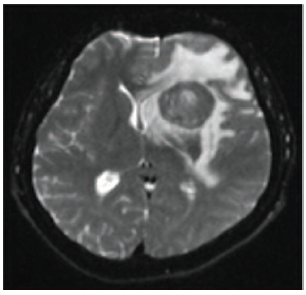
Figure 1. CT Scan Show a Cerebral Mass in Fronto-Temporal Region