Volume: 13 Issue: 2 April 2015
FULL TEXT
Objectives: Patients who have liver transplant are at high risk of developing de novo malignancies. The purpose of this study was to evaluate incidence and histologic type of de novo malignancies after liver transplant in a liver transplant center.
Materials and Methods: In 1700 patients who had orthotopic liver transplant from deceased and living donors from January 1992 to October 2012, de novo malignancies after transplant were analyzed.
Results: There were 38 patients (2.2%) who developed de novo malignancy. Pathologic diagnosis was posttransplant lymphoproliferative disorder in 24 patients (63%), gastrointestinal adenocarcinoma in 4 patients (10%), Kaposi sarcoma in 3 patients (8%), pancreatic head adenocarcinoma in 2 patients (5%), papillary thyroid carcinoma in 1 patient (3%), lumbosacral multiple myeloma in 1 patient (3%), conjunctive carcinoma in 1 patient (3%), testicular cancer in 1 patient (3%), and metastatic adenocar-cinoma to the vertebrae of unknown origin in 1 patient (3%). In the 24 patients who had posttransplant lymphoproliferative disorder, 20 patients (83%) were children aged < 10 years, and 5 patients (21%) died of this disease.
Conclusions: Posttransplant lymphoproliferative disorder was the most common malignancy among liver transplant recipients. This disease primarily involved children and was a major cause of morbidity and mortality. Preventive and early diagnostic strategies are justified to decrease morbidity and mortality from de novo malignancy after liver transplant.
Key words : Cancer, Hepatic failure, Immunosuppression, Lymphoma
Introduction
Liver transplant is the treatment of choice for acute and chronic liver failure that does not respond to medical or surgical therapy. Immunosuppressive drugs are necessary to prevent rejection of grafts. Adverse effects of immunosuppressive drugs include posttransplant de novo malignancy.1 Although advances in immunosuppressive regimens have decreased the incidence of rejection, the incidence of de novo malignancy has increased from 3% to 26%.2 De novo malignancy is the second most common cause of late death after transplant, and the incidence of death from malignancy is increasing and may surpass cardiovascular disease as the leading cause of death.
The risk of developing malignancy is much greater in transplant recipients than the general population.3,4 This has been attributed to the immunosuppressive state after transplant. Cytotoxic T cells, macrophages, and natural killer cells inhibit the growth of oncogenic viruses in vitro.5,6 These protective mechanisms against the development of malignancy are impaired by immunosuppressive agents. Furthermore, some immunosuppressive drugs have direct carcinogenic effects, such as cyclosporine, which may cause cancer cell proliferation.7 Therefore, the use of immuno-suppressive drugs may predispose patients to develop de novo malignancy after transplant.8
The purpose of the present study was to evaluate the incidence of malignancy after liver transplant at a major liver transplant center.
Materials and Methods
From January 1992 to October 2012, a total of 1700 patients who received liver transplant from deceased and living donors were entered into the study. Patients who had explanted liver pathology reports that showed malignancy were excluded. The immuno-suppressive regimen included a calcineurin inhibitor (tacrolimus or cyclosporine), corticosteroid, and mycophenolate mofetil. Calcineurin inhibitors were substituted with sirolimus in patients who had severe kidney damage. Prednisolone was tapered over 3 to 6 months after transplant except in patients who had autoimmune hepatitis.
All patients were followed according to the hospital protocols for transplant recipients and specific diseases. Qualitative Epstein-Barr virus and cytomegalovirus DNA polymerase chain reaction tests were performed for all patients. Serial monitoring was performed for liver function, immune-mediated rejection, and de novo malignancy with various examinations, laboratory tests, and imaging studies. The diagnosis of de novo malignancy was based on clinical findings and confirmed with a tissue biopsy, histopathologic evaluation, and immunohisto-chemical staining.
All patients who had de novo malignancy received full treatment including surgical resection, chemotherapy, and radiotherapy. Patients who had posttransplant lymphoproliferative disorder (PTLD) received 4 courses of rituximab, and chemotherapy was given to patients who had lymphoma confirmed by histology; in these patients, mycophenolate mofetil was discontinued, tacrolimus and prednisolone were decreased, and sirolimus was started. Qualitative Epstein-Barr virus and cytomegalovirus DNA polymerase chain reaction tests were performed and patients were treated empirically with intravenous ganciclovir.
Results
In 1700 children and adult liver transplant recipients, de novo malignancy developed in 38 (2.2%) patients (Table 1). The mean age of patients was 34 ± 10 years (range, 1.5-67 y) and the mean time to develop de novo malignancy after transplant was 67 months (range, 3-132 mo). There were 24 patients (63%) who developed PTLD, mostly children aged < 10 years (20 children [83%]). There were 14 patients who developed nonlymphoid malignancies (incidence, 0.8%). Mean follow-up time was 58 ± 42 months (range, 2-234 mo).
In the 38 patients who had de novo malignancy, pathologic diagnosis was PTLD in 24 patients (63%), gastrointestinal adenocarcinoma in 4 patients (10%), Kaposi sarcoma in 3 patients (8%), pancreatic head adenocarcinoma in 2 patients (5%), papillary thyroid carcinoma in 1 patient (3%), lumbosacral multiple myeloma in 1 patient (3%), conjunctive carcinoma in 1 patient (3%), testicular cancer in 1 patient (3%), and metastatic adenocarcinoma to the vertebrae of unknown origin in 1 patient (3%).
In the 24 patients who had PTLD, histologic analysis showed lymphoma in 13 patients (non-Hodgkin lymphoma, 9 patients [38%]; Hodgkin lymphoma, 4 patients [17%]) and B-cell hyperplasia in 11 patients (polymorphic, 6 patients [25%]; monomorphic, 5 patients [21%]). Viral assays showed that patients who had PTLD were seropositive for cytomegalovirus in 10 patients (41.6%), Epstein-Barr virus in 6 patients (25%), and both cytomegalovirus and Epstein-Barr virus in 5 patients (20.8%).
In 4 patients who had gastrointestinal carcinoma, 3 patients had primary gastric carcinoma (TNM staging, T3N0M0, T2N1M0, and T3N1M0); in these 3 patients, treatment included gastrectomy with extended lymph node dissection (D2 gastrectomy) and adjuvant chemotherapy. In 1 patient who had right colon cancer (T2N1M0), treatment included right hemicolectomy and systemic chemotherapy.
In the 38 patients who had de novo malignancy, 10 patients (26%) died because of the malignancy including 7 patients who had PTLD (18%), 2 patients who had gastrointestinal adenocarcinoma (5%), and 1 patient who had metastatic adenocarcinoma to the vertebrae of unknown origin (3%).
Discussion
As the liver transplant emerges as a life-saving procedure for treating end-stage liver disease, some complications after transplant are increasingly seen. One of these complications (which is the second common cause of late death in liver transplant patients) is the development of de novo malignancy. Use of immunosuppressive drugs, and contracting some viruses, have been proposed as the most likely causes of developing de novo malignancies in organ transplant recipients. Benlloch and associates9 showed that after introduction of more potent immuno-suppressive drugs such as tacrolimus, de novo malignancy has increased in incidence and may appear earlier after transplant than previously noted.9 Higher doses of immunosuppressive drugs may increase the risk of developing de novo tumors, and this effect is dependent on the dosage.
The incidence and histologic type of de novo malignancies may differ between transplant centers. The reported incidence of de novo malignancy after liver transplant is 2.6% to 8.8%.3,10-12 The incidence of de novo malignancy in the present study (2.2%) was lower than other studies, and the incidence of nonlymphoid malignancy was 0.8%.
After solid-organ transplant, PTLD and skin cancers are the most common malignancies that may develop.13,14 Gastrointestinal, genitourinary, lung, and oropharyngeal tumors also may develop after liver transplant. In the present study, there were no skin, lung, or oropharyngeal cancers. Genetic and environmental factors may vary between studies and account for differences in types of cancers observed. Alcohol use, which is a risk factor for posttransplant malignancy, is uncommon in our country. Some malignancies that are common in our country such as esophageal, colorectal, and gastric cancer also were observed in the present study; further study is justified to identify the reasons for this finding.
Although the incidence of lymphoid malignancy in the present study was comparable to that reported previously, the lymphoid to nonlymphoid malignancy ratio in our study (24:14 = 1.7:1) was higher than other reports. This difference probably occurred because of the low incidence of nonlymphoid malignancies and not a high prevalence of lymphoid malignancies.
Transplant recipients have low survival after developing de novo malignancy. Therefore, a program of neoplasia surveillance for prevention and early detection of de novo malignancies may increase survival. In our program, we focused on PTLD to reduce morbidity and mortality from posttransplant malignancy. Many studies confirmed that Epstein-Barr virus and cytomegalovirus may be associated with the development of PTLD. Most patients in the present study who had PTLD were children aged < 10 years; therefore, we started a prophylactic antiviral regimen for all pediatric liver transplant recipients.
Other measures to reduce the risk of developing de novo malignancy after liver transplant may include cessation of risk factors such as smoking, alcohol consumption, and sunlight exposure. Strategies for early detection of malignancy may include intermittent upper endoscopy and colonoscopy in high-risk patients.
In conclusion, PTLD was the most common malignancy after liver transplant in the present study and primarily involved children. In addition, PTLD was the most common cause of mortality and morbidity associated with de novo malignancy after transplant. Posttransplant morbidity and mortality from de novo malignancy may be decreased with preventive programs and programs that identify the incidence and histologic type of de novo malignancy in different populations.
References:
- National Institutes of Health Consensus Development Conference
Statement: liver transplantation - June 20-23, 1983. Hepatology.
1984;4(suppl 1):107S-110S.
CrossRef - PubMed - Yao FY, Gautam M, Palese C, et al. De novo malignancies following liver
transplantation: a case-control study with long-term follow-up. Clin
Transplant. 2006;20(5):617-623.
CrossRef - PubMed - Jain AB, Yee LD, Nalesnik MA, et al. Comparative incidence of de novo
nonlymphoid malignancies after liver transplantation under tacrolimus using
surveillance epidemiologic end result data. Transplantation.
1998;66(9):1193-1200.
CrossRef - PubMed - Haagsma EB, Hagens VE, Schaapveld M, et al. Increased cancer risk after
liver transplantation: a population-based study. J Hepatol.
2001;34(1):84-91.
CrossRef - PubMed - Penn I. Depressed immunity and the development of cancer. Clin Exp
Immunol. 1981;46(3):459-474.
PubMed - Lotzová E. Definition and functions of natural killer cells. Nat Immun.
1993;12(4-5):169-176.
PubMed - Hojo M, Morimoto T, Maluccio M, et al. Cyclosporine induces cancer
progression by a cell-autonomous mechanism. Nature. 1999;397(6719):530-534.
CrossRef - PubMed - Murray JE, Wilson RE, Tilney NL, et al. Five years' experience in renal
transplantation with immunosuppressive drugs: survival, function,
complications, and the role of lymphocyte depletion by thoracic duct
fistula. Ann Surg. 1968;168(3):416-435.
CrossRef - PubMed - Benlloch S, Berenguer M, Prieto M, et al. De novo internal neoplasms
after liver transplantation: increased risk and aggressive behavior in
recent years? Am J Transplant. 2004;4(4):596-604.
CrossRef - PubMed - Frezza EE, Fung JJ, van Thiel DH. Non-lymphoid cancer after liver
transplantation. Hepatogastroenterology. 1997;44(16):1172-1181.
PubMed - Saigal S, Norris S, Muiesan P, Rela M, Heaton N, O'Grady J. Evidence of
differential risk for posttransplantation malignancy based on
pretransplantation cause in patients undergoing liver transplantation. Liver
Transpl. 2002;8(5):482-487.
CrossRef - PubMed - Sanchez EQ, Marubashi S, Jung G, et al. De novo tumors after liver
transplantation: a single-institution experience. Liver Transpl.
2002;8(3):285-291.
CrossRef - PubMed - Chak E, Saab S. Risk factors and incidence of de novo malignancy in
liver transplant recipients: a systematic review. Liver Int.
2010;30(9):1247-1258.
CrossRef - PubMed - Zafar SY, Howell DN, Gockerman JP. Malignancy after solid organ
transplantation: an overview. Oncologist. 2008;13(7):769-778.
CrossRef - PubMed
Volume : 13
Issue : 2
Pages : 163 - 166
DOI : 10.6002/ect.2013.0135
From the 1Shiraz Transplant Research Center, Shiraz University of
Medical Sciences, Shiraz; and the 2Surgical Oncology Research Center,
Imam Reza Hospital, Faculty of Medicine, Mashhad University of Medical Sciences,
Mashhad, Iran
Acknowledgements: The authors have no conflicts of interest.
Corresponding author: Mohsen Aliakbarian, Surgical Oncology Research
Center, Imam Reza Hospital, Ibne Sina Street, Faculty of Medicine, Mashhad
University of Medical Sciences, Mashhad, Iran
Phone: +98 511 8022677
Fax: +98 511 8525255
E-mail: aliakbarianm@mums.ac.ir
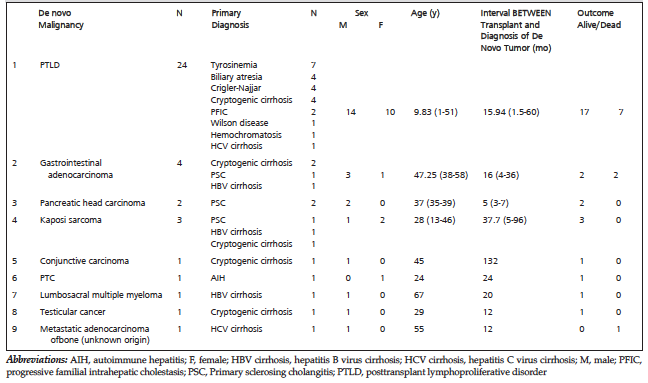
Table 1. The Comparison of EffeDemographic and Clinical Characteristics of Patients Who Had De Novo Malignancy After Liver Transplant