Volume: 11 Issue: 6 December 2013
FULL TEXT
Graft site candidiasis is a rare but life-threatening complication of renal transplant. We report the course and management of 2 renal transplant recipients, using kidneys from a single donor, both of whom developed vascular complications secondary to Candida infection.
Key words : Mycotic aneurysm
Case Report
Donor
A 66-year-old white man was admitted to the intensive care unit after a
subarachnoid hemorrhage. Treatment was futile, so it was withdrawn, and he was
accepted as an organ donor. Microbiologic and serologic assays were negative.
Sixteen hours after the admission, organ recovery was performed in a controlled
donation after cardiac death procedure (Maastricht classification III). Only the
kidneys were retrieved by the National Organ Retrieval Service, and the organs
were placed in static cold storage in Marshall’s solution. An iatrogenic small
bowel perforation was noted at retrieval.
Recipient 1 (index case)
A 62-year-old white man with end-stage renal failure secondary to polycystic
kidney disease received the left kidney. He was on hemodialysis, had a prior
stroke, and had undergone a right nephrectomy for symptomatic polycystic
disease. Human leukocyte antigen mismatch was 111. Cytomegalovirus
serology was positive, while human immunodeficiency virus, hepatitis B virus,
and hepatitis C virus serology were negative.
The left kidney was transplanted into the right iliac fossa with end-to-side anastomoses to the external iliac artery and vein. The ureter was anastomosed to the bladder with an onlay technique, and a ureteric stent was inserted. The cold ischemic time was 8 hours 21 minutes. Good perfusion of the transplant kidney was noted with immediate graft function. Basiliximab was given at induction, and on day 4, and maintenance immunosuppression was achieved using tacrolimus, mycophenolate mofetil, and prednisolone. He had no immediate postoperative complications.
Three months later, he was readmitted with transplant dysfunction. He developed hematuria, and an ultrasound scan suggested the presence of a false aneurysm. A computed tomography scan revealed a 3-cm false aneurysm at the anastomosis of the renal transplant artery (Figure 1). The hematuria persisted and became profuse. An emergency surgical exploration of the graft was performed. An intraperitoneal approach was used to gain proximal control of the right common iliac artery. The kidney was well perfused, and the false aneurysm was identified at the anastomosis. There was no evidence of infection. The aneurysm was excised along with a cuff of the transplanted renal artery and a section of the native right external iliac artery. Vascular reconstruction was performed via an end-to-end anastomosis between the proximal right external iliac artery and the transplanted renal artery. The internal iliac artery could not be used because of severe calcification. A Dacron graft was anastomosed end-to-side between the proximal right common iliac artery, and end-to-end to the native distal right external iliac artery (Figure 2). The excised tissue was sent for analysis to the microbiology and histology departments.
Aneurysmal tissue grew a yeast, later identified as Candida albicans. The patient initially was given the broad-spectrum antifungal agent, caspofungin, pending full identification and susceptibility testing. Maintenance immunosuppression was reduced.
Eighteen days after reconstruction, he developed a fever and pain over the transplanted kidney. A computed tomography scan revealed areas of kidney infarction with pockets of gas and fluid. He returned to the operating theatre for a transplant nephrectomy. The Dacron graft was well incorporated; therefore, removal was not attempted. Immunosuppression was stopped and antifungal treatment continued.
Thirteen days after the nephrectomy, he developed localized peritonitis. A repeat computed tomography angiogram demonstrated a new pseudoaneurysm at the Dacron-external iliac artery anastomosis with active extravasation. A stent was placed radiologically for temporary control of the hemorrhaging. He was then returned to the operating theatre for removal of all of the remaining prosthetic material, high ligation of the proximal right external iliac artery, and a femoro-femoral reconstruction using the right superficial femoral vein.
After the transplant nephrectomy, the recipient was re-established on hemodialysis. All wounds have healed, and mobility and independent function have recovered to presurgical levels. He remains on life-long antifungal therapy. Fluconazole was chosen because it is relatively safe and well-absorbed orally.
Recipient 2
A 62-year-old white man received the partner right kidney. He had renal
failure secondary to polycystic kidney disease and was established on
hemodialysis. He had undergone a mitral valve replacement 4 years earlier. Human
leukocyte antigen mismatch was 111, cytomegalovirus, human
immunodeficiency virus, hepatitis B virus, and hepatitis C virus serology all
were negative.
The donor kidney was situated in the left iliac fossa with end-to-side anastomoses to the external iliac artery and vein. An onlay ureteric anastomosis to the bladder was formed by inserting a ureteric stent. Cold ischemic time was 9 hours 56 minutes. Good kidney perfusion and immediate graft function were achieved. Immunosuppression consisted of basiliximab, tacrolimus, mycophenolate mofetil, and prednisolone. He had no immediate postoperative complications.
The patient was discharged on postoperative day 5, with follow-up by the referring physician. He subsequently had a right intracranial hemorrhage with dense left hemiplegia. Three months after the transplant, he was readmitted to his local hospital with a rejection episode that was successfully treated with antithymocyte globulin. A computed tomography angiogram demonstrated a 2.5-cm false aneurysm involving the renal artery to the external iliac artery anastomosis. A further 1.6-cm aneurysm was seen to arise from the renal artery down-stream from the anastomosis. The patient was referred back to the transplant unit.
There, he underwent urgent surgical exploration. Transplant nephrectomy, excision of the aneurysms, and ligation of the external iliac artery were performed. Vascular reconstruction was not attempted because of the patient’s premorbid state, and the severity of his left leg paralysis. Histologically, the tissue demonstrated a mycotic aneurysm of the renal artery containing septate hyphae and buds consistent with a Candida infection.
This recipient made minimal recovery from the intracranial bleed, and he had persistent left hemiplegia. The left leg became progressively more ischemic, and required an above-the-knee amputation. He has been re-established on hemodialysis and remains on oral fluconazole.
Discussion
Fungal infections are reported in up to 5% of renal transplant recipients.1 Candida is the most frequently isolated species, occurring in 45% of these cases.2 Consequences of infection are usually minor, but Candida albicans can penetrate endothelial cells, and the resulting arteritis can be catastrophic if associated with aneurysm formation or anastomotic rupture.3
Intracranial hemorrhage can be caused by septic emboli associated with systemic candidiasis. We clinically suspected that this was the cause in our second recipient, and it influenced the choice of antifungal agents, as echinocandins (eg, caspofungin) do not penetrate the central nervous system, making triazoles (eg, fluconazole) the treatment of choice.
Contamination of the renal allograft or preservation fluid at organ retrieval is the most likely source of arterial candidiasis in these cases. A retrospective multicenter study reviewed 18 617 renal transplant recipients, 18 of whom had proven graft site candidiasis.3 The organs were from 12 deceased donors, 7 of which had associated digestive tract breaches. The authors concluded that contamination had occurred during organ recovery, probably because of digestive tract breach, with subsequent infection of the peritoneum and the preservation fluid. Outcomes in these 18 patients were poor: 3 patients died, and there were 9 nephrectomies. This led the authors to recommend notification of all digestive tract breaches, routine culture of preservation fluid, instigation of antifungals in the presence of positive cultures, Doppler ultrasound monitoring, and prompt open surgery after confirming graft site candida involvement.
Several other studies have supported the routine culture of preservation fluid, which is not currently common practice in the United Kingdom.1,4,5 However, the optimal management following a positive culture result remains unclear. Mai and associates recommended mandatory nephrectomy for all renal transplant recipients whose kidney had been stored in Candida-infected preservation fluid.5 This was after their experience with 4 such patients; 2 were diagnosed only with Candida graft site infection at autopsy after dying of massive bleeding; another experienced a major hemorrhage but survived after a nephrectomy and ligation of the iliac vessels; the fourth patient survived but lost the graft after prompt surgery. Positive cultures for Candida are identified in up to 10% of preservation fluid.6 Routine nephrectomy would likely result in an unacceptably high rate of transplant loss.
Graft-conserving management has been advocated by others. Matignon and associates identified 8 patients with confirmed graft-site candidiasis, secondary to infected preservation fluid.1 Six of these patients were treated with antifungals, all had regular imaging, and at 1 to 2 years, they were all alive with a functioning transplant. It is important to recognize that imaging may not always identify all vascular complications, as bleeding can occur secondary to anastomotic rupture without formation of an aneurysm.5 A second surgical look has been advocated, in addition to imaging to identify these cases.7
Surgical management is complicated by the presence of infection that limits reconstructive options. Open surgery is associated with high rates of transplant loss.8 The simplest option is to perform a nephrectomy, with ligation of the iliac artery; although this can result in limb loss.9 Vascular reconstruction is challenging, and various options have been attempted including extra-anatomical bypass, bypass using a deep vein, allogeneic homografts, or polytetrafluoroethylene or silver grafts.10
In conclusion, Candida graft infection remains a rare complication of renal transplant; however, it can have catastrophic results resulting in death or graft loss. Early identification of those at risk by routine culture of preservation fluid is advised. These patients are likely to benefit from appropriate and early antifungal treatment, regular imaging, and early surgery if vascular complications develop. Life-long antifungal therapy should be considered if complete resection of the infected tissue cannot be confirmed.
Change in management at our unit
We now routinely culture all kidney transplant preservation fluid. Since
this change, 1 donor sample has tested positive for Candida albicans. The
recipients of both kidneys have been established on antifungal therapy and
undergo routine ultrasound surveillance.
References:
- Matignon M, Botterel F, Audard V, et al. Outcome of renal
transplantation in eight patients with Candida sp. contamination of
preservation fluid. Am J Transplant. 2008;8(3):697-700. doi:
10.1111/j.1600-6143.2007.02112.x.
CrossRef - PubMed - Badiee P, Alborzi A. Invasive fungal infections in renal transplant
recipients. Exp Clin Transplant. 2011;9(6):355-362.
PubMed - Albano L, Bretagne S, Mamzer-Bruneel MF, et al. Evidence that graft-site
candidiasis after kidney transplantation is acquired during organ recovery:
a multicenter study in France. Clin Infect Dis. 2009;48(2):194-202. doi:
10.1086/595688.
CrossRef - PubMed - Calviño J, Romero R, Pintos E, et al. Renal artery rupture secondary to
pretransplantation Candida contamination of the graft in two different
recipients. Am J Kidney Dis. 1999;33(1):E3.
CrossRef - PubMed - Mai H, Champion L, Ouali N, et al. Candida albicans arteritis
transmitted by conservative liquid after renal transplantation: a report of
four cases and review of the literature. Transplantation.
2006;82(9):1163-1167.
CrossRef - PubMed - Gottesdiener KM. Transplanted infections: donor-to-host transmission
with the allograft. Ann Intern Med. 1989;110(12):1001-1016.
PubMed - Canaud G, Timsit MO, Zuber J, et al. Early conservative intervention for
candida contamination of preservative fluid without allograft nephrectomy.
Nephrol Dial Transplant. 2009;24(4):1325-1327. doi: 10.1093/ndt/gfn622.
CrossRef - PubMed - Zavos G, Pappas P, Kakisis JD, et al. Endovascular repair as
first-choice treatment of iliac pseudoaneurysms following renal
transplantation. Transplant Proc. 2005;37(10):4300-4302.
CrossRef - PubMed - Koo CK, Rodger S, Baxter GM. Extra-renal pseudoaneurysm: an uncommon
complication following renal transplantation. Clin Radiol.
1999;54(11):755-758.
CrossRef - PubMed - Berglund D, Bergqvist D, Lundqvist E, et al. Vascular reconstruction
using allogeneic homografts in a renal transplant patient with
pseudoaneurysm and infected vascular prosthesis. Transplantation.
2012;93(4):e15-e16. doi: 10.1097/TP.0b013e31824198b5.
CrossRef - PubMed

Volume : 11
Issue : 6
Pages : 558 - 561
DOI : 10.6002/ect.2012.0272
From the Renal Transplant Unit, Derriford Hospital, Plymouth Hospitals NHS
Trust, Plymouth, United Kingdom
Acknowledgements: No financial support or grants have been provided for
this study. There are no conflicts of interest.
Corresponding author: Alison Guy, University Hospitals Birmingham,
Mindelsohn Way, Edgbaston, Birmingham, B15 2 WB, United Kingdom
Phone: +44 121 627 2000
Fax: +44 121 371 5858
E-mail:
alisonguy@doctors.net.uk.
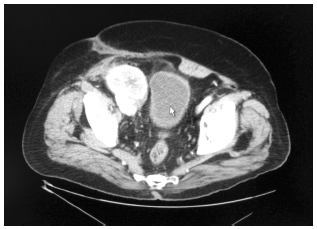
Figure 1. Computed Tomography Showing Pseudoaneurysm at the Site of the Kidney Transplant
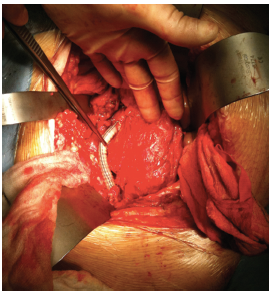
Figure 2. Intraoperative Photograph Showing a Dacron Graft Between the Right Common Iliac Artery and the Distal External Iliac Artery With the Transplanted Kidney In Situ