Volume: 11 Issue: 2 April 2013
FULL TEXT
Objectives: Evidence exists that decreased in triiodothyronine (T3) and thyroxine (T4) levels are associated with the severity of liver disease, and these hormones could be used as disease prognostic factors, but there are paradoxes in this regard in the literature. This study aimed at evaluating the correlation between thyroid hormone levels and severity of liver disease.
Materials and Methods: We measured thyroid hormone levels in 83 children with liver cirrhosis using radioimmunoassay techniques.
Results: Four patients (4.8%) showed a decrease in the amount of T3 and 9 patients (10.8%) revealed increased levels of T3. Also, decreases were seen in the T4 levels of 7 patients (8.4%), and 4 patients (4.8%) showed increases in levels of T4. The serum albumin levels were lower and international normalized ratio was higher in patients with low T3 and low T4. This study reveals that the Model for End-Stage Liver Disease and Pediatric End-Stage Liver Disease scores are statistically related to the decreased amounts of T4 (P = .036). The Model for End-Stage Liver Disease and Pediatric End-Stage Liver Disease scores and the Child scores were higher in low T3 patients, but this was not significant (P > .05).
Conclusions: Decreased levels of thyroid hormones are correlated with the severity of disease and can be seen in more advanced cirrhosis. Patients with decreased T4 levels need a liver transplant more immediately than those patients that do not have decreased T4 levels.
Key words : Thyroid hormone, Cirrhosis, Liver transplant, Children
Introduction
Serum concentrations of thyroid hormones vary in patients with hepatic disorders, especially those with liver cirrhosis.1-4 In some studies of liver cirrhosis where the peripheral conversion of thyroxine (T4) to triiodothyronine (T3) have been examined, the liver was found a major site of this peripheral conversion.5 The liver metabolizes thyroid hormones and regulates their systemic endocrine effects; therefore, liver diseases could affect thyroid hormone metabolism.6 A complex relation exists between the thyroid gland and the liver in healthy persons in the general population. This study sought to investigate serum levels of thyroid hormones in children with cirrhosis. The findings will be helpful in identifying prognostic parameters that assist patient classification and adjust treatment disciplines.
Materials and Methods
Subjects
This study used 83 children (38 females [45.8%] and 45 males [54.2%]; mean
age, 7.2 ± 5.4 y; age range, 6 mo to 18 y) with liver cirrhosis owing to
differing causes awaiting a liver transplant. Between March 2009 and March 2011,
these children were referred to the pediatric gastroenterologist of the
Pediatric Hepatology Clinic affiliated to Shiraz University of Medical Sciences.
A full medical history was taken. All the individuals underwent a complete
clinical examination and did not show any signs or symptoms of thyroid
dysfunction. The exclusion criteria were autoimmune cirrhosis, renal
dysfunction, and nephrotic syndrome.
To survey the severity of hepatic diseases, the criteria including as Pediatric End-Stage Liver Disease/Model for End-Stage Liver Disease (PELD/MELD) scores and Child score were assessed. Pediatric End-Stage Liver Disease scores for children younger than 12 years was calculated based on the international normalized ratio (INR), age, weight, albumin, and total bilirubin. For children older than 12 years, the MELD score was calculated based on the INR, total bilirubin, and serum creatinine. The Child score was assessed based on levels of encephalopathy, ascites, INR, serum bilirubin, and albumin, as shown in the table of Child-Turcotte-Pugh classification (Table 1).
Samples and biochemical assay
Written, informed consent was obtained from the patients or their parents
before the study. The study was approved by the Local Ethics Committee of Shiraz
University of Medical Sciences. All protocols conformed with the ethical
guidelines of the 1975 Helsinki Declaration. Five mL of venous blood was taken
from all the subjects in the morning after overnight fasting and was left to
clot at 37°C for 15 minutes and then centrifuged at 4000 rpm for 10 minutes. The
serum was then separated and divided into several aliquots and stored at -20°C
to be thawed once for analysis. Determination of serum T3 and T4 was carried out
by radioimmunoassay7 using BioCheck, Inc. (Foster City, CA, USA).
Statistical analyses
Statistical analyses were performed with SPSS software (SPSS: An IBM
Company, version 15.0, IBM Corporation, Armonk, NY, USA). Results are expressed
as means ± standard deviation (SD). The t test was used to compare values
between the groups regarding continuous variables and P values. The correlation
between the 2 variables was determined by Pearson product moment correlation
analysis.
Results
None of the patients had any clinical signs or symptoms of thyroid dysfunction. The most prevalent diseases in the study groups were cryptogenic cirrhosis (n=28, 33.8%) and progressive familial intrahepatic cholestasis (n=18, 21.8%). Other causes of cirrhosis were biliary atresia (n=13, 15.7%), Wilson disease (n=9, 10.8%), tyrosinemia (n=7, 8.4%), neonatal hepatitis (n=6, 7.2%), Budd-Chiari syndrome (n=1, 1.2%), and cardiac cirrhosis (n=1, 1.2%). There were 24 patients (28.9%) in Child A class, 41 (49.4%) in Child B class, and 18 patients (21.7%) in Child C class.
Four patients (4.8%) showed a decrease in the amount of T3, and 9 patients (10.8%) revealed increased levels of T3. Also, decreases in the amount of T4 were seen in 7 patients (8.4%), and 4 patients (4.8%) showed an increase in the level of T4. In patients with decreases in T3, hepatic diseases seen were cryptogenic cirrhosis (50%), Wilson disease (25%), and progressive familial intrahepatic cholestasis (25%). Causes of cirrhosis in patients increases in the level of T3 were biliary atresia (33.3%), progressive familial intrahepatic cholestasis (33.3%), and cryptogenic cirrhosis (33.3%). Regarding low T4 level, Wilson disease (42.9%), cryptogenic (28.6%), biliary atresia (14.3%) and progressive familial intrahepatic cholestasis (14.3%) were the causes of cirrhosis. Biliary atresia (75%) and neonatal hepatitis (25%) were the underlying liver diseases in patients with increased levels of T4.
The comparison of albumin levels, INR, total bilirubin, PELD/MELD scores, and Child scores on 3 different scales of the T3 hormone is shown in Table 2. Children with low T3 levels had lower serum albumin and higher serum bilirubin and INR; however, these differences were not significant (P = .21, P = .81, and P = .051). There was no significant correlation between levels of T3 and severity of liver disease according to PELD/MELD (P = .14) and Child (P = .11) scores, although mean PELD/MELD and Child scores were higher in patients with low serum T3 levels.
The comparison of albumin levels, INR, total bilirubin, PELD/MELD scores, and Child scores on 3 different scales of T4 hormone is shown in Table 3. Those children with cirrhosis with low T4 levels had lower albumin and higher INR levels; however, these were not significant (P = .3, P = .92). Mean bilirubin levels were higher in high T4 group, but this was not significant (P = .74). There was a significant relation between PELD/MELD scores and decreases in the amount of T4 (P = .036), while no correlation was observed between the changes in the amount of T4 and Child scores (P = .059) although the mean Child score was higher in low T4 group.
Discussion
Thyroid hormone abnormalities are common in cirrhotic children, as demonstrated by the 24 patients (28.9%) in this study with abnormally levels of thyroid hormones. Our results are comparable those of an adult study in United States that reported the prevalence of thyroid dysfunction is 13% in primary biliary cirrhosis, 11% in primary sclerosing cholangitis, and 25% in nonalcoholic fatty liver disease.8 In this study, 4.8% of the subjects showed a decrease in the T3 level while 10.8% had an increased level of T3 hormone. Considering T4 hormone levels, 8.4% of the participants had a decreased T4 level, while 4.8% showed an increase in the amount of this peptide hormone. Such variable alterations also have been reported by Huang and Liaw.9
The liver plays a key role in thyroid hormone balance, modifying total circulating concentrations of T3 and T4. The liver is the site of synthesis and degradation of carrier proteins (ie, thyroxin binding globulin, thyroxin-binding prealbumin, and albumin) and is a major site of peripheral conversion, degradation, and excretion of thyroid hormones.10,11 Thyroid abnormalities have been reported in acute and chronic liver diseases, and thyroid hormone levels have been evaluated with all the clinically available indices, confirming the existence of several abnormalities in thyroid function tests in both cirrhosis and chronic liver diseases, as shown in this study.12,13 Circulating thyroid hormone levels may range from normal values14 to the marked abnormalities seen in the “euthyroid sick syndrome.”15 The thyroid is involved, primarily and secondarily, in the hemodynamic alterations of cirrhosis; a reduction in vasodilator FT3 may play a role in the pathophysiology.16
On the other hand, all cirrhotic children were clinically euthyroid in our study; it seems that euthyroidism is maintained in most patients as a result of low-normal FT3 and high-normal FT4.11
There was no significant correlation between the serum T3 levels and the amounts of albumin, bilirubin, and INR in this study, and this is in concordance with the results of Huang and associates’9. However, Agha and associates17 reported that serum T3 and FT3 have an inverse correlation with serum bilirubin and a positive correlation with serum albumin. The trend in this study was lower albumin and higher bilirubin and INR in patients with low T3; however, lacking a significant and small sample size may be cause of these differences.
Furthermore, T3 serum concentrations appear to parallel the severity of liver dysfunction.8,10-13 Our findings revealed no correlation between the amount of T3 and the severity of the hepatic disease. We observed that mean PELD/MELD and Child scores were higher in children with low T3 levels, but this was not significant (P = .14, and P = .11). Agha and associates17 concluded that alterations in serum T3 and FT3 levels correlate well with the disease severity and may be useful in assessing the course and prognosis in cirrhotic patients. These same alterations may be due to the age of the children in our study. Moreover, in this study, a significant relation was found between the PELD/MELD scores (which shows the severity of the disease) and T4 level and children with low T4 levels had significantly higher PELD/MELD scores (P = .036). Also, our results showed that mean Child scores were higher in patients with low T4 levels, but this was not significant (P = .059). It seems that thyroid dysfunction become more severe with more advanced liver disease.
This study is one of the few pediatric studies regarding this issue, but it has significant limitations in that we did not check FT3 and FT4 levels. The thyroid hormones are 99% bound to thyroxine-binding globulin, thyroxine-binding prealbumin, and albumin in plasma. The free hormone component within plasma is in equilibrium with the protein-bound hormone, and it is this free fraction that accounts for the hormone’s biological activities. In cirrhosis, the levels of thyroxine-binding globulin, prealbumin, and albumin are changed, so it is better to check free and total T3 and T4 to confirm thyroid dysfunction.
These results can be helpful in choosing the proper candidates for liver transplant. Owing to more severe and more advanced hepatic disorders, and considering our results, patients with low T3 and T4 levels need a liver transplant more immediately than do other patients. Finally, these data can be helpful indices for making decisions about the patients’ allocation for liver transplant.
References:
- Schussler GC, Schaffner F, Korn F. Increased serum thyroid hormone
binding and decreased free hormone in chronic active liver disease. N Engl J
Med. 1978;299(10):510-515.
CrossRef - PubMed - Ross DS, Daniels GH, Dienstag JL, Ridgway EC. Elevated thyroxine levels
due to increased thyroxine-binding globulin in acute hepatitis. Am J Med.
1983;74(4):564-569.
CrossRef - PubMed - Nomura S, Pittman CS, Chambers JB Jr, Buck MW, Shimizu T. Reduced
peripheral conversion of thyroxine to triiodothyronine in patients with
hepatic cirrhosis. J Clin Invest. 1975;56(3):643-652.
CrossRef - PubMed - Van Thiel DH, Smith WI Jr, Wight C, Abuid J. Elevated basal and abnormal
thyrotropin-releasing hormone-induced thyroid-stimulating hormone secretion
in chronic alcoholic men with liver disease. Alcohol Clin Exp Res.
1979;3(4):302-308.
CrossRef - PubMed - Smith SJ, Bos G, Gerbrandy J, Docter R, Visser TJ, Hennemann G. Lowering
of serum 3,3’,5-triiodothyronine thyroxine ratio in patients with myocardial
infarction; relationship with extent of tissue injury. Eur J Clin Invest.
1978;8(2):99-102.
CrossRef - PubMed - Moustafa AH, Ali EM, Mohamed TM, Abdou HI. Oxidative stress and thyroid
hormones in patients with liver diseases. Eur J Intern Med.
2009;20(7):703-708.
CrossRef - PubMed - Wisdom GB. Enzyme-immunoassay. Clin Chem. 1976;22(8):1243-1255.
PubMed - Silveira MG, Mendes FD, Diehl NN, Enders FT, Lindor KD. Thyroid
dysfunction in primary biliary cirrhosis, primary sclerosing cholangitis and
non-alcoholic fatty liver disease. Liver Int. 2009;29(7):1094-1100.
CrossRef - PubMed - Huang MJ, Liaw YF. Changes in thyroid hormone concentration in liver
disease [in Chinese]. Taiwan Yi Xue Hui Za Zhi. 1989;88(5):527-529, 526.
PubMed - Green JR, Snitcher EJ, Mowat NA, Ekins RP, Rees LH, Dawson AM. Thyroid
function and thyroid regulation in euthyroid men with chronic liver disease:
evidence of multiple abnormalities. Clin Endocrinol (Oxf).
1977;7(6):453-461.
CrossRef - PubMed - Borzio M, Caldara R, Borzio F, Piepoli V, Rampini P, Ferrari C. Thyroid
function tests in chronic liver disease: evidence for multiple abnormalities
despite clinical euthyroidism. Gut. 1983;24(7):631-636.
CrossRef - PubMed - Oren R, Sikuler E, Wong F, Blendis LM, Halpern Z. The effects of
hypothyroidism on liver status of cirrhotic patients. J Clin Gastroenterol.
2000;31(2):162-163.
CrossRef - PubMed - Antonelli A, Ferri C, Pampana A, et al. Thyroid disorders in chronic
hepatitis C. Am J Med. 2004;117(1):10-13.
CrossRef -
PubMed - Majumdar SK, Shaw GK, O’Gorman P, Aps EJ, Thomson AD. Thyroid status in
patients with alcoholic liver disease. Drug Alcohol Depend.
1981;7(4):389-391.
CrossRef - PubMed - Wartofsky L, Burman KD. Alterations in thyroid function in patients with
systemic illness: the "euthyroid sick syndrome". Endocr Rev.
1982;3(2):164-217.
CrossRef - PubMed - Spadaro L, Bolognesi M, Pierobon A, Bombonato G, Gatta A, Sacerdoti D.
Alterations in thyroid Doppler arterial resistance indices, volume and
hormones in cirrhosis: relationships with splanchnic haemodynamics.
Ultrasound Med Biol. 2004;30(1):19-25.
CrossRef - PubMed - Agha F, Qureshi H, Khan RA. Serum thyroid hormone levels in liver
cirrhosis. J Pak Med Assoc. 1989;39(7):179-183.
PubMed

Volume : 11
Issue : 2
Pages : 150 - 153
DOI : 10.6002/ect.2012.0182
From the 1Gastroenterohepatology Research Center, the 2Shiraz
Transplant Research Center, and the 3Department of Pediatric
Endocrinology, Namazi Hospital, Shiraz University of Medical Sciences, Shiraz,
Iran
Acknowledgements: Drs. Dehghani, Haghighat, Imanieh, Karamifar, and
Malek-Hosseini were involved in the study concept and design, drafting of the
manuscript, critical revision of the manuscript, study supervision, and Drs.
Eghbali and Malekpour were in charge of acquisition of data, analysis and
interpretation of data, drafting of the manuscript. We also thank Ms. Afsaneh
Keivanshekouh and the Research Improvement Centre of Shiraz University of
Medical Sciences for improving the English in this manuscript. The article is
extrapolated from a thesis written by Fatemeh Eghbali. It was financially
supported by Shiraz University of Medical Sciences grant No 88-1535. The authors
have no conflicts of interest to disclose.
Corresponding author: Seyed Mohsen Dehghani, MD, Associate Professor of
Pediatric Gastroenterology, Gastroenterohepatology Research Center, Shiraz
Transplant Research Center, Namazi Hospital, Shiraz University of Medical
Sciences, Shiraz, 71937-11351, Iran
Phone: +98 711 626 1775
Fax: +98 711 647 4298
E-mail: dehghanism@sums.ac.ir
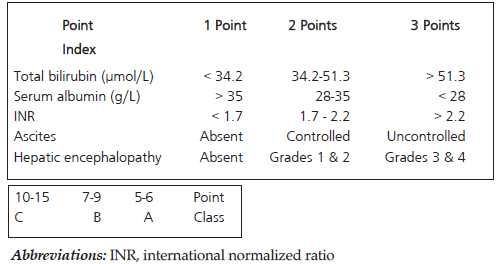
Table 1. Child-Turcotte-Pugh Classification of Liver Cirrhosis
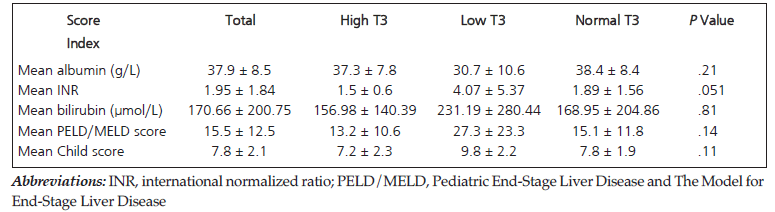
Table 2. Comparison of the Amount of Albumin, INR, Total Bilirubin,PELD/MELD Score, and Child Score in Different Scales of T3 hormone
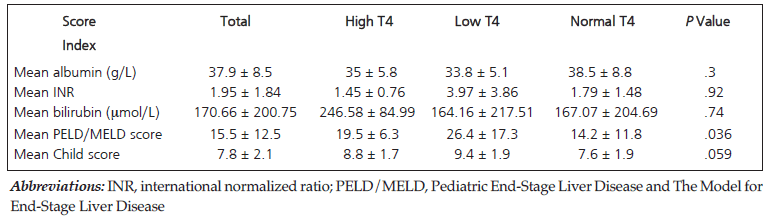
Table 3. Comparison of the Amount of Albumin, INR, Total Bilirubin,PELD/MELD Score, and Child Score in Different Scales of the T4 Hormone