Volume: 10 Issue: 6 December 2012
FULL TEXT
Mycobacterium genavense is recognized as a life-threatening pathogen in severely immunocompromised patients, mostly in those with advanced human immunodeficiency virus infection. We report a case of M. genavense infection in a lung-transplant recipient with late-onset death occurring from disseminated infection. In human immunodeficiency virus-negative patients, there exist only about 10 reports of disseminated M. genavense infection in immunocompromised hosts; and to our knowledge, this is a first reported case of M. genavense infection after a lung transplant. Diagnosis of M. genavense was obtained only with nucleic acid-based identification technique, as frequently observed in a few cases of human immunodeficiency virus-negative patients. A striking feature was the recurrence of this infection in our patient after a seemingly infection-free period of 3 years. Because M. genavense infection can be life-threatening, clinicians must be aware of the frequent requirement for nucleic-acid–based identification for its diagnosis.
Key words : Mycobacterium genavense, Nontuberculous mycobacterium, Lung transplant
Introduction
Mycobacterium genavense is a slow-growing nontuberculous mycobacterium that causes localized or disseminated disease in immunocompromised patients. Disseminated infection with Mycobacterium genavense has been described mostly in patients with advanced human immunodeficiency virus (HIV) infection.1 In HIV-negative patients, about 10 reports of disseminated M. genavense infection have been published in immunocompromised hosts,2-10 including only 4 cases have occurred in transplant recipients in the last 5 years.2, 6-8 We report a case in a lung transplant recipient, with a fatal outcome more than 3 years after a diagnosis owing to late-onset recurrence of the infection.
Case Report
A 43-year-old woman who had received a right single-lung transplant for lymphangioleiomyomatosis, was hospitalized 7 years later (June 2007) because of fever, weight loss, and decreased spirometry findings. The patient had stable stage 1 bronchiolitis obliterans syndrome for 5 years. On admission, maintenance immunosuppressive treatment consisted of tacrolimus, mycophenolate mofetil, and prednisone. A thoracic computed tomography scan revealed minimal bronchiolar inflammation and mediastinal centimeter lymph nodes. Direct examination of several respiratory specimens showed acid-fast bacilli, and their culture allowed identification of M. genavense only by polymerase chain reaction (PCR) and sequencing for the broad-range eubacterial 16S rRNA gene.
In the reported case, traditional cultures on solid media were insufficient for identification and did not allow drug-susceptibility testing. This is a well-known situation in previously reported cases of M. genavense infection. Even with prolonged incubation, traditional culture methods identify M. genavense only 30% to 50% of the time.11 Because culturing M. genavense is difficult, susceptibility data are limited. Clinical resolution was achieved with clarithromycin (15 mg/kg/d, 18 mo), ethambutol (20 mg/kg/d, 18 mo), and amikacin (15 mg/kg/d, 3 mo), with negative result for acid-fast bacilli. Concomitantly, mycophenolate mofetil was stopped and trough levels of tacrolimus were lowered (6-8 ng/mL). The outcome was uneventful during the next 3 years. Because of bronchiolitis obliterans syndrome stage 1, low-dose maintenance azithromycin (250 mg × 3 time per wk) also was administered.
In May 2010, the patient presented again with weight loss, weakness, fever, and decreased spirometry findings. A thoraco-abdominal computed tomography revealed alveolar infiltrates in the lung graft only (Figure 1) and enlarged abdominal mesenteric lymph nodes. Direct examination and culture of repeat bronchial aspirates gave negative results. A surgical thoracotomy was performed and open-lung biopsies showed numerous granulomas and Ziehl-Neelsen stain showed positive bacilli from histologic examination. Recurrence of M. genavense infection was again confirmed by PCR and sequencing of broad-range eubacterial 16S rRNA from lung-tissue specimens. The previous treatment (clarithromycin, ethambutol, amikacin) was resumed in June 2010, although antibiotic susceptibility testing could not be obtained because standard cultures of lung-tissue biopsies remained negative. Surgical sampling of the enlarged mesenteric lymph nodes also was performed, showing granulomas, which confirmed dissemination of the infection.
After 4 months of treatment, the patient’s medical condition worsened. She was placed under ventilatory support in a critical-care unit in October 2010 and ultimately died from disseminated infection with multiorgan failure in December 2010. Failure to reinstate treatment was suggested by the onset of numerous positive acid-fast bacilli after direct examination of respiratory specimens obtained before the patient’s death.
Discussion
This case describes a relapsing M. genavense infection 7 years after a lung transplant. To our knowledge, this is the first report of a lung-transplant recipient with M. genavense infection. An unusual aspect is the recurrence of this infection after a seemingly infection-free period of 3 years. Although we were unable to demonstrate that recurrent and original isolates were identical, owing to the lack of cultures in both infection episodes, the recurrence of this rare infection in the same patient is highly suggestive of the same strain of M. genavense. It is hypothesized that the intensity of immunosuppression, although tapered after the first episode, still favored the fatal recurrence of this infection.
About 10 cases of disseminated M. genavense infection in HIV-negative patients have been published in the last 15 years (Table 1). Among them, death occurred in 5 of 10 cases, directly attributed to disseminated M. genavense infection in 4 cases (40%) (Table 1). Cause of immunosuppression was variable, including solid-organ (2 in kidney, 1 in a heart) or allogenic stem cell transplant (n=1), hematologic disorders (n=2), connectivitis (n=3), and prolonged corticosteroids (n=1; Table 1). In the few cases that occurred in transplant recipients,2, 6-8 M. genavense infection occurred late after the transplant (7 months to 7 years), with disseminated disease in all cases, lung involvement in 3 of the 5 cases2, 8 (and present report), and caused death in 2 of 5 patients8 (and present report).
As in our recipient, standard mycobacterial culture on solid media was often insufficient to identify the mycobacteria, and diagnosis of M. genavense was frequently obtained only by PCR and sequencing the 16S rRNA gene, or a reverse hybridization DNA probe.2, 6, 8 Hence, M. genavense diagnosis remains challenging owing to the difficulty in obtaining cultures, even over prolonged times,2 and their frequency is probably underestimated. Because of the life-threatening character of M. genavense infection and difficulties in identifying this mycobacterium by standard culture, clinicians must be aware of the need for nucleic acid-based identification techniques for diagnosis of M. genavense infection in transplant recipients.
References:
- Böttger EC, Teske A, Kirschner P, et al. Disseminated "Mycobacterium
genavense" infection in patients with AIDS. Lancet. 1992;340(8811):76-80.
CrossRef - PubMed - Doggett JS, Strasfeld L. Disseminated Mycobacterium genavense with pulmonary
nodules in a kidney transplant recipient: case report and review of the
literature. Transpl Infect Dis. 2011;13(1):38-43.
CrossRef - PubMed - Lorenzen J, Meyer-Olson D, Haubitz M, et al. Infection with Mycobacterium
genavense in a patient with systemic lupus erythematosus. Clin Rheumatol.
2009;28(suppl 1):S39-S41.
CrossRef - PubMed - Sharifian A, Humphris J, Leong RW, Jones DB. Education and imaging.
Gastrointestinal: Mycobacterium genavense enteritis in an immunosuppressed
patient. J Gastroenterol Hepatol. 2009;24(8):1474.
CrossRef - PubMed - Dumouchel-Champagne H, Charlier-Woerther C, Boibieux A, et al. Disseminated
nontuberculous infections with Mycobacterium genavense during sarcoidosis. Eur
Respir Rev. 2009;18(114):299-301.
CrossRef - PubMed - Lu KJ, Grigg A, Leslie D, Finlay M, Sasadeusz J. Mycobacterium genavense
duodenitis following allogeneic peripheral blood stem cell transplantation.
Transpl Infect Dis. 2009;11(6):534-536.
CrossRef - PubMed - de Lastours V, Guillemain R, Mainardi JL, et al. Early diagnosis of
disseminated Mycobacterium genavense infection. Emerg Infect Dis.
2008;14(2):346-347.
CrossRef - PubMed - Nurmohamed S, Weenink A, Moeniralam H, Visser C, Bemelman F. Hyperammonemia
in generalized Mycobacterium genavense infection after renal transplantation. Am
J Transplant. 2007;7(3):722-723.
CrossRef - PubMed - Krebs T, Zimmerli S, Bodmer T, Lämmle B. Mycobacterium genavense infection in
a patient with long-standing chronic lymphocytic leukaemia. J Intern Med.
2000;248(4):343-348.
CrossRef - PubMed - Bogdan C, Kern P, Richter E, et al. Systemic infection with Mycobacterium
genavense following immunosuppressive therapy in a patient who was seronegative
for human immunodeficiency virus. Clin Infect Dis. 1997;24(6):1245-1247.
CrossRef - PubMed - Böttger EC. Mycobacterium genavense: an emerging pathogen. Eur J Clin
Microbiol Infect Dis. 1994;13(11):932-936.
CrossRef - PubMed

Volume : 10
Issue : 6
Pages : 618 - 620
DOI : 10.6002/ect.2012.0052
From the 1Service de Pneumologie B et de Transplantation Pulmonaire; the
2Centre
de Référence des Mycobacteries, CHU Pitié-Salpétrière; the 3Service d’Anatomie
et Cytologie Pathologiques; the 4Service de Réanimation Médicale; and the
5Service de Bactériologie, CHU Bichat-Claude Bernard, Paris, France.
Corresponding author: Olivier Brugière, MD, Service Pneumologie B et
Transplantation pulmonaire, Hopital Bichat, 16 rue Henri Huchard, 75018 Paris,
France
Phone: +33 14 025 6914
Fax: +33 14 025 7210
E-mail:
olivier.brugière@bch.aphp.fr
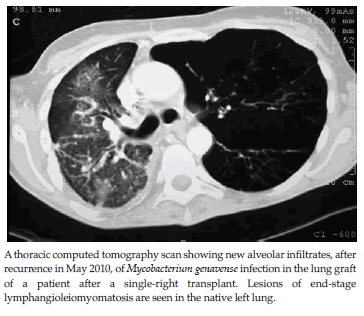
Figure 1. Thoracic CT Scan
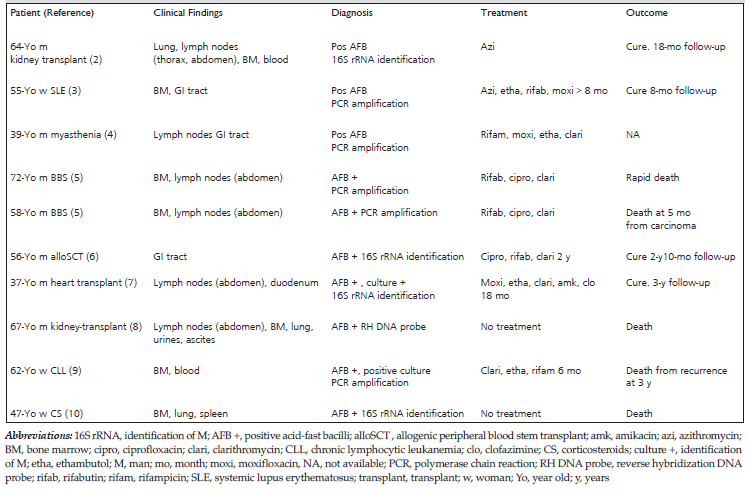
Table 1. Reported Cases of Disseminated Mycobacterium genavense in Human Immunodeficiency Virus-Negative Immunosuppressed Patients