Volume: 10 Issue: 3 June 2012
FULL TEXT
Objectives: With the current disparity between donor organ availability and recipient need, creative techniques help optimize the use of available organs. We present a case of a woman, who was worked-up as a kidney donor, who was incidentally found to have a saccular aneurysm on her renal artery. The patient was asymptomatic, normotensive, and had normal renal function.
Materials and Methods: We performed a laparoscopic robotic donor nephrectomy, repaired the aneurysm on the back table, and transplanted the organ into the recipient.
Results: The donor underwent a successful robotic nephrectomy, successfully eradicating any risk of aneurysmal complications; the recipient received an anatomically normal organ with excellent function.
Conclusions: An altruistic act by the donor identified a potentially fatal lesion, which was not only remedied, but the intended donation proceeded when a creative approach was used.
Key words : Kidney transplant, Renal artery, Aneurysm
Introduction
Conventional management of a renal artery aneurysm involves arterial reconstruction or endovascular repair.1-4 Few cases of ex vivo repair have been described for strategically located aneurysms,1, 5, 6 and even fewer cases using laparoscopic nephrectomy with autotransplant have been described.7-9 To the best of our knowledge, we present the first case of laparoscopic robotic nephrectomy after allotransplant of the repaired organ.
Case Report
A 49-year-old woman with end-stage renal disease secondary to type 2 diabetes mellitus, who was currently being dialyzed, identified a friend as a potential kidney donor. The donor was a 37-year-old woman with an unremarkable medical history who, as a part of preoperative work-up, underwent an arteriography, which found a 2.5-cm right renal artery aneurysm at the trifurcation of the artery (Figure 1).
The arterial pathology in the right kidney was addressed whether the patient would be approved as a donor or not. Because an acceptable modality of treatment of renal artery aneurysms would include laparoscopic nephrectomy, ex vivo repair, and autotransplant, we elected to modify the procedure by performing laparoscopic robotic nephrectomy, ex vivo repair, and allotransplant of the repaired kidney. Laparoscopic robotic nephrectomy was performed using a previously described technique.10
The kidney including the artery, vein, ureter, and defatting, was dissected at the back bench. After the structures were skeletonized, we addressed the aneurysm. The 2.5-cm aneurism was identified at the trifurcation of the main renal artery (Figure 2) and was excised.
Excision left a large defect on the main renal artery and the lower polar artery was totally detached from the main trunk. At this point, the recipient operation began. After dissecting the right external iliac vessels, an elliptical patch from the anterior wall of the external iliac vein was excised from the site where the venous anastomosis would later be performed. The patch was sutured to the defect of the main renal artery with 7-0 Prolene (Figure 3).
The kidney was implanted into the external iliac vessels using a standard vascular technique. The lower polar renal artery was anastomosed separately to the external iliac artery. The graft had excellent and uniform perfusion after the clamps were removed.
The postoperative courses of the donor and the recipient were unremarkable. A follow-up ultrasound showed excellent flow in the graft 4 years after the transplant.
Discussion
Renal artery aneurysms are uncommon. Incidence in the literature varies between 0.1% and 1%.2 The exact cause of renal artery aneurysms is not known. However, they have been described in association with hypertension, hematuria, and other visceral aneurysms. The published indications and techniques to repair renal artery aneurysms vary by author. Some authors agree that its simple presence is an indication for repair, especially in pregnant patients or in any woman who desires children.2, 10 Aneurysm size is another parameter. Some authors will recommend observation for aneurysms less than 1 cm in asymptomatic patients.2, 3 Most would agree that aneurysms larger than 1.5 cm should be repaired. Any symptom related to a renal artery aneurysm, such as pain due to dissection or expansion or renal hypertension, is an indication for immediate repair.
Several authors have described techniques to repair renal artery aneurysms.2, 3, 5, 6, 12 The most commonly described method is excision of the aneurysm and repair with a venous patch. For small saccular aneurysms, clipping is an appropriate alternative. In cases where there is more than 1 branch, excising the aneurysm from the main branch and reconstructing by performing an anastomosis of 2 branches in a side-to-side manner, is acceptable. For complex lesions such as multiple aneurysms, aneurysms located at the border of the kidney parenchyma, or a ruptured renal artery aneurysm, ex vivo repair may be indicated.
Our patient had a 2.5-cm saccular aneurysm. Laparoscopic nephrectomy in case of renal artery aneurysm in the setting of kidney transplant has been described.13, 14 We are the first to describe the use of robotic surgery in this setting.
Conclusions
Kidneys from living donors with renal vascular disease such as an aneurysm can be safely reconstructed and transplanted with a good outcome for both the recipient and the donor. Application of new technology like the da Vinci surgical system could be of value in these unusual situations.
References:
- Gelin LE, Claes G, Gustafsson A, Storm B. Total bloodlessness for
extracorporeal organ repair. Rev Surg. 1971;28(5):305-316.
PubMed - Ortenberg J, Novick AC, Straffon RA, Stewart BH. Surgical treatment of renal
artery aneurysms. Br J Urol. 1983;55(4):341-346.
CrossRef - PubMed - Pfeiffer T, Reiher L, Grabitz K, et al. Reconstruction for renal artery
aneurysm: operative techniques and long-term results. J Vasc Surg.
2003;37(2):293-300.
CrossRef - PubMed - Salam TA, Lumsden AB, Martin LG, Smith RB 3rd. Nonoperative management of
visceral aneurysms and pseudoaneurysms. Am J Surg. 1992;164(3):215-219.
CrossRef - PubMed - Knobloch K, Wiebe K, Lichtenberg A, Fischer S, Gohrbandt B, Haverich A. Ex
vivo repair and renal autotransplantation for complex renal artery aneurysms in
a solitary kidney. Ann Vasc Surg. 2005;19(3):407-410.
CrossRef - PubMed - Ota K, Mori S, Awane Y, Ueno A. Ex situ repair of renal artery for
renovascular hypertension. Arch Surg. 1967;94(3):370-373.
CrossRef - PubMed - Ratner LE, Ciseck LJ, Moore RG, Cigarroa FG, Kaufman HS, Kavoussi LR.
Laparoscopic live donor nephrectomy. Transplantation. 1995;60(9):1047-1049.
PubMed - Kuo PC, Plotkin JS, Stevens S, Cribbs A, Johnson LB. Outcomes of laparoscopic
donor nephrectomy in obese patients. Transplantation. 2000;69(1):180-182.
CrossRef - PubMed - Simforoosh N, Basiri A, Tabibi A, Shakhssalim N, Hosseini Moghaddam SM.
Comparison of laparoscopic and open donor nephrectomy: a randomized controlled
trial. BJU Int. 2005;95(6):851-855.
CrossRef - PubMed - Horgan S, Vanuno D, Sileri P, Cicalese L, Benedetti E. Robotic-assisted
laparoscopic donor nephrectomy for kidney transplantation. Transplantation.
2002;73(9):1474-1479.
CrossRef - PubMed - Beseth BD, Quinones-Baldrich WJ. Renal artery aneurysm secondary to
fibromuscular dysplasia in a young patient. Ann Vasc Surg. 2005;19(5):605-608.
CrossRef - PubMed - El Tayar AR, Labruzzo C, Haritopoulos K, Hakim NS. Renal artery aneurysm: ex
vivo repair and autotransplantation: case report and review of the literature.
Int Surg. 2003;88(2):61-63.
PubMed - Maciel RF, Branco AJ, Branco AW, et al. Renal artery aneurysm in hand-assisted
laparoscopic donor nephrectomy: case report. Transplant Proc.
2003;35(8):2858-2859.
CrossRef - PubMed - Desgrandchamps F, Jabbour ME, Gossot D, et al. Hand-assisted laparoscopic
live donor nephrectomy in a patient with renal artery aneurysm. Surg Endosc.
2001;15(1):101.
CrossRef - PubMed
Volume : 10
Issue : 3
Pages : 293 - 295
DOI : 10.6002/ect.2011.0165
From the Division of Transplantation, Department of Surgery, University of
Illinois at Chicago (UIC), Chicago, IL, USA
Acknowledgements: The study was not supported by any funding sources.
Corresponding author: Mario Spaggiari, MD, Division of Transplantation,
Department of Surgery, University of Illinois at Chicago, USA
Phone: +1 312 788 4350
Fax: +1 312 413 3483
E-mail:
mariospaggiari@yahoo.it
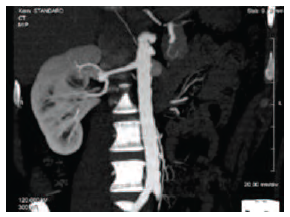
Figure 1. Arteriography
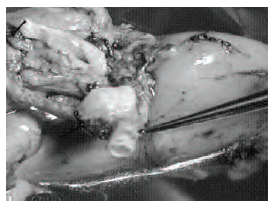
Figure 2. Aneurysm at the renal artery trifurcation.
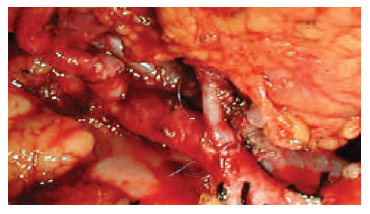
Figure 3. Renal artery reconstruction with the recipient's iliac venous patch.