Volume: 22 Issue: 1 January 2024 - Supplement - 1
FULL TEXT
Objectives: We aimed to examine kidney transplant graft survival over 10 years using retrospective analysis.
Materials and Methods: Deidentified data of 429 patients extracted from the institution’s statistical database were analyzed using descriptive statistics methods and analysis of variance.
Results: Graft survival rates at 3, 5, and 10 years were 89.8%, 84.1%, and 81.3%, respectively. Main causes of graft loss were death with a functioning kidney graft and chronic graft nephropathy.
Conclusions: In this study, 3-, 5-, and 10-year graft survival rates were satisfactory and similar to the results of other single-center studies in the world. The best survival was observed 3 years after the transplant procedure.
Key words : Chronic kidney disease, End-stage renal disease, Graft failure, Graft survival rates, Renal transplantation
Introduction
The number of patients with chronic kidney disease (CKD) all over the world has been increasing.1-3 Regardless of the etiology and pathogenesis of kidney damage, CKD leads to progressive and irreversible sclerosis of the renal parenchyma.4 End-stage renal disease is an irreversible decline in kidney function requiring renal replacement therapy such as chronic dialysis and kidney transplant.5
Kidney transplant provides not only the best quality of life but also the longest life expectancy.6,7 Currently, around 30 000 kidney transplant procedures are performed worldwide.1,8 Despite the great accumulated experience, kidney transplant is accompanied by a number of significant complications. Cardiovascular diseases and infections are the leading causes of death in kidney transplant recipients. Other complications include surgical complications (urological, vascular, bleeding and hematomas, lymphocele), which have rates of 15% to 17%,9 and nonsurgical complications, such as delayed graft function.
We aimed to examine kidney transplant graft survival over 10 years (2012 to 2022) using retrospective analysis. The study included patients treated at the private medical center MedServis (Baku, Azerbaijan).
Materials and Methods
Our study included 429 kidney transplant graft recipients. All study transplant patients were under medical supervision at the private medical center MedServis (Baku, Azerbaijan) during the period from 2012 to 2022; separate facilities performed the transplant procedures. We used deidentified data extracted from patient medical records from the institution’s statistical database.
We analyzed quantitative data (patient survival, mortality patterns, and graft losses) by descriptive statistics methods and analysis of variance. We performed statistical analysis of retrospective data using SPSS software version 16.
Results
Of 429 kidney transplant graft recipients, 273 were males (64%) and 156 were females (36%), and mean age was 43.5 ± 0.64 years (range, 15-72 years) (Table 1). Duration of hemodialysis before transplant procedure ranged from 2 weeks to 7 years, with average of 1.12 ± 0.17 years. Before kidney transplant, 354 patients (82.7%) had arterial hypertension. The number of patients with repeat kidney transplant was 3 (0.66%). All patients underwent heterotopic kidney transplant.
All patients received a standard triple immuno-suppressive therapy consisting of calcineurin inhibitor, mycophenolate mofetil, and prednisolone.
During the 10-year period, 74 of 429 kidney transplant graft recipients (17.2%) died; 53 were males (71.6%), and 20 (27%) were females. The number of patients returning to dialysis after kidney transplant graft failure was 6 (1.39%) (1 female [16.6%]; 5 males [83.4%]).
Graft survival rates at 3, 5, and 10 years were 89.8%, 84.1%, and 81.3%, respectively (Figure 1). Main causes of graft loss were death with a functioning kidney graft and chronic graft nephropathy. Leading causes of death were infection-related complications, especially complications of COVID-19.
Discussion and Conclusions
We present our 10-year single-center experience on outcomes of kidney transplants. In this study, 3-, 5- and 10-year graft survival rates were satisfactory and similar to the results of other single-center studies in the world. The best survival was observed 3 years after kidney transplant.
References:
- Pour-Reza-Gholi F, Nafar M, Saeedinia A, et al. Kidney retransplantation in comparison with first kidney transplantation. Transplant Proc. 2005;37(7):2962-2964. doi:10.1016/j.transproceed.2005.08.034
CrossRef - PubMed - Jedrzejko K, Kieszek R, Kwapisz M, Nita M, Durlik M, Kwiatkowski A. Comparison of kidney transplantation results from the same deceased donor between patients with the first transplantation and retransplanted patients. Transplant Proc. 2018;50(6):1726-1729. doi:10.1016/j.transproceed.2017.12.058
CrossRef - PubMed - Ingsathit A, Kantachuvesiri S, Rattanasiri S, et al. Long-term outcome of kidney retransplantation in comparison with first kidney transplantation: a report from the Thai Transplantation Registry. Transplant Proc. 2013;45(4):1427-1430. doi:10.1016/j.transproceed.2012.08.029
CrossRef - PubMed - Sugi MD, Albadawi H, Knuttinen G, et al. Transplant artery thrombosis and outcomes. Cardiovasc Diagn Ther. 2017;7(Suppl 3):S219-S227. doi:10.21037/cdt.2017.10.13
CrossRef - PubMed - Kawano PR, Yamamoto HA, Gerra R, et al. A case report of venous thrombosis after kidney transplantation - we can save the graft? Time is the success factor. Int J Surg Case Rep. 2017;36:82-85. doi:10.1016/j.ijscr.2017.04.022
CrossRef - PubMed - Kwon OJ, Kwak JY. The impact of sex and age matching for long-term graft survival in living donor renal transplantation. Transplant Proc. 2004;36(7):2040-2042. doi:10.1016/j.transproceed.2004.07.046
CrossRef - PubMed - Courtney AE, McNamee PT, Maxwell AP. The evolution of renal transplantation in clinical practice: for better, for worse? QJM. 2008;101(12):967-978. doi:10.1093/qjmed/hcn136
CrossRef - PubMed - Shahbazi F, Ranjbaran M, Karami-Far S, Soori H, Manesh HJ. Graft survival rate of renal transplantation during a period of 10 years in Iran. J Res Med Sci. 2015;20(11):1046-1052. doi:10.4103/1735-1995.172814
CrossRef - PubMed - Tasaki M, Saito K, Nakagawa Y, et al. 20-year analysis of kidney transplantation: a single center in Japan. Transplant Proc. 2014;46(2):437-441. doi:10.1016/j.transproceed.2013.10.052
CrossRef - PubMed

Volume : 22
Issue : 1
Pages : 263 - 264
DOI : 10.6002/ect.MESOT2023.P74
From the 1Private Medical Center MedServis, the 2Scientific Surgical Center, named after Academician M. Topchubashov, and the 3Republican Clinical Urological Hospital, named after Academician M. Javadzadeh, Baku, Azerbaijan
Acknowledgements: The authors have not received any funding or grants in support of the presented research or for the preparation of this work and have no declarations of potential conflicts of interest.
Corresponding author: Zemfira Hasanova, Mammadguluzade str. 3, Baku, AZ1009 Azerbaijan
E-mail: doctor_79-79@mail.ru
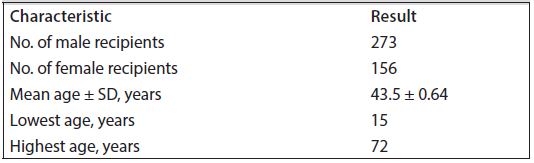
Table 1. Patient Demographic Characteristics (N = 429)
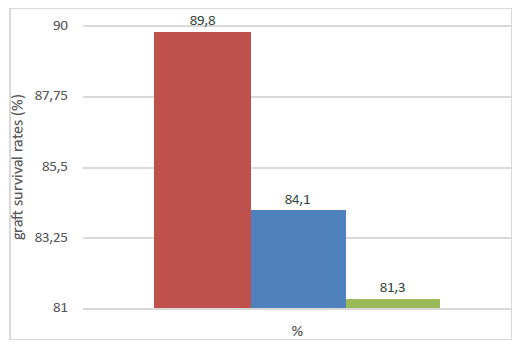
Figure 1. Graft Survival Rates at 3, 5, and 10 Years After Transplant