Volume: 22 Issue: 1 January 2024 - Supplement - 1
FULL TEXT
Objectives: Kidney transplant is the best treatment for patients with end-stage kidney disease. In many regions of the world, including the Middle East, most kidney transplants are from living donors. In contrast to recipients, data for living donors remain scarce. Here, we describe living donor baseline characteristics at first hospital check at a single center in Baghdad, Iraq.
Materials and Methods: We collected and analyzed demographic, laboratory, imaging, and histocompatibility data from donor records at the Nephrology and Renal Transplantation Center, Medical City-Baghdad, Baghdad, Iraq, from July 2022 to September 2022.
Results: We included 124 kidney donors (56.4% male) who donated their kidneys 1 to 3 years previous to our study, with a mean age of 34.84 ± 10.04 years and mean body mass index (weight in kilograms divided by height in meters squared) of 27.11 ± 2.12. Most donors donated their kidneys to a first-degree relative (69.2%); blood group O was the most prevalent (47.5%). More than half of the donors were unemployed. Histocompatibility testing showed that 40% of the donors had >3 human leukocyte antigen mismatches with their recipients, and 30% of the recipients were high-risk sensitized patients with a calculated panel reactive antibody >50%. Regarding the virus status, 68.5% of the donors tested positive for cytomegalovirus immunoglobulin G, 8% of the transplants were high-risk cytomegalovirus status, and 43.5% tested positive for Epstein-Barr virus immunoglobulin G. Renal imaging showed that 75.8% of donors had a single artery and 24.1% had a double artery (26.6% double left, 40% double right, and 33.3% both).
Conclusions: For living transplant procedures at a single center in Iraq, most were from related donors. Most donors are unemployed, which mandates future health and social support. High immunological and viral risks must not be ignored in a single center with living related donors.
Key words : Iraq, Kidney transplant, Living donation, Transplantation
Introduction
Organ donation is the cornerstone of transplantation. The source of organs for donation is either a living or deceased donor. Although the evidence has many limitations, the risks of living donation are accepted as sufficiently low to justify the practice.1-3 According to a report from the Global Observatory on Organ Donation and Transplantation, more than 35 000 living donor transplants were performed in 2021 globally, of which 8915 living donor kidney transplants were in the American region and 3517 were in the Middle East region.4 Iraq started renal transplantation in 1973 and continues with a living donor, ABO-compatible program with a present rate of 24 living donor transplants per million population at 8 transplant units across the country.5,6 This rate remains lower than the rate in other countries, such as Turkey.7 In an Iraqi study from 2022, the fear of future health risks after donation was cited as the most important barrier against the choice to become a living donor.8 Most transplant databases are concerned with the transplant recipients and transplant outcomes, and limited data are available on living donors at presentation and in the long-term, especially in developing regions with limited infrastructure and unsophisticated methods of documentation.9 Living kidney donors represent clinical, social, and ethical challenges to the transplant team, with potential for many debates. Here, we describe the demographic and clinical characteristics of living kidney donors at first check for a single center in Iraq.
Materials and Methods
Data were collected from the Nephrology and Renal Transplantation Center donation clinic, Medical City, Baghdad, Iraq. Donors who did their first check at this center up to 3 years before our study were included. Donors with incomplete data or those who did not complete the process of donation either due to donor or recipient causes were excluded from the study. We collected data for the period between July 2022 and September 2022. A total of 124 donors were included in the study, and we collected and analyzed records about their sex, age, relation to the recipient, body mass index (BMI; calculated as weight in kilograms divided by height in meters squared), blood group, occupation, human leukocyte antigen (HLA) matching, antibodies against cytomegalovirus (CMV) and Epstein-Barr virus (EBV), and the renal imaging results. The study was performed in accordance with the Iraqi research ethics code 2018.
Statistical analyses
We used SPSS software (version 24.0) for all statistical analyses. Descriptive statistics of the studied sample are presented as mean values with standard deviation or as frequency with percentage.
Results
Most of the donors in our study were male (56.4%). The mean age of donors was 34.84 ± 10.04 years, and the mean BMI was 27.11 ± 2.12. Most donors donated their kidneys to a first-degree relative (69.2%); blood group O was the most prevalent ABO type (47.5%). More than half of the donors were unemployed. Histocompatibility testing showed that 40% of the donors had more than 3 HLA mismatches with their recipients, and 30% of the recipients were high-risk, sensitized patients with a calculated panel reactive antibody >50%.
Regarding virus status, 68.5% of the donors tested positive for CMV immunoglobulin G (IgG), and 8% of the transplants were high-risk CMV status; 43.5% tested positive for EBV IgG. Renal imaging showed 75.8% of the donors had a single artery and 24.1% had a double artery (26.6% double left, 40% double right, and 33.3% both renal arteries) (Table 1).
Discussion
Living kidney donation is the most common transplant service in the Middle East, including Iraq. In this study of a single center, most donors were male, but this may not represent the whole picture in Iraq; the data show that, for countries in the Middle East region with a living donation program, women are more likely to donate a kidney, versus men.5,10 The donors in our study were young (mean age 34.84 ± 10.04 years), and this is consistent with the data for Iran11 but lower than for Turkish donors.12 Most of the donors in our study were overweight, which may highlight the shifting paradigms in eligibility criteria for living kidney donation and the trend toward accepting overweight donors.13,14 However, in countries that solely depend on living donors, this may represent the inadequacy of donor evaluation and urgency for a decision to transplant in the absence of a deceased donor program.Donation was predominantly to a first-degree relative in this study. In a previous Iraqi report of people with various educational backgrounds, 37% were willing to donate to a related recipient.8 Furthermore, in a survey of Bahraini medical students, 60% were willing to donate to their family members.15 These findings emphasize the importance of improved education and heightened awareness regarding altruistic donation. The renal transplant service in Iraq is an ABO-compatible service, which could explain the high percentage of donors with blood group O, whereas in Saudi Arabia, there is an ABO-incompatible renal transplant service with excellent patient and graft survival.16
Most of the donors in our study were unemployed, and this could be a barrier to future follow-up. In a large cohort of living kidney donors from the United States,17 a lack of health insurance was associated with lower rates of clinical and laboratory follow-up. Thus, there is a greater need for subsidized care for unemployed donors, such as health insurance, social safety unit, or incentive programs. All this should be supplemented with a donor registry program.
The HLA mismatching and pretransplant sensitization are strong barriers to transplant in the absence of other options such as paired kidney donation and deceased donation programs. The limited access and high financial cost associated with desensitization add to the problem. In our study, 40% of the donors had more than 3 HLA mismatches to their recipients, and 30% of the patients were highly sensitized, with a calculated panel reactive antibody of more than 50%. Therefore, implementation of innovative immunological assays and matching software could facilitate progress in paired kidney exchange programs and organ allocation strategies.
A significant number of the donors had positive CMV IgG status with 8% of the transplants having high-risk CMV status, and this would likely require the adoption of CMV prophylaxis with consequent increased financial cost. Also, EBV IgG-positive status was found in 43.5% of the donors, which would likely increase posttransplant complications, especially posttransplant lymphoproliferative disease, and adversely affect patient survival.18
Ideally, a living donor graft should have a simple and accessible vascular anatomy for a better outcome.19 In our study, 24.1% of the donors had a double artery (either left or right or both arteries are doubled). Renal transplant using grafts with multiple renal vessels is technically difficult, with increased warm ischemia time, increased mean operative time, and a higher risk for vascular and urological complications, versus grafts with a single renal artery.20 Sophisticated surgical training is needed to obtain successful outcomes with such complicated donors.
Conclusions
This study of a living kidney donation program in a single center in Iraq showed that the process is challenged by the donors’ social, immunological, viral, and anatomic status. Improvements in transplant services, including better diagnostics, surgical training, and patient and donor education, are crucial. Such changes will best facilitate a possible implementation of deceased donation and donor exchange programs.
References:
- Ommen ES, Winston JA, Murphy B. Medical risks in living kidney donors: absence of proof is not proof of absence. Clin J Am Soc Nephrol. 2006;1(4):885-895. doi:10.2215/CJN.00840306
CrossRef - PubMed - Lentine KL, Patel A. Risks and outcomes of living donation. Adv Chronic Kidney Dis. 2012;19(4):220-228. doi:10.1053/j.ackd.2011.09.005
CrossRef - PubMed - Lentine KL, Segev DL. Health outcomes among non?Caucasian living kidney donors: knowns and unknowns. Transplant International. 2013;26(9):853-864. doi:10.1111/tri.12088
CrossRef - PubMed - Global Observatory on Donation and Transplantation. 2021 Global Report. December 2022. Accessed June 15, 2023. https://www.transplant-observatory.org/2021-global-report-5/
CrossRef - PubMed - Ali A. Renal transplantation in Iraq. Transplantation. 2021;105(6):1131-1134. doi:10.1097/TP.0000000000003426
CrossRef - PubMed - International Registry in Organ Donation and Transplantation. Iraq. Accessed July 2, 2023. https://www.irodat.org/?p=database&c=IQ#d
CrossRef - PubMed - Andacoglu O, Aki FT. Global perspective on kidney transplantation: Turkey. Kidney360. 2021;2(7):1160-1162. doi:10.34067/KID.0002542021
CrossRef - PubMed - Ali AA, Al-Hashimi BA, Al-Taee HA, Bahaaldan SS. Knowledge and attitude of people with or without a medical education regarding organ donation and transplant: a sample from the city of Baghdad. Exp Clin Transplant. 2022;20(3):299-305. doi:10.6002/ect.2020.0145
CrossRef - PubMed - Dayal C, Davies M, Diana NE, Meyers A. Living kidney donation in a developing country. PLoS One. 2022;17(5):e0268183. doi:10.1371/journal.pone.0268183
CrossRef - PubMed - Kurnikowski A, Krenn S, Lewandowski MJ, et al. Country-specific sex disparities in living kidney donation. Nephrol Dial Transplant. 2022;37(3):595-598. doi:10.1093/ndt/gfab305
CrossRef - PubMed - Malakoutian T, Hakemi MS, Nassiri AA, et al. Socioeconomic status of Iranian living unrelated kidney donors: a multicenter study. Transplant Proc. 2007;39(4):824-825. doi:10.1016/j.transproceed.2007.04.018
CrossRef - PubMed - Açikgöz O, Altinel M. Demographic characteristics of Turkish kidney donors and the impact of donor-recipient relationship on postoperative outcomes: a single-center experience. N J Urol. 2023;18(1):100-107. doi:10.33719/yud.2023;18-1-1230358
CrossRef - PubMed - Issa N, Vaughan LE, Denic A, et al. Larger nephron size, low nephron number, and nephrosclerosis on biopsy as predictors of kidney function after donating a kidney. Am J Transplant. 2019;19(7):1989-1998. doi:10.1111/ajt.15259
CrossRef - PubMed - Ahmadi AR, Lafranca JA, Claessens LA, et al. Shifting paradigms in eligibility criteria for live kidney donation: a systematic review. Kidney Int. 2015;87(1):31-45. doi:10.1038/ki.2014.118
CrossRef - PubMed - El-Agroudy AE, Jaradat A, Arekat M, et al. Survey of medical students to assess their knowledge and attitudes toward organ transplantation and donation. Saudi J Kidney Dis Transpl. 2019;30(1):83-96. doi:10.4103/1319-2442.252936
CrossRef - PubMed - Ali T, Broering D, Aleid H, et al. ABO incompatible kidney transplantation: the Saudi experience. Saudi J Kidney Dis Transpl. 2019;30(3):655-662. doi:10.4103/1319-2442.261340
CrossRef - PubMed - Casagrande LH, Collins S, Warren AT, Ommen ES. Lack of health insurance in living kidney donors. Clin Transplant. 2012;26(2):E101-104. doi:10.1111/j.1399-0012.2011.01558.x
CrossRef - PubMed - Sprangers B, Riella LV, Dierickx D. Posttransplant lymphoproliferative disorder following kidney transplantation: a review. Am J Kidney Dis. 2021;78(2):272-281. doi:10.1053/j.ajkd.2021.01.015
CrossRef - PubMed - Krishna A, Maqbool U, Jain M, Prakash O, Kumar S, Seenu V. Outcomes of complex V/S simple vascular anatomy grafts following living donor renal transplant-experience from a Tertiary Care Center. J Clin Nephrol Ren Care. 2020;6:059.
CrossRef - PubMed - Bessede T, Droupy S, Hammoudi Y, et al. Surgical prevention and management of vascular complications of kidney transplantation. Transpl Int. 2012;25(9):994-1001. doi:10.1111/j.1432-2277.2012.01533.x
CrossRef - PubMed

Volume : 22
Issue : 1
Pages : 229 - 232
DOI : 10.6002/ect.MESOT2023.P58
From the Nephrology and Renal Transplantation Center, Medical City, Baghdad, Iraq
Acknowledgements: The author has not received any funding or grants in support of the presented research or for the preparation of this work and has no declarations of potential conflicts of interest.
Corresponding author: Huda Al-Taee, Nephrology and Renal Transplantation Center, Medical City, Baghdad, Iraq
E-mail: hd_altaee@yahoo.com
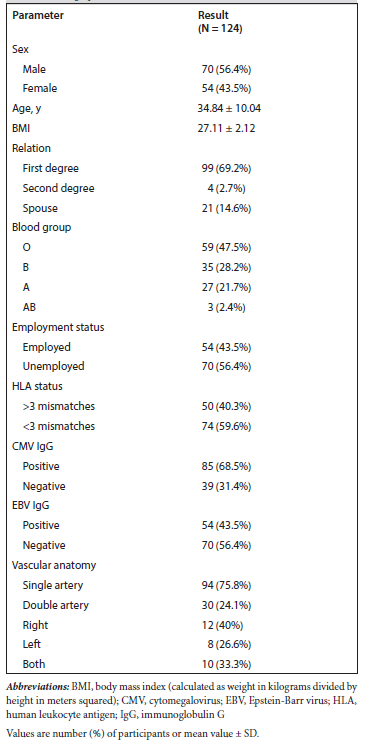
Table 1. Demographic and Clinical Data of Donors