Volume: 22 Issue: 1 January 2024 - Supplement - 1
FULL TEXT
Objectives: In Turkey, the rate of organ donations has not reached the desired level. Although the vital importance of organ transplantation is known, the low participation in organ donation is an issue that needs to be examined meticulously. Organ donation decisions can be affected by demographic factors, such as family, personality traits, and religion and by psychological factors, such as attitude, intention, and sacrifice. For this reason, it is important to find the reasons that prevent people from being a donor and to develop intervention methods for them. In this context, we aimed to evaluate the relationship between the balance of decision-making regarding organ donation and the level of empathy.
Materials and Methods: A total of 638 adults (mean age of 25.32 ± 9.95 years; n = 468 female participants and n = 170 male participants) voluntarily participated in the study. We used the Organ Donation Decisional Balance Survey to measure basic information on participants’ personal valuations on the importance of positive and negative aspects of donor decisions. We used the Empathy Quotient scale to determine the empathy level of participants. We determined the relationship between variables using Pearson correlation analysis.
Results: Organ donation balance had positive correlations with measures of cognitive empathy subscale (r = 0.115; P < .01), emotional reactivity subscale (r = 0.117; P < .01), and social skills subscale (r = 0.084; P < .05).
Conclusions: We found a positive relationship between empathy and the individual decision-making balance on donation; therefore, empathy development and altruism may affect organ donation decisions.
Key words : Altruism, Attitude, Intent, Organ donor
Introduction
Organ donation is an important treatment for those with end-stage organ failure. Although organ transplant rates from deceased donors are high in developed countries, developing countries mostly use organs from living donors.1
The option of obtaining organs from a living donor is offered as the best temporary solution to the problem of organ shortages. According to the World Health Organization, although there are more than 130 000 transplants all over the world, this number only meets 10% of the total need.2 For this reason, it is important to encourage people to donate and to increase donations after death.
Lack of knowledge, distrust in the health system, views of families, the sanctity of the body, a clear understanding of religious provisions, and the views of religious leaders can affect people’s attitudes on organ donation.3 Studies are ongoing to better understand the decision-making process regarding organ donation.4 With the consideration that attitudes and behaviors are more positive among people who have a chronic disease or need organ transplant themselves or for their families, we can state that a motivating force for organ donation in societies is to increase the level of empathy in people.5
Empathy refers to the ability to relate to another individual’s emotional state and to take an individual’s perspective in a given situation.6 In a study of nursing and paramedic students, Milaniak and colleagues reported a correlation between empathy levels and willingness to be a donor, willingness to sign a donor card, and attitudes toward organ donation.7 Soylu and colleagues reported a relationship between empathic disposition and altruism and organ transplantation.8
Although there are positive thoughts about organ donation in our society, people may not put these thoughts into practice. For this reason, we believe that it is important to address the positive and negative aspects that people have when deciding on organ donation, not only with 1 dimension of empathy, but with other dimensions, to determine the issues that should be emphasized in programs and campaigns prepared to increase the number of donors.
Although there have been studies on organ donation intention, most of these studies have been done on university students. For this reason, we suggest that studies with large samples from different populations using objective questionnaires on whether an increase in empathy level in other disciplines will strengthen the decision for organ transplantation are important. The relationship between the level of empathy and altruism of attitudes toward organ donation in Turkey has been examined, but the relationship between organ donation and decision-making balance with all dimensions of empathy such as cognitive, emotional, and social skills has not been investigated to the best of our knowledge. Therefore, we aimed to evaluate the relationship between the decision-making balance on organ donation and all subdimensions of empathy.
Materials and Methods
The analytical cross-sectional study was conducted between November 2020 and January 2021 in Ankara, Turkey. We included 638 adult volunteers (age 25.32 ± 9.95 y), which included 468 female (age 24.97 ± 9.53 y) and 170 male (age 26.14 ± 10.86 y) volunteer participants. Inclusion criteria included age ≥18 years. Individuals under the age of 18 years and those over 65 years were not included in the study. We prepared questionnaires on Google forms, which were shared online in phone applications and/or sent by e-mail. Before participants started the survey, we had participants read an explanation about the study and provide their approval for participation. Sociodemographic characteristics of the participants were questioned.
Organ Donation Decisional Balance Survey
The Organ Donation Decisional Balance Survey consists of 13 items intended to measure the basic information about a person’s personal valuation on the importance of the positive and negative aspects of donor decisions.9 Survey items ask about 6 possible advantages and 7 possible disadvantages of organ donation. Responses were on a 5-point Likert scale, ranging from 1 (“not at all important”) to 5 (“extremely important”). Decisional balance scores were created by dividing participants’ summed advantage score by their summed disadvantage score, with possible ratio scores ranging from 0.2 to 5.0. Ratio scores higher than 1 indicated a more positive decisional balance. Aytar and colleagues conducted the Turkish validity and reliability study.10
Empathy Quotient scale
The Empathy Quotient scale, developed by Lawrence and colleagues, was used to determine the empathy level of participants.11 The scale consists of positive and negative, totalling 13 items and 3 factors. Responses to items in the scale are on a 5-point Likert scale ranging from 1 (“strongly disagree”) to 5 (“strongly agree”). The subscales determined are as follows: social skills, emotional reactivity, and cognitive empathy. The summation of the total items provide the score for the empathy quotient. This scale was adapted to Turkish by Kaya and Çolako?lu.12
Statistical analyses
We analyzed the obtained data using SPSS version 21.0 (IBM SPSS Statistics for Windows). We determined mean ± standard deviation or the number and percent for the measured variables. Relationships between variables were determined with Pearson correlation analysis. A correlation coefficient of ≤35% indicated weak, 36% to 67% indicated moderate, 68% to 90% indicated high, and ≥91% indicated very high relationships.13
Results
Sociodemographic information indicated that 7.52% of the participants had high school and below education, 92.48% had greater than high school education, 24.60% were working, 75.40% were not working, 13.63% were married, and 86.37% were single (Table 1). Among participants, 14.42% had chronic diseases (Table 1).
Among participants, 78% had awareness about organ donation, 79% knew how to be an organ donor, 67% understood which organs could be donated, and 40% agreed it was right to be an organ donor.
Mean values of organ donation decisional balance survey and empathy quotient scale scores are shown in Table 2. Findings showed that social skill, emotional response, and cognitive empathy subscale scores were higher in female participants than in male participants.
Results of correlation analysis are shown in Table 3. Organ donation balance had positive correlations with measures of the cognitive empathy subscale (r = 0.115; P < .01), emotional reactivity subscale (r = 0.117; P < .01), and social skills subscale (r = 0.084; P < .05).
Discussion
In this study, we explored the relationship between the decision-making balance on organ donation and level of empathy. We found that 92% of the participants had awareness of organ donation. Our findings showed that male and female participants have a positive balance in decision-making in organ donation. In other words, it was determined that all participants had a positive view of deciding to donate organs.
George and colleagues stated that students have more positive attitudes toward organ donation than other individuals.14 Studies on organ donation attitudes tend to include students; however, we believe it is important to conduct studies with different groups.
We found that social skill, emotional reaction, and cognitive empathy scores were higher among our female participants than among our male participants. According to this result, we can say that empathy skill levels in all subscales were better and more positive among our female participants than among our male participants. Because of the high empathy levels among female participants, we can say that the decision-making balance scores for organ donation scores were higher among female than among male participants. Soylu and colleagues found that the mean empathic tendency points were higher in females than in males.8 Yee and colleagues reported that women were significantly more willing to donate their organs to family members or strangers than men and that the desire to help others was important in the decision to donate organs among women. Empathy levels among women in our study were also higher than men in our study, which is compatible with results in the literature.15
We also found that all empathy subscales were positively related to the balance of organ donation. According to this result, as the empathy levels of individuals increase, decision-making on organ donation also changes positively. Cohen and Hoffner stated that empathetic disposition has a positive effect on organ donation.16
In another study on organ transplant, young adults with a high level of empathy had a high intention to donate organs.17 Milaniak and colleagues found a significant relationship between not consenting to organ donation and empathy level. They stated that 63% of those with low level of empathy, 25% of those with moderate level of empathy, and 44% of those with high level of empathy had fear of the operation.7 Newton and colleagues stated that the altruistic motivation to help others was the most common identified motivator for becoming an organ donor.18
Attitudes and behaviors about organ donation among people who have a chronic disease or need organ transplantation in themselves or their families are more positive; thus, we can say that a motivating force for organ donation in societies is to increase the level of empathy in people.5 It is important to develop a positive attitude toward organ donation, to reduce negative attitudes, to increase the knowledge level about organ donation, and to raise public awareness on this issue.9
In Turkey, research on organ donation is generally limited to students and health care professionals. We believe that our inclusion of different groups is one of the positive aspects of this study. In addition, the large sample number and the short questionnaire on organ donation were advantages.
Limitations
Our study had a limitation: only people who are literate and lived in Ankara were included in the study.
Conclusions
There is a positive relationship between empathy and the decision-making balance of individuals on organ donation. Projects are needed aimed at increasing participation in organ donation, including establishing positive social norms through empathy and altruistic motives.
We believe that planning events and campaigns to increase organ donation can increase the empathy level of donors; training of health care personnel on organ transplant teams to increase empathy-centered attitudes will contribute to increases in organ donation.
References:
- Ozsoy B, Herrera-Gayol A, Unal Y, Askar M, Haberal M, Cantarovich M. Impact of religion on opinions about organ donation and transplantation in university students from a Single University in Turkey. Exp Clin Transplant. 2021;19(7):645-650. doi:10.6002/ect.2021.0054
CrossRef - PubMed - World Health Organization. Health topics: transplantation. 2020. Accessed May 11, 2021. http://www.who.int/topics/transplantation/en/
CrossRef - PubMed - Ali A, Ahmed T, Ayub A, et al. Organ donation and transplant: the Islamic perspective. Clin Transplant. 2020;34(4):e13832. doi:10.1111/ctr.13832
CrossRef - PubMed - Ordin YS, Söylemez BA. Effects of peer education on attitudes toward organ donation in nursing students. Transplant Proc. 2018;50(10):2971-2975. doi:10.1016/j.transproceed.2018.02.094
CrossRef - PubMed - Yakar B, Batba? CS, Önalan E, ?çaçan G, Demir M. Attitudes and related factors toward organ donation among relatives of chronic kidney disease patients and healthy individuals. Cukurova Med J. 2020;45(4):1436-1443. doi:10.17826/cumj.734337
CrossRef - PubMed - Umair S, Jo Ann H, Waqas U. Posthumous organ donation decision: the role of empathy and knowledge on the attitude and willingness to donate among university students in Pakistan. Saudi J Kidney Dis Transpl. 2021;32(6):1552-1561. doi:10.4103/1319-2442.352415
CrossRef - PubMed - Milaniak I, Wilczek-Ru?yczka E, Przyby?owski P. Role of empathy and altruism in organ donation decision making among nursing and paramedic students. Transplant Proc. 2018;50(7):1928-1932. doi:10.1016/j.transproceed.2018.02.153
CrossRef - PubMed - Soylu D, Soylu A, ?en S. Two significant concepts in organ donation: empathic tendency and altruism. Transpl Immunol. 2022;75:101731. doi:10.1016/j.trim.2022.101731
CrossRef - PubMed - Hall KL, Robbins ML, Paiva A, Knott JE, Harris L, Mattice B. Donation intentions among African American college students: decisional balance and self-efficacy measures. J Behav Med. 2007;30(6):483-495. doi:10.1007/s10865-007-9121-8
CrossRef - PubMed - Aytar A, Aytar A, Altintas A, Ayvazoglu Soy EH, Akdur A, Haberal M. Organ donation decisional balance survey: reliability and validity of the Turkish version. Exp Clin Transplant. 2020;18(Suppl 2):58-64. doi:10.6002/ect.rlgnsymp2020.L9
CrossRef - PubMed - Lawrence EJ, Shaw P, Baker D, Baron-Cohen S, David AS. Measuring empathy: reliability and validity of the Empathy Quotient. Psychol Med. 2004;34(5):911-919. doi:10.1017/s0033291703001624
CrossRef - PubMed - Kaya B, Çolako?lu Ö. Adaptation of empathy quotient (EQ) scale. ?nönü Üniversitesi E?itim Fakültesi Dergisi. 2015;16(1):17-30. doi:10.17679/iuefd.16127895
CrossRef - PubMed - Mason RD, Lind DA, Marchal WG. Statistics. An Introduction. 4th ed. Dryden Press; 1994.
CrossRef - PubMed - George P, Chittem M, Dwivedi R, et al. The empathy factor: the role of empathy in knowledge, attitude, and practice of organ donation in India - a crossectional, observational study. Indian J Transplant. 2022;16(3):274-281. doi:10.4103/ijot.ijot_64_21
CrossRef - PubMed - Yee E, Hosseini, SM, Duarte B, et al. Sex disparities in organ donation: finding an equitable donor pool. J Am Heart Assoc. 2021;10(19):e020820. doi:10.1161/JAHA.121.020820
CrossRef - PubMed - Cohen EL, Hoffner C. Gifts of giving: the role of empathy and perceived benefits to others and self in young adults’ decisions to become organ donors. J Health Psychol. 2013;18(1):128-138. doi:10.1177/1359105311433910.
CrossRef - PubMed - Demir B, Kumkale GT. Individual differences in willingness to become an organ donor: a decision tree approach to reasoned action. Pers Individ Differ. 2013;55(1):63-69. doi:10.1016/j.paid.2013.02.002
CrossRef - PubMed - Newton JD. How does the general public view posthumous organ donation? A meta-synthesis of the qualitative literature. BMC Public Health. 2011;11:791. doi:10.1186/1471-2458-11-791
CrossRef - PubMed

Volume : 22
Issue : 1
Pages : 219 - 223
DOI : 10.6002/ect.MESOT2023.P53
From the 1Vocational School of Health Sciences, the 2Department of Exercise and Sport Sciences, and the Department of General Surgery, 3Division of Transplantation, Baskent University, Ankara, Turkey
Acknowledgements: This study was supported by the Baskent University Research Fund and for the preparation of this work. The authors have no declarations potential conflicts of interest.
Corresponding author: Ayça Aytar, Physiotherapy Programme, Vocational School of Health Sciences, Baskent University Ankara, Turkey
Phone: +0312 246 66 66 - 2157
E-mail: aycaaytar@baskent.edu.tr
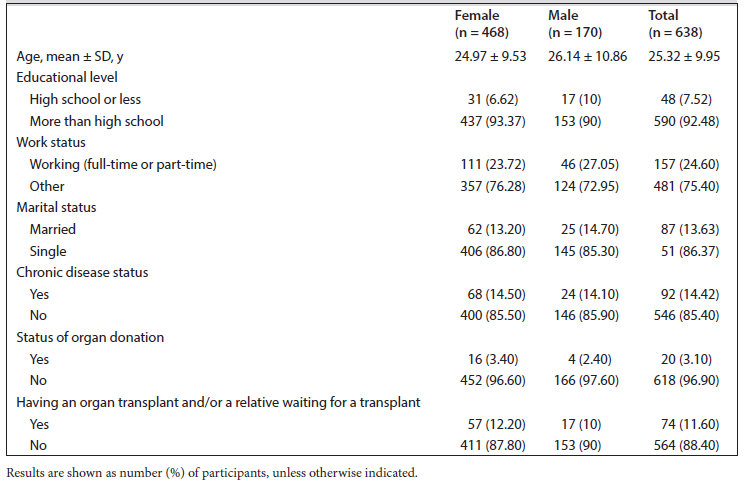
Table 1. Sociodemographic Characteristics of Participants
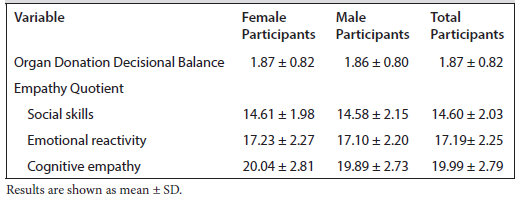
Table 2. Scores on Organ Donation Decisional Balance and Empathy Quotient
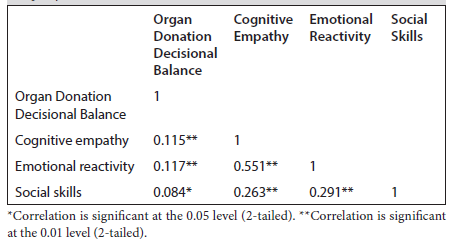
Table 3. Pearson Correlation Coefficients Between Organ Donation Decisional Balance and Measures of Social Skills, Emotional Reactivity, and Cognitive Empathy