Volume: 16 Issue: 1 March 2018 - Supplement - 1
FULL TEXT
Objectives: Organ donation is the most important stage for organ transplant. Studies reveal that attitudes of families of brain-dead patients toward donation play a significant role in their decision. We hypothesized that supporting family awareness about the meaning of organ donation, including saving lives while losing a loved one, combined with being informed about brain death and the donation process must be maintained by intensive care unit physicians through standardized interviews and questionnaires to increase the donation rate.
Materials and Methods: We retrospectively evaluated the final decisions of families of 52 brain-dead donors treated at our institution between 2014 and 2017. Data underwent descriptive analyses. The standard interview content was generated after literature search results were reviewed by the authors. Previously, we examined the impact of standardized interviews done by intensive care unit physicians with relatives of potential brain-dead donors regarding decisions to donate or reasons for refusing organ donation. After termination of that study, interviews were done according to the intensivist’s orientation, resulting in significantly decreased donation rates. Standardized interviews were then started again, resulting in increased donation rates.
Results: Of 17 families who participated in standardized interviews, 5 families (29.4%) agreed to donate organs of their brain-dead relatives. In the other group of families, intensivists governed informing the families of donation without standardized interviews. In this group of 35 families, 5 families (14.3%) approved organ donation. The decision regarding whether to agree to organ donation was statistically different between the 2 family groups (P < .05).
Conclusions: Conducting a standard interview between relatives of brain-dead donors and the intensivists, facilitating visits between relatives and the brain-dead patients, and informing relatives about the donation process resulted in an increased rate of organ donation compared with routine protocols.
Key words : Attitudes and beliefs, Family discussion, Intensive care physician, Potential brain-dead donor
Introduction
Transplant is the therapy of choice for end-stage organ failure. Better results due to improvements in surgical techniques and pharmacologic and immunologic approaches have enabled improved patient survival. Unfortunately, the increase in the number of patients on transplant wait lists is not met by the number of organ donations.
In developed countries, transplant procedures are done mostly from deceased donors, whereas in our country it is the opposite. According to the International Registry on Organ Donation and Transplantation in 2015, Turkey showed the highest rate of living organ donation in the world, ie, 45.4 donors per million population (pmp), with only 6.3 donors pmp for actual deceased organ recovery.1 After creation of a system for organ donation (“Organizacion Nacional de Trasplantes”) and its promotion, Spain has become the world leader in deceased organ donations with 40 donors pmp. Matesanz and associates concluded that, by a healthcare system making adaptations according to recommendations of organ donation organizations and using these novel strategies to deal with the challenges in organ donation, organ donation and transplant rates can be increased.2
In our previous study, we investigated how intensivists affect the decision-making process during interviews with family members of potential donors and the reasons for not giving consent to donate.3 After the termination of that study, the rate of donation declined significantly. We subsequently restarted the standardized interviews again, which eventually increased the donation rate. In this current study, we compared the time periods and analyzed the best method to enhance organ donation approval.
Materials and Methods
In this retrospective study, the final decisions of families of brain-dead donors who were treated at the Marmara University Pendik Training and Research Hospital Intensive Care Units between May 2014 and March 2017 were evaluated. The study was conducted after authorization from the institution and approval by the Ethics in Clinical Research Committee of Marmara University School of Medicine (09.2017.308).
In our previous study, we examined the impact of standardized interviews done by intensivists with relatives of brain-dead potential donors regarding the decision to donate or the reason to refuse organ donation.3 After termination of that study, interviews with families were done according to the individual intensivist. During this 18-month period, donation rates declined significantly. After that, standardized interviews were again started, resulting in increased donation rates. We divided the families into 2 groups: group S represented the group who received standardized interviews and group NS represented those who received information from the intensivists without direction.
A standard interview content (which included a potential donor questionnaire, family notification, brain death criteria fulfilment, and organ donation conversation questionnaires) was generated in the previous study after literature results were reviewed by the authors3 (Table 1). The questionnaires were used by intensivists during the interviews with families of the potential donors. Data had undergone descriptive analyses.
Results
The families of 52 intubated potential organ donor patients were included in the study. Of 17 families who received the standardized interview, 5 families (29.4%) agreed to donate organs of their brain-dead relatives. In this group (group S), families of relatives with Glasgow coma scale < 5 were approached and interviewed 3 times daily. The first interviews, which were done after brain death diagnosis, lasted 16.1 ± 6 minutes (range, 10-30 min); second interviews were done with the hesitant families and lasted 10 ± 4 minutes (range, 5-15 min). During this period, families were able to see their relatives 2 to 5 times per day.
In the second group (group NS), the intensivists governed informing the families and interviews were not standardized. During this period, families were approached and interviewed once or twice per day and could see their relatives once per day. The approximate interview duration was 10 to 15 minutes. Of 35 families in the NS group, 5 families (14.3%) approved organ donation.
The decision regarding whether to donate was significantly different between the groups (P < .05; Figure 1).
Discussion
To raise the rate of donations from deceased donors, early detection and diagnosis of brain death should be done. Donations after brain death and after cardiac death are the sources of deceased donations. Campaigns to raise awareness of the importance of donation and to encourage people to donate should be implemented. Awareness about donation is especially important as is early diagnosis of brain death.
Similar to the Spanish model, in Turkey, intensivists are responsible for disseminating information as they are the doctors in charge of potential donors.2 Intensivists diagnose brain death, inform the relatives about the situation, prepare families for the expected course during the donation process, and inform the organ donation coordinator. Because intensivists have a prominent role in the process, they are trained about donation, transplant, death, and mourning. All health personnel are trained on communication techniques, how to give bad news, how to approach minorities, and how to work within cultural differences. The decision to donate might be influenced by the attending doctor’s approach and the doctor’s communication skills, confidence, and knowledge; therefore, simulation-based communication training sessions may be helpful and should be included in clinician education programs.4
Organ donation coordinators are the ones that ask for the family’s permission of donation after a diagnosis of brain death is made. Having the coordinators involved early in the process is beneficial for families and their understanding of the donation process, which can lead to increased donation rates; therefore, early diagnosis is essential.5
Donation rates are different between regions and hospitals and even within hospitals during different time phases. The reasons for these differences should be understood as they could allow improvements in donation rates.
In our current practice, even if the person who has died has provided consent for donation, we seek consent from the next of kin before proceeding with organ retrieval. In Turkey, we do not have a standard protocol or path for discussing donation with families and obtaining consent; the process differs depending on the circumstances.
The attitude of families toward donation plays an important role; therefore, to increase the donation rate, we must know which families are more likely to give consent. Families of young, white, male donors who have died from trauma are more likely to give consent for donation.6 In Australia among the non-English-speaking families, the rate of consent is low (12.5%).7 It is important that good communication (verbal and nonverbal) is established between intensivists and families.
Intensivists should be aware of the religious and cultural background of the donors and their families. Because the interviews done with families play a significant role in decisions to donate, differences in religious and cultural background should be considered. Culture models the perception of health and illness and the behavior and beliefs of people; therefore, giving information and bad news should be tailored according to the individual.8
Environmental variables within hospitals, intensivists’ sociodemographic characteristics, and their attitudes toward organ donation do not affect consent rates; however, their comfort level in answering questions from families about donation has been shown to be significantly associated with organ donation.6 When information is given by the same intensivist who has detailed knowledge about the intensive care unit course of the patient, a bond with relatives could develop.
In a study of factors influencing consent of families for transplant, 55% of the families had made their decision on the first interview, with 56.7% in favor of donation, 25.5% not in favor of donation, and 16.9% undecided.6 In our group S, 23.5% of the families had agreed to donation on the first interview, 23.5% (4 families) were undecided, and 1 family gave consent after the second interview.
The frequency of talking frankly about the patient’s condition and providing information is important. The donation rate was low when families were surprised to be asked about donation; having frequent interviews that are started before the donation request are associated with favorable outcomes.6 In the standardized interview that we conducted, the frequency and duration of the interviews done with the families were recorded as they are extremely important; interviews should be done frequently and thoroughly to explain the condition of their relative, and unlimited visits with their relative should be allowed if the intensive care unit conditions are appropriate. We recommend that a first interview should be done when the Glasgow coma scale is < 5. Interactions with families of potential donors should be done properly, not only to ask for consent but also to allow families to accept the imminent loss of their loved ones.
The place and timing of providing information to families are also important. A location where relatives can express their feelings and thoughts freely is optimal. Interviews must not be done in the doctors’ or nurses’ rooms but rather in designated areas. Information must be given frankly without using medical terms and should be provided in a nonemotional manner. Although the truth must not be hidden, discussing brain death should not be presented abruptly; as with other terminally ill patients, it should be done gradually step by step.9 When brain death is considered, relatives must be informed before tests are initiated. This will give time for relatives to accept the idea of losing someone who they love. The declaration of brain death should be done by the same intensivist who is in charge of the patient, and then the organ donation coordinator must be introduced to the relatives.
Conclusions
Intensivists who followed a standardized information interview combined with allowing relatives to have frequent visits with the potential brain-dead donor led to improved donation rates in our institution.
References:
- The International Registry on Organ Donation and Transplantation Website. 2015 Report. www.irodat.org. Accessed November 26, 2017.
- Matesanz R, Domínguez-Gil B, Coll E, Mahíllo B, Marazuela R. How Spain reached 40 deceased organ donors per million population. Am J Transplant. 2017;17(6):1447-1454.
CrossRef - PubMed - Birtan B, Arslantas MK, Dincer PC, et al. Effect of interviews done by intensive care physicians on organ donation. Transplant Proc. 2017;49(3):396-398.
CrossRef - PubMed - Potter JE, Gatward JJ, Kelly MA, et al. Simulation-based communication skills training for experienced clinicians to improve family conversations about organ and tissue donation. Prog Transplant. 2017;27(4):339-345.
CrossRef - PubMed - Garside J, Garside M, Fletcher S, Finlayson B. Utilisation of an embedded specialist nurse and collaborative care pathway increases potential organ donor referrals in the emergency department. Emerg Med J. 2012;29(3):228-232.
CrossRef - PubMed - Siminoff LA, Gordon N, Hewlett J, Arnold RM. Factors influencing families' consent for donation of solid organs for transplantation. JAMA. 2001;286(1):71-77.
CrossRef - PubMed - Marck CH, Neate SL, Skinner MR, et al. Factors relating to consent for organ donation: prospective data on potential organ donors. Intern Med J. 2015;45(1):40-47.
CrossRef - PubMed - Girlanda R. Deceased organ donation for transplantation: Challenges and opportunities. World J Transplant. 2016;6(3):451–459.
CrossRef - PubMed - Deschepper R, Bernheim JL, Vander Stichele R, et al. Truth-telling at the end of life: a pilot study on the perspective of patients and professional caregivers. Patient Educ Couns. 2008;71(1):52-56.
CrossRef - PubMed
Volume : 16
Issue : 1
Pages : 51 - 54
DOI : 10.6002/ect.TOND-TDTD2017.O21
From the 1Anaesthesiology and Reanimation Department, Marmara University School of Medicine; the 2Transplantation Coordination Unit, Marmara University Pendik Training and Research Hospital; and the 3Anaesthesiology and Reanimation Department, Marmara University Pendik Training and Research Hospital, Istanbul, Turkey
Acknowledgements: The authors have no sources of funding for this study and have no conflicts of interest to declare.
Corresponding author: Pelin Corman Dincer, Marmara University, Marmara University Pendik Training and Research Hospital, Fevzi Cakmak Mah, Muhsin Yazicioglu Cad. No: 10 Ust Kaynarca, 34899 Pendik, Istanbul, Turkey
Phone: +90 216 6254659
E-mail: pelincorman@yahoo.com
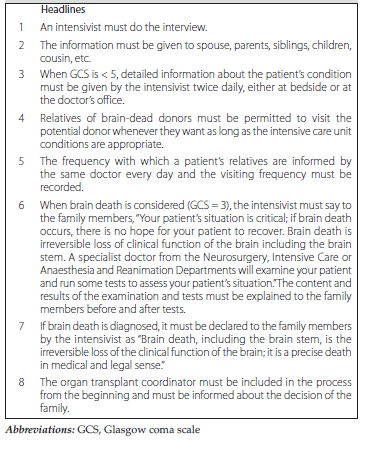
Table 1. The Standardized Interview
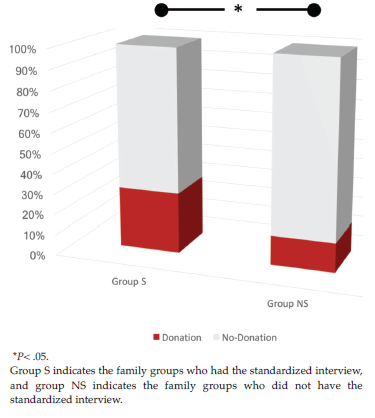
Figure 1. Donation and Nondonation Rates of the Family Groups