Volume: 12 Issue: 1 March 2014 - Supplement - 1
FULL TEXT
There has been a large gap between the number of patients awaiting liver transplants and those receiving them. In the East, living-donor liver transplant has become the major source of grafts, whereas in the West, deceased-donor grafts have been the major source for liver transplants. Some newly developed or developing donor types are discussed.
Key words : Donor pool, Extended criteria donors, Donation after cardiac death, HIV donors, Facebook phenomenon
Introduction
For the last 20 years, orthotopic liver transplant has become a therapy for treating end-stage liver diseases. The demand for liver transplant has increased rapidly, creating a large gap between the number of patients awaiting liver transplants and those receiving them. In Eastern countries, living-donor liver transplant has become the sole source of grafts, but in Western countries, deceased-donor grafts have been the only source for liver transplant. In April 2013, the United Network of Organ Sharing reported that 15 854 patients were awaiting liver transplant in the United States. In 2012, there were 6256 liver transplants performed in the United States including 6010 deceased-donor and 246 living-donor liver transplants (Figure 1). From 2000 to 2005, the number of living-donor liver transplants performed in United States decreased because of 3 reported donor deaths and donor risk 0.5%.
The alternatives introduced into the regular practice of liver transplants
include:
Extended criteria donors: These are donors who have donor age > 55 years,
donor hospital stay > 5 days, cold ischemia time > 10 hours, and warm ischemia >
40 minutes. The use of allografts from extended criteria donors to appropriate
recipients has been used for acceptable transplant outcomes, as an alternative
to higher waitlist mortality. An extended criteria donor score ≤ 2 is associated
with acceptable outcomes.1-5
Donation after cardiac death: These donors have been known previously as non–heart-beating donors. Care in the operating room is withdrawn after adequate consent is obtained from the family. Donation after cardiac death differs from donation from brain death donors. With donation after cardiac death, 5 minutes must pass after extubation from the respirator before death can be declared. Warm ischemia time until removal of the organs should be ≤ 20 minutes for best results. Graft survival is lower when the warm ischemia time is > the allotted time. The frequency of biliary complications is 35% in this group.6 Hepatic artery thrombosis also is more frequent in this group. A careful match between the donor and the recipient is critical for this operation.
Advanced donor age: Advanced age significantly decreases patient and graft survival in recipients with hepatitis C virus infection. If the allograft is suitable, advanced age donation may be appropriate in matched recipients. It is recommended that recipients who have hepatitis C virus infection are matched to an organ from a donor aged < 55 years.
ABO incompatibility: These grafts are not recommended except in emergency situations for pediatric recipients. Grafts from donors having blood type A2 can be given to type O recipients.
Steatosis: Donors who have low or moderate steatosis can be considered for donor grafts, and donor liver biopsies are encouraged.
Anti-hepatitis B core antigen-positive donors: These donors can be accepted for recipients who have not been exposed to hepatitis B and who receive hepatitis B immune globulin and antiviral prophylaxis.7
Malignancy: Organs should not be used from people who have a history of malignancy outside of the central nervous system, but organs from people with previous central nervous system tumors may be acceptable.8
Hepatitis C virus-positive donors: Allografts from hepatitis C virus-positive donors can be accepted for hepatitis C virus-positive recipients. Survival is comparable with the use of hepatitis C virus-negative allografts. Currently, determining donor genotype is not done in routine practice.
Human immunodeficiency virus (HIV): There is new literature that suggests that organs from HIV-positive donors can be accepted for HIV-positive recipients.9 In 2013, President Obama signed the law for HIV donations to be used for HIV-positive recipients.
Infections: Increased screening in endemic areas is important, and donor cause of death should be identified before organ procurement. West Nile virus and Rabies virus are important central nervous system viral infections that should be identified in the donor.
Split liver transplant: Splitting is associated with technical challenges, and not all allografts are appropriate for splitting. Success is much greater in specialized centers with appropriate recipient match.10 Biliary complications may be associated with certain preservation solutions, especially among DCD donations.11
Facebook phenomenon: Since May 1, 2012, Facebook users have been able to share their organ donor status with friends, family, and the public, similar to the way they share other information. The information is part of the Web site’s new Timeline feature that asks users to share stories and photographs. Since launching this feature, the results of the Facebook organ donation initiative have been phenomenal. The number of registered donors in the United States increased 1183% in the first week, and donor registration remained increased 1 month later.12
References:
- Cameron AM, Ghobrial RM, Yersiz H, et al. Optimal utilization of donor
grafts with extended criteria: a single-center experience in over 1000 liver
transplants. Ann Surg. 2006;243(6):748-753.
CrossRef - PubMed - Barshes NR, Horwitz IB, Franzini L, Vierling JM, Goss JA. Waitlist
mortality decreases with increased use of extended criteria donor liver
grafts at adult liver transplant centers. Am J Transplant.
2007;7(5):1265-1270.
CrossRef - PubMed - Nickkholgh A, Weitz J, Encke J, et al. Utilization of extended donor
criteria in liver transplantation: a comprehensive review of the literature.
Nephrol Dial Transplant. 2007;22(suppl 8):viii29-viii36.
PubMed - Sutaria R, Adams DH. Efforts to expand the donor pool for liver
transplantation. F1000 Med Rep. 2010;2:42.
PubMed - Gordon Burroughs S, Busuttil RW. Optimal utilization of extended hepatic
grafts. Surg Today. 2009;39(9):746-751.
CrossRef - PubMed - Stewart ZA, Cameron AM, Singer AL, Montgomery RA, Segev DL.
Histidine-Tryptophan-Ketoglutarate (HTK) is associated with reduced graft
survival in deceased donor livers, especially those donated after cardiac
death. Am J Transplant. 2009;9(2):286-293.
CrossRef - PubMed - Malik MU, Abdi T, Woreta T, et al. Prophylaxis among HBcAb positive liver transplant recipients: HBIG plus oral antivirals versus antivirals alone. Poster presented at: American Association for the Study of Liver Diseases Single Topic Meeting; March 21-22, 2013; Arlington, VA.
- Kim B, Woreta T, Chen PH, et al. Donor-transmitted malignancy in a liver
transplant recipient: a case report and review of literature. Dig Dis Sci.
2013;58(5):1185-1190.
CrossRef - PubMed - Boyarsky BJ, Hall EC, Singer AL, Montgomery RA, Gebo KA, Segev DL.
Estimating the potential pool of HIV-infected deceased organ donors in the
United States. Am J Transplant. 2011;11(6):1209-1217.
CrossRef - PubMed - Hong JC, Yersiz H, Busuttil RW. Where are we today in split liver
transplantation? Curr Opin Organ Transplant. 2011;16(3):269-273.
CrossRef - PubMed - Gulsen MT, Girotra M, Cengiz-Seval G, et al. HTK preservative solution
is associated with increased biliary complications among patients receiving
DCD liver transplants: a single center experience. Ann Transplant.
2013:18:69-75..
CrossRef - PubMed - Cameron AM, Massie AB, Alexander CE, et al. Social media and organ donor
registration: the Facebook effect. Am J Transplant. 2013;13(8):2059-2065.
CrossRef - PubMed

Volume : 12
Issue : 1
Pages : 70 - 71
DOI : 10.6002/ect.25Liver.L61
From the Department of 1Transplant Hepatology and 2Transplant
Surgery, Johns Hopkins Liver Transplantation Program, Baltimore, MD, USA
Acknowledgements: The authors have no conflicts of interest to disclose,
and there was no funding for this study.
Corresponding author: Ahmet Gurakar, MD, Transplant Hepatology, Division
of Gastroenterology and Hepatology, Johns Hopkins University School of Medicine,
720 Rutland Avenue, Ross Research Building, No. 918, Baltimore, MD 21205, USA
Phone: +1 410 614 5389
Fax: +1 410 614 9612
E-mail: Aguraka1@jhmi.edu
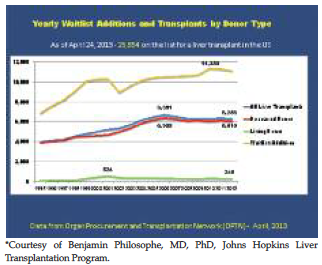
Figure 1. Liver Transplant Waitlist and Procedures in the United States*