Volume: 8 Issue: 4 December 2010
FULL TEXT
Extracorporeal Membrane Oxygenation Bridging to Lung Transplant Complicated by Heparin-Induced Thrombocytopenia
In patients with acute respiratory failure and life-threatening impairment of pulmonary gas exchange, venovenous extracorporeal membrane oxygenation offers further therapeutic options. During extracorporeal membrane oxygenation treatment, systemic anticoagulation is usually achieved by heparin administration, which exposes patients to the risk of heparin-induced thrombocytopenia type II. We present a patient with acute respiratory distress syndrome on venovenous extracorporeal membrane oxygenation who experienced heparin-induced thrombocytopenia type II and in whom anticoagulation was continued with argatroban. Because respiratory failure did not resolve, the patient was bridged to lung transplant with extracorporeal membrane oxygenation. Argatroban anticoagulation was safely used until lung transplant (on day 114 after extracorporeal membrane oxygenation initiation) and after transplant in the presence of hepatic failure.
Key words : Argatroban, Acute respiratory distress syndrome, Lung assist, Anticoagulation, Complications
Background
In acute respiratory distress syndrome (ARDS), persistent respiratory failure secondary to progressive alveolar fibrosis is associated with a poor prognosis (1). Currently, extracorporeal membrane oxygenation (ECMO) as a bridge to lung transplant may be the only remaining therapeutic option left in isolated, irreversible respiratory failure (2). Exposing blood to the ECMO system’s artificial surface activates the coagulation system and increases the risk of thromboembolic events. Thus, effective anticoagulation is mandatory and is usually achieved by administering unfractionated heparin. However, anticoagulation with heparin leads to risk of developing heparin-induced thrombocytopenia type II (HIT II), which is associated with a mortality of 16% when thrombosis develops (3). A drop in platelet count of more than 50% within days 5 to 15 after heparin initiation is considered highly suggestive for HIT II. Laboratory tests for HIT II include functional tests or antigen assays. If HIT II is suspected, immediate termination of heparin administration and initiation of an alternative anticoagulation strategy are essential (4). Limited experience with alternative anticoagulants on ECMO includes danaparoid (5), lepirudin (6, 7), and argatroban (8, 9), and reported treatment periods are fewer than 12 days (8). We report the case of a patient with unresolving ARDS who developed HIT II on venovenous ECMO. He was subsequently anticoagulated with argatroban and bridged to bilateral lung transplant after 114 days.
Case Report
A 40-year-old man with ARDS due to herpes simplex (HSV) pneumonitis was admitted to our intensive care unit on day 2 of mechanical ventilation with a 14-day history of cough and malaise. His leukocyte count was 11 × 109/L, and C-reactive protein was 89 mg/L. Liver function indices were normal. Ventilator settings on admission were pressure control mode, peak inspiratory pressure (Pinsp), 42 cm H2O; positive end-expiratory pressure (PEEP), 12 cm H2O; respiratory rate (RR), 35 breaths/minute; tidal volume (VT), 440 mL (6.3 mL/kg). Arterial blood gases on FiO2, 1.0; pH, 7.36; PaCO2, 8.5 kPa; PaO2, 8.9 kPa. Because lung function did not improve, the patient was placed on venovenous ECMO (Medtronic Bio-Medicus 540 Bio-Console, Medtronic, Inc., Minneapolis, MN, USA; and Jostra QUADROX D oxygenator, Maquet-Cardiopulmonary-AG, Hirrlingen, Germany). Thereafter, ventilator support was reduced to protective settings (Pinsp, 32 cm H2O; PEEP, 16 cm H2O; RR, 8 breaths/minute; and VT, 350 mL [5 mL/kg]). Heparin was titrated to an activated partial thromboplastin time (aPTT) of 45-60 seconds.
After 19 days on heparin therapy, the platelet count decreased from > 100 × 109/L to 60 × 109/L over 24 hours. Under the clinical suspicion of HIT II, heparin was stopped and argatroban started at a rate of 0.35 µg/kg/minute (course of platelet count, aPTT, bilirubin, and argatroban dosing are given in the Figure). As with heparin, argatroban was titrated to an aPTT of 45-60 sec. A heparin PF4 (HPF4) ELISA (GTI-HAT, Diagast Laboratories, Jülich, Germany) test was positive for HIT antibodies. Within 4 days after heparin withdrawal, the platelet count recovered to 121 × 109/L. After 37 days of acyclovir and broad-spectrum antibiotic treatment on ECMO, with lung protective ventilation including a 21-day prednisolone treatment course (initial dosage: 1 mg/kg/d), open lung biopsy revealed diffuse alveolar damage with alveolar fibrosis, indicating irreversible lung failure (negative immunohistochemistry for HSV antigen). With isolated lung failure, the patient was listed for a high urgency lung transplant. Mean daily transfusion requirements were 0.7 units of packed red blood cells (PRBCs) during the first 19 days on heparin and 0.44 units of PRBCs on argatroban anticoagulation until transplant. Clinical findings throughout did not suggest thromboembolic events.
After 114 days on ECMO, the patient underwent a bilateral lung transplant with argatroban stopped 2 hours preoperatively. Because HPF4 antibodies where not detectable in the imminent pretransplant period the patient was heparin anticoagulated for cardiopulmonary bypass. Venovenous ECMO had to be reinstalled postoperatively owing to primary graft failure, and definite chest closure was delayed until 5 days after surgery. Severe bleeding requiring massive transfusion and multiple reoperations complicated the early postoperative course. No anticoagulants were given until 4 days after surgery when argatroban was restarted. The course was further complicated by persistent graft failure and invasive pulmonary aspergillosis, with an ongoing need for ECMO. The transfusion requirement after resuming argatroban anticoagulation at a reduced rate of 0.02 µg/kg/min in the presence of hepatic failure was 0.6 units of PRBCs per day. Results of postoperative testing for HPF4 antibodies on day 6 after heparin re-exposure were negative. Eventually, the patient died 17 days after surgery from persistent multiple organ failure.
Discussion
The diagnosis of HIT II in patients treated with extracorporeal devices remains a challenge because thrombocytopenia is common in patients on ECMO, and HIT II might be present despite negative testing (8, 10). On the other hand, positive testing for HPF4 antibodies is found in 88% of patients with ventricular assist devices (VADs), and HIT II has been diagnosed in 3 of 9 ARDS patients on ECMO in another series (8, 11). Given the effect on mortality, awareness for the occurrence of HIT II is necessary in these patients. Because of its pharmacokinetics and metabolism, argatroban, a direct thrombin inhibitor, was chosen as an anticoagulant for our patient. Argatroban is metabolized by the liver, and its half-life is approximately 45 minutes in patients with normal liver functioning (12). It has been used successfully for anticoagulation in adult patients with HIT II on ECMO and can be monitored by the use of aPTT (target range, 1.5 to 3 times baseline aPTT) (8, 9). Use of lepirudin or danaparoid during ECMO also has been suggested (5, 6, 7). However, in the presence of renal dysfunction, the half-life of both substances is extended from hours to days, which exposes patients to additional bleeding risks (4). This is even more important if major surgery is impending. In critically ill patients, argatroban requirements are generally much lower than the manufacturer’s recommended initial dose of 2 µg/kg/min. A 10-fold decreased initial dose is recommended for these patients (13). Therefore, argatroban was started with 0.35 µg/kg/min, and adjusted dosing varies from 0.25 to 1.63 µg/kg/min before transplant to maintain an aPTT within 45-60 seconds. Although approval for argatroban treatment is limited to 14 days, switching to oral anticoagulation with vitamin K antagonists was omitted in our patient for several reasons: Continued ECMO dependency with sustained bleeding risk; forthcoming lung transplant; and reports of safe, extended use in critically ill patients up to 63 days (14).
Despite severe liver failure after transplant, argatroban anticoagulation was manageable but required a nearly 100-fold dosage reduction (mean aPTT, 48 ± 9 sec; mean argatroban dosing, 0.02 µg/kg/min). This is in contrast to a nearly 10-fold higher dosage (0.15 µg/kg/min) reported in patients on ECMO with hepatic dysfunction (8). Differences in targeted degree of anticoagulation (mean aPTT, 65 ± 14 sec) and liver function (bilirubin, 39.3 ± 51.3 µmol/L) when compared with our patient (aPTT, 48 ± 9 sec; bilirubin, 302.6 ± 56.4 µmol/L) could explain this. Furthermore, our reported daily PRBC requirement of 0.4 to 0.7 units is comparable to a recently reported demand of 0.8 units per day (15). A significant effect of argatroban anticoagulation on perioperative bleeding complications seems unlikely because prothrombin time (concomitantly prolonged during effective argatroban anticoagulation) was within the normal range immediately after surgery. Furthermore, distinct bleeding sources were identifiable during reoperations, and bleeding subsided after surgical bleeding control. The decrease in platelet count directly after transplant is unlikely to be related to heparin re-exposure during surgery, because major blood loss during surgery and consecutive RBC and FFP transfusion resulted in dilutional thrombocytopenia. Furthermore, 6 days after surgery, no HPF4 antibodies were detectable.
There may be concerns about the continued use of a heparin-coated ECMO system in our patient; especially because heparin-coated circuit components (oxygenator and pump head) had to be exchanged repeatedly. However, in patients with VADs who developed HIT II, no differences in prevalence or persistence of HPF4 antibodies or thromboembolic events where found between heparin-coated VADs and noncoated VADs after discontinuing heparin (16). Our findings support this because HPF4 antibodies disappeared in our patient and the platelet count remained stable.
This report demonstrates that anticoagulation with argatroban in a patient with HIT II on ECMO support was accomplishable over a extended period of 95 days without significant bleeding events, allows a bridge to lung transplant, and was safe even in the presence of hepatic failure.
References:
- Meduri GU, Headley AS, Golden E, Carson SJ, Umberger RA, Kelso T, et al. Effect of prolonged methylprednisolone therapy in unresolving acute respiratory distress syndrome: a randomized controlled trial. JAMA. 1998;280(2):159-165.
- Jackson A, Cropper J, Pye R, Junius F, Malouf M, Glanville A. Use of extracorporeal membrane oxygenation as a bridge to primary lung transplant: 3 consecutive, successful cases and a review of the literature. J Heart Lung Transplant. 2008;27(3):348-352.
- Nand S, Wong W, Yuen B, Yetter A, Schmulbach E, Gross Fisher S. Heparin-induced thrombocytopenia with thrombosis: incidence, analysis of risk factors, and clinical outcomes in 108 consecutive patients treated at a single institution. Am J Hematol. 1997;56(1):12-16. Erratum in: Am J Hematol. 1998;58(3):253.
- Keeling D, Davidson S, Watson H; Haemostasis and Thrombosis Task Force of the British Committee for Standards in Haematology. The management of heparin-induced thrombocytopenia. Br J Haematol. 2006;133(3):259-269. Erratum in: Br J Haematol. 2006;134(3):351.
- Bauer C, Vichova Z, Ffrench P, Hercule C, Jegaden O, Bastien O, et al. Extracorporeal membrane oxygenation with danaparoid sodium after massive pulmonary embolism. Anesth Analg. 2008;106(4):1101-1103.
- Balasubramanian SK, Tiruvoipati R, Chatterjee S, Sosnowski A, Firmin RK. Extracorporeal membrane oxygenation with lepirudin anticoagulation for Wegener's granulomatosis with heparin-induced thrombocytopenia. ASAIO J. 2005;51(4):477-479.
- Dager WE, Gosselin RC, Yoshikawa R, Owings JT. Lepirudin in heparin-induced thrombocytopenia and extracorporeal membranous oxygenation. Ann Pharmacother. 2004;38(4):598-601.
- Beiderlinden M, Treschan T, Görlinger K, Peters J. Argatroban in extracorporeal membrane oxygenation. Artif Organs. 2007;31(6):461-465.
- Cornell T, Wyrick P, Fleming G, Pasko D, Han Y, Custer J, et al. A case series describing the use of argatroban in patients on extracorporeal circulation. ASAIO J. 2007;53(4):460-463.
- Chan M, Malynn E, Shaz B, Uhl L. Utility of consecutive repeat HIT ELISA testing for heparin-induced trombocytopenia. Am C Hematol.2008;83:212-217.
- Koster A, Sänger S, Hansen R, Sodian R, Mertzlufft F, Harke C, et al. Prevalence and persistence of heparin/platelet factor 4 antibodies in patients with heparin coated and noncoated ventricular assist devices. ASAIO J. 2000;46(3):319-322.
- Swan SK, Hursting MJ. The pharmacokinetics and pharmacodynamics of argatroban: effects of age, gender, and hepatic or renal dysfunction. Pharmacotherapy. 2000;20(3):318-329.
- Beiderlinden M, Treschan TA, Görlinger K, Peters J. Argatroban anticoagulation in critically ill patients. Ann Pharmacother. 2007;41(5):749-754. Erratum in: Ann Pharmacother. 2007;41(7):1320.
- Heil S. Heparin-induced thrombocytopenia type II with thrombosis in an intensive care patient: therapy management using the direct thrombin inhibitor argatroban [in German]. Anaesthesist. 2009;58(11):1119-1122.
- Müller T, Philipp A, Luchner A, Karagiannidis C, Bein T, Hilker M, et al. A new miniaturized system for extracorporeal membrane oxygenation in adult respiratory failure. Crit Care. 2009;13(6):R205.
- Koster A, Loebe M, Sodian R, Potapov EV, Hansen R, Müller J, et al. Heparin antibodies and thromboembolism in heparin-coated and noncoated ventricular assist devices. J Thorac Cardiovasc Surg. 2001;121(2):331-335.
Volume : 8
Issue : 4
Pages : 329 - 332
From the Departments of 1Anesthesiology, 2Surgery,
3Cardiac Surgery, and 4Internal Medicine of the University Hospital Grosshadern, Ludwig-Maximilians-University,
81377 Munich, Germany
Funding was provided solely from institutional and/or departmental sources.
Address reprint requests to: Michael E. Dolch, MD, Department of Anesthesiology,
University Hospital Grosshadern, Marchioninistr. 15, 81377 Munich, Germany,
Ludwig-Maximilians-University
Phone: +49 89 7095 2723
Fax: +49 89 7095 5720
E-mail:
Michael.Dolch@med.uni-muenchen.de
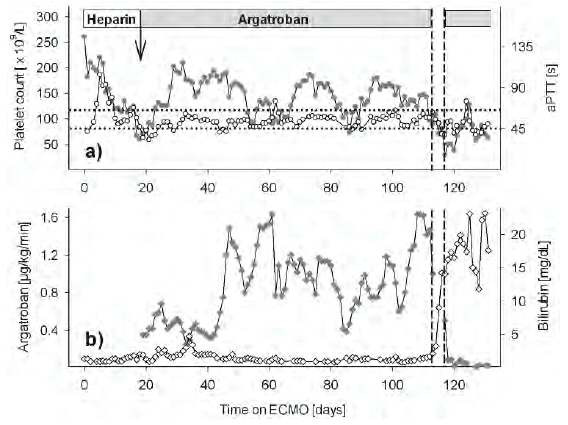
Figure 1. a) Course of platelet count (grey circles) and aPTT (open circles); b) Changes in argatroban dosing (grey diamonds) and bilirubin levels (open diamonds). Vertical dashed lines: perioperative halted argatroban anticoagulation. Horizontal dotted lines: aPTT range of 45-60 s.