Volume: 23 Issue: 12 December 2025
FULL TEXT
Abstract
Objectives: Kidneys classified to be so-called tumor-bearing kidneys as potential donor kidneys typically involve small (<4 cm), low-grade renal tumors resected ex vivo. Kidney transplant remains the definitive treatment for end-stage renal disease, yet organ shortages persist worldwide. The use of kidneys with small, resectable renal tumors has been proposed as a strategy to expand the donor pool.
Materials and Methods: A national online survey was conducted from November to December 2019, targeting urologists, nephrologists, and transplant surgeons based in the United Kingdom. The aim was to assess clinician perspectives on the use of tumor-bearing kidneys as potential donor kidneys in selected patients with end-stage renal disease.
Results: Of 230 clinicians approached, 108 responded (47%). Support for the use of tumor-bearing kidneys as potential donor kidneys was highest among transplant surgeons (100%), followed by urologists (71%) and nephrologists (54%).
Conclusions: The findings demonstrate broad support among United Kingdom clinicians for the selective use of tumor-bearing kidneys as potential donor kidneys. Despite ethical and logistical concerns, this consensus may justify the initiation of formal trials and the development of centralized protocols to increase organ availability.
Key words : Marginal donors, National survey, Organ shortage, Renal transplantation, Renal tumors
Introduction
Renal transplant is the gold standard treatment for patients with end-stage renal disease (ESRD). However, the persistent shortage of donor organs remains a major challenge. According to the United Kingdom (UK) National Health Service Blood and Transplant 2015/2016 report, over 5000 adults were on the kidney transplant wait list, but only 2945 transplants were performed. The median wait time was 905 days for patients registered between April 2010 and March 2013.1,2
To address this shortage, extended criteria donor strategies have been adopted. Simultaneously, data from the British Association of Urological Surgeons showed that more than 7000 nephrectomies were performed in 2014, including 2900 for stage T1 renal cancers. These early-stage tumors often qualify for nephron-sparing surgery or potential donation following tumor excision.3
The use of kidneys containing small renal tumors (ie, tumor-bearing kidneys as potential donor kidneys [TAPER kidneys]), after ex vivo tumor resection, has emerged as a viable option to expand the donor pool for select high-risk patients with ESRD. Previous work has documented favorable outcomes with low recurrence rates.4
In this study, we used a national survey to explore the clinical, ethical, and logistical views of UK clinicians on the use of TAPER kidneys.
Materials and Methods
A retrospective, cross-sectional online survey was conducted from November to December 2019. The survey was distributed to UK-based urologists (with a focus on renal surgery), transplant surgeons, and nephrologists.
Participants were asked about their willingness to support the use of TAPER kidneys for patients with ESRD, particularly those who are elderly, difficult to match, or experiencing dialysis-related complications. Data collected included respondent specialty, support for TAPER kidney use, and perspectives on relevant clinical scenarios.
Ethical approval was not obtained, as the study collected only anonymous clinician responses and no patient-level data.
Results
A total of 230 clinicians were contacted (110 urologists, 70 nephrologists, and 50 transplant surgeons). Res-ponse rates were 52% for urologists (58/110), 46% for nephrologists (32/70), and 36% for transplant sur-geons (18/50). This response rate may introduce selection bias; however, the respondents were drawn from diverse regions and hospital types across the UK, supporting the representativeness of their perspectives. Table 1 shows a comparative analysis by specialty to highlight variation in agreement levels of support for the use of TAPER kidneys. However, the survey did not collect detailed demographic data such as clinician age or years of experience, which we acknowledge is a limitation of our study.
Results, showing 41 of 58 urologists (71%), 14 of 32 nephrologists (54%), and 18 of 18 transplant surgeons (100%), suggested a broad consensus, particularly among transplant surgeons, supporting the cautious use of TAPER kidneys in selected high-risk patients with ESRD.
Discussion
Clinical evidence
Several studies have demonstrated the safety and efficacy of TAPER kidneys. Nicol and colleagues4 reported successful transplant of 43 kidneys with resected tumors, showing low recurrence rates at a median follow-up of 9 years. Other case series reported no tumor recurrence at up to 210 months.5
Ethical considerations
Although there are currently no national or inter-national guidelines specific to TAPER kidneys, some transplant centers have established internal protocols. Discussions are proceeding within profes-sional societies with regard to the development of registries and formal clinical trials.
A potential ethical concern is the conflict of interest in cases for which nephrectomy for tumor removal may be influenced by transplant intent. Centralized multidisciplinary team (MDT) review of small renal masses can mitigate this risk and ensure unbiased evaluation of options, including partial nephrectomy or autotransplant.6,7
Surgical and training implications
Directing all TAPER nephrectomies to transplant centers may hinder training opportunities in non-transplant hospitals. A hybrid model, whereby local urologists operate under supervision or guidance from regional transplant teams, could preserve training while ensuring organ quality and safety.8
Histology evaluation
The TAPER kidneys benefit from detailed imaging and frozen section pathology, and only low-grade tumors are considered, which often resulted in more rigorous screening than with standard deceased donors.
Oncology follow-up
Recipients may require additional surveillance. However, studies have shown that transplant offers a better quality of life and is a more cost-effective option than long-term dialysis, even with added follow-up.9-11
Conclusions
Although the survey was conducted in 2019, the issue of donor organ shortage remains highly relevant. In addition, the global COVID-19 pandemic that followed may have hindered the conduct of more recent large-scale surveys; therefore, these insights remain valuable for ongoing policy development and trial design. Findings remain pertinent due to the ongoing global donor organ shortage and continued interest in the expansion of marginal donor criteria. Furthermore, the COVID-19 pandemic disrupted organ donation and transplant activities worldwide, which potentially delayed contemporaneous surveys. Despite this, the topic of TAPER kidneys remains clinically relevant, particularly as discussions continue with regard to the expansion of the donor pool. Recent studies have supported the cautious use of TAPER kidneys, aligning with the clinical consensus reflected in this survey (ie, Clark and colleagues, Dube and colleagues, and the National Health Service).12-14
The national survey reported here revealed a favorable view among UK clinicians regarding the use of TAPER kidneys for select patients with ESRD. With appropriate ethical safeguards, MDT oversight, and informed consent, TAPER kidneys represent a promising strategy to address organ shortages. Our findings support the rationale for initiation of a formal TAPER clinical trial. We propose a preliminary framework for TAPER kidney use that includes criteria for donor tumor characteristics (eg, small, <4 cm, low-grade), recommended imaging and histopathology, MDT review, and specific elements for recipient informed consent.
References:
- NHS Blood and Transplant. Transplant Organ Specific Reports. September 20, 2016. https://www.odt.nhs.uk/statistics-and-reports/organ-specific-reports/
CrossRef:
PubMed:
- Kidney Care UK. Support for kidney patients and their families. https://kidneycareuk.org/get-support/
CrossRef:
PubMed:
- The British Association of Urological Surgeons. Audit Outcomes Report on Oncology Analyses of Nephrectomies. 2014. https://www.baus.org.uk/_userfiles/pages/files/Publications/Audit/NephrectomyFinalanalysis2014.pdf
CrossRef:
PubMed:
- Nicol DL, Preston JM, Wall DR, et al. Kidneys from patients with small renal tumours: a novel source of kidneys for transplantation. BJU Int. 2008;102(2):188-192. doi:10.1111/j.1464-410X.2008.07562.x
CrossRef - PubMed - Buell JF, Hanaway S, Thomas M, Sharma A, Slakey DH, Chavin LJ. Donor kidneys with small renal cell cancers: can they be transplanted? Transplant Proc. 2005;37(2):581-582. doi:10.1016/j.transproceed.2004.12.118
CrossRef - PubMed - Penn I. Primary kidney tumors before and after renal transplantation. Transplantation. 1995;59(4):480-485.
CrossRef - PubMed - Mannami M, Mannami R, Mitsuhata N, et al. Last resort for renal transplant recipients, ‘restored kidneys’ from living donors/patients. Am J Transplant. 2008;8(4):811-818. doi:10.1111/j.1600-6143.2007.02145.x
CrossRef - PubMed - Arslan K, Akbulut H, Aydin S, Yilmaz I. Renal transplantation with kidneys affected by tumours: clinical experience and review. Int J Nephrol. 2010;2010:1-6.
CrossRef - PubMed:
- Iqbal MM, Rahman N, Alam M, et al. Quality of life is improved in renal transplant recipients versus that shown in patients with chronic kidney disease with or without dialysis. Exp Clin Transplant. 2020;18(Suppl 1):64-67. doi:10.6002/ect.TOND-TDTD2019.P11
CrossRef - PubMed - Chkhotua A, Pantsulaia T, Managadze L. The quality of life analysis in renal transplant recipients and dialysis patients. Georgian Med News. 2011;11(200):10-17.
CrossRef:
PubMed - Eriksson JK, Neovius M, Jacobson SH, Elinder CG, Hylander B. Healthcare costs in chronic kidney disease and renal replacement therapy: a population-based cohort study in Sweden. BMJ Open. 2016;6:e012062. doi:10.1136/bmjopen-2016-012062
CrossRef - PubMed - Zazoulina J, Khehra K, Gill J. Motivators and barriers to living donor kidney transplant as perceived by past and potential donors. Canadian J Kid Health Dis. 2022;9. doi:10.1177/20543581221137179
CrossRef - PubMed - Dube GK. Utilization of donor kidneys with small renal tumors. Transplant Rev (Orlando). 2021;35(4):100640. doi:10.1016/j.trre.2021.100640.
CrossRef - PubMed:
- National Health Service Blood and Transplant. Organ Donation and Transplantation Activity Report 2023. https://www.odt.nhs.uk/statistics-and-reports/
CrossRef:
PubMed:

Volume : 23
Issue : 12
Pages : 784 - 786
DOI : 10.6002/ect.2025.0138
From the 1Department of Surgery, College of Medicine, Mohammed Bin Rashid University of Medicine and Health Sciences, Dubai Healthcare City, Dubai; the 2Mediclinic City Hospital, Dubai, United Arab Emirates; the 3Department of Urology, Belfast City Hospital, Belfast; the 4Aberdeen Royal Infirmary, Aberdeen, United Kingdom; and the 5Department of Transplant, Belfast City Hospital, Belfast, United Kingdom
Acknowledgements: The authors have not received any funding or grants in support of the presented research or for the preparation of this work and have no declarations of potential conflicts of interest.
Corresponding author: Ali Thwaini, Department of Surgery, College of Medicine, Mohammed Bin Rashid University of Medicine and Health Sciences, Dubai Healthcare City, Dubai
E-mail: iniziaj@hotmail.com
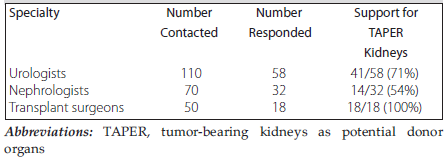
Table 1. Support for the Use of Tumor-Bearing Kidneys as Potential Donor Organs by Specialty