Volume: 22 Issue: 5 May 2024
FULL TEXT
Vasoplegia describes a constellation of low vascular resistance and normal cardiac output. Vasoplegia is common after cardiac surgery in general and in heart transplant recipients more specifically and occurs in over one-half of all heart transplant recipients with a varying degree of severity. The pathophysiology of vasoplegia is multifactorial and associated with a cascade of inflammatory mediators. Routine treatment of vasoplegia is based on medical vasopressor therapy, but in severe cases this may be insufficient to maintain adequate blood pressure and does not address the underlying pathophysiology. We report a case of severe vasoplegic shock in a heart transplant recipient who was successfully managed with a multimodal therapy combination of methylene blue, immunoglobulins enriched with immunoglobulin M, cytokine adsorption, and broad-spectrum antibiotics. This represents a promising therapeutic approach for heart transplant patients with vasoplegia.
Key words : Immunoglobulins, Methylene blue, Multimodal therapy, Vasoplegia
Inroduction
Shock in patients after heart transplant can be a diagnostic and therapeutic challenge. When cardiac output is normal and there are no signs of postoperative right-side heart failure or systemic infection, shock is most likely of vasoplegic nature.1,2 Vasoplegic shock is a broad term without a universal definition that describes low systemic vascular resistance triggered by complex and not fully understood mechanisms associated with a cascade of inflammatory mediators.3,4 Specific diagnostic criteria have not yet been defined, and vasoplegia is essentially a diagnosis of exclusion. Although vasoplegia has not been linked to impaired outcomes after heart transplant overall, severe cases of vasoplegic shock are associated with a poor prognosis.5,6 Vasopressors are commonly administered to maintain blood pressure, but these agents do not target underlying pathophysiological mechanisms, and prolonged administration of vasopressors at high doses carries substantial negative side effects.
New targeted medical treatments for vasoplegic shock beyond standard vasopressor therapy are emerging, including angiotensin II, methylene blue, and hydroxocobalamin, but there remains no established treatment regimen for multimodal combinations.7,8 Our case report describes a heart transplant recipient with severe vasoplegic shock in the postoperative period who was successfully treated with a multimodal combination therapeutic regimen of methylene blue, immunoglobulins enriched with immunoglobulin M, cytokine adsorption, and broad-spectrum antibiotics.
This case report complies with the Declaration of Helsinki. Informed consent was obtained from the patient.
Case Report
Patient and history
A 47-year-old male patient with advanced dilated cardiomyopathy received a heart transplant at our institution in March 2023. The patient had a family history of cardiac disease, and in May 2021 he had been placed on the wait list for transplant. Right-side heart catheterization at time of listing showed postcapillary pulmonary hypertension with mean pulmonary artery pressure of 35 mm Hg, pulmonary capillary wedge pressure of 25 mm Hg, and pulmonary vascular resistance of 160 dyn*s/cm5. Permanent atrial fibrillation was present despite previous broad intervention, including electrical cardioversion, pulmonary vein isolation, and ablation of the mitral isthmus. The patient had a history of chronic kidney disease stage 3 according to the Kidney Disease Improving Global Outcomes classification system, with preoperative creatinine of 4.1 mg/dL, blood urea nitrogen of 304 mg/dL, and glomerular filtration rate according to Chronic Kidney Disease Epidemiology Collaboration calculation of 16 mL/min. Past medical history included a partial thyroidectomy 8 years prior to transplant for suspicious nodules; polyarthritis, diabetes mellitus type 2, sensorimotor polyneuropathy, and obstructive sleep apnea. Medication included bisoprolol, com-bined sacubitril/valsartan, torasemide, xipamide, spironolactone, vericiguat, dapagliflozin, amiodarone, digitoxin, edoxaban, febuxostat, prednisolone, and pregabalin. The wait list status was changed to high urgent in February 2023 due to refractory heart failure fulfilling the Eurotransplant criteria for inotrope dependency.9
Donor organ and transplant
The matched donor organ originated from a 42-year-old male donor with brain death due to intracranial hemorrhage. Prophylactic cefuroxime 1.5 g given 3 times daily and clindamycin 600 mg given 3 times daily had been administered. Donor leukocytes prior to organ donation were 18.6 × 10⁹ cells/L and C-reactive protein was 108 mg/L. Tests for cytomegalovirus immunoglobulin G (IgG) showed positive results in the donor. The donor heart was recovered using 4 liters of Bretschneider cardioplegia. Heart transplant was performed in accordance with the bicaval technique. Total ischemic time for the donor heart was 258 minutes, of which 211 minutes were cold ischemia, and the remaining 47 minutes were warm ischemia. Recipient patient time on cardiopulmonary bypass was 2 hours and 59 minutes.
Vasoplegic shock and treatment
On arrival at the intensive care unit (ICU), to maintain adequate blood pressure, the patient required norepinephrine at a rate of 33.33 ?g/min, vasopressin at 0.05 IU/min, epinephrine at 16.7 ?g/min, milrinone at 33.33 ?g/min, and nitric oxide at 20 parts per million via inhalation, despite a cardiac index of 4.4 L/min. Per standard protocol, the patient received immunosuppressive therapy with tacrolimus, mycophenolate mofetil, and methylprednisolone. Because the patient had preexisting allergy to penicillin and trimethoprim/sulfamethoxazole, initial antibiotic therapy was meropenem, with atovaquone given for pneumocystis prophylaxis. High vasopressor demand persisted with no improvement after arrival at the ICU. Swan-Ganz catheter measurement showed severely decreased systemic vascular resistance of 307 dyn*sec/cm5 (indexed to body surface area 857 dyn*s/cm5/m2) (Figure 1). Vasoplegic shock was suspected, and treatment with methylene blue was initiated 12 hours after arrival at the ICU. Laboratory tests on the first postoperative day showed leukocytes of 22.5 × 10⁹ cells/L, C-reactive protein of 38 mg/L, interleukin-6 of 455 pg/L, and procal-citonin of 2.98 ng/L.
On postoperative day 1, initial antibiotic therapy was supplemented with a single dose of gentamicin, with addition of vancomycin and ciprofloxacin. Ciprofloxacin was discontinued on day 2, and vancomycin and meropenem were administered for a total of 9 days each. On postoperative day 2, the patient developed a fever of more than 39 °C and reduced diuresis of 80 mL/2 h despite continuous furosemide infusion. The patient's immunoglobulin levels showed IgG 851 mg/dL, IgA 279 mg/dL, and IgM 59 mg/dL. Treatment with IgM-enrichened immunoglobulins was initiated and continued for 3 days (Figure 2). In addition, from postoperative day 2 the patient received continuous hemodialysis with cytokine adsorption to remove excess inflammatory mediators (CytoSorb hemoadsorption filter, CytoSorbents Corporation).
Vasoplegic shock symptoms quickly showed signs of resolution, and by the end of postoperative day 3 the patient no longer required norepinephrine or vasopressin, and taper of epinephrine was possible until full discontinuation on postoperative day 6. By postoperative day 4 systemic vascular resistance had increased to normal levels of 749 dyn*s/cm5 (indexed to body surface area 1851 dyn*s/cm5/m2).
Microbiological sampling was sterile throughout the vasoplegic syndrome. The patient was extubated on postoperative day 6. Transvenous endomyocardial biopsy was performed on postoperative day 9 and showed no sign of cellular or humoral rejection. The remaining ICU stay was uneventful, and the patient was transferred to the normal cardiosurgical ward on postoperative day 14.
Discharge and follow-up
The patient was discharged on day 30 after heart transplant. Postoperative echocardiography showed good left ventricular function with an ejection fraction of 61% in Simpson biplane assessment. All heart valves showed no sign of significant pathology. At the 6-month follow-up, the patient was doing well in his home environment with no major cardiac adverse events or signs of graft rejection. Kidney function had significantly improved, and the patient no longer required renal dialysis.
Discussion
Vasoplegia of varying degrees occurs in appro-ximately 50% of patients after heart transplant. Treatment of this condition is challenging, with present day standard-of-care vasopressor therapy insufficient to maintain blood pressure in many severe cases; also, prolonged use of these agents is limited by negative side effects.10 Various agents are emerging to address the underlying pathophysiology of vasoplegia, but to date there is no established combination regimen.11 We describe a patient who experienced severe vasoplegic shock after heart transplant, in whom vasopressors were inadequate to maintain blood pressure but for whom a multimodal treatment regimen was successful. This multimodal treatment consisted of a combination regimen of methylene blue, IgM-enrichened immunoglobulins, cytokine adsorption, and broad-spectrum antibiotics. This approach was safe and well tolerated by the patient, who fully recovered. Our case report describes a promising therapeutic option to successfully treat severe vasoplegic shock in heart transplant patients.
References:
- Batchelor RJ, Wong N, Liu DH, et al. Vasoplegia following orthotopic heart transplantation: prevalence, predictors and clinical outcomes. J Card Fail. 2022;28(4):617-626. doi:10.1016/j.cardfail.2021.11.020
CrossRef - PubMed - Qin TX, Yao YT. Vasoplegic syndrome in patients undergoing heart transplantation. Front Surg. 2023; 13:10:1114438.doi:10.3389/fsurg.2023.1114438.
CrossRef - PubMed - Busse LW, Barker N, Petersen C. Vasoplegic syndrome following cardiothoracic surgery-review of pathophysiology and update of treatment options. Crit Care. 2020;24(1):36. doi:10.1186/s13054-020-2743-8
CrossRef - PubMed - Shaefi S, Mittel A, Klick J, et al. Vasoplegia after cardiovascular procedures-pathophysiology and targeted therapy. J Cardiothorac Vasc Anesth. 2018;32(2):1013-1022. doi:10.1053/j.jvca.2017.10.032
CrossRef - PubMed - Chan JL, Kobashigawa JA, Aintablian TL, et al. Vasoplegia after heart transplantation: outcomes at 1 year. In: Interactive Cardiovascular and Thoracic Surgery. Vol 25. Oxford University Press;2017:212-217. doi:10.1093/icvts/ivx081
CrossRef - PubMed - Ali JM, Patel S, Catarino P, et al. Vasoplegia following heart transplantation and left ventricular assist device explant is not associated with inferior outcomes. J Thorac Dis. 2020;12(5):2426-2434. doi:10.21037/jtd.2020.03.53
CrossRef - PubMed - Sovic W, Mathew C, Blough B, et al. Angiotensin II: a multimodal approach to vasoplegia in a cardiac setting. Methodist Debakey Cardiovasc J. 2021;17(4):98-101. doi:10.14797/mdcvj.576
CrossRef - PubMed - Mehaffey JH, Johnston LE, Hawkins RB, et al. Methylene blue for vasoplegic syndrome after cardiac operation: early administration improves survival. Ann Thorac Surg. 2017;104(1):36-41. doi:10.1016/j.athoracsur.2017.02.057
CrossRef - PubMed - Smits J. Chapter 6: ET thoracic allocation system (EThAS). Eurotransplant Manual. Version 4.8. Eurotransplant Foundation; 2022. https://www.eurotransplant.org/professionals/eurotransplant-manual/
CrossRef - PubMed - Webb AJ, Seisa MO, Nayfeh T, Wieruszewski PM, Nei SD, Smischney NJ. Vasopressin in vasoplegic shock: a systematic review. World J Crit Care Med. 2020;9(5):88-98. doi:10.5492/wjccm.v9.i5.88
CrossRef - PubMed - Ltaief Z, Ben-Hamouda N, Rancati V, et al. Vasoplegic syndrome after cardiopulmonary bypass in cardiovascular surgery: pathophysiology and management in critical care. J Clin Med. 2022;11(21):6407. doi:10.3390/jcm11216407
CrossRef - PubMed

Volume : 22
Issue : 5
Pages : 406 - 408
DOI : 10.6002/ect.2023.0322
From the 1Department of Cardiac Surgery; the 2Assist Device Programme, Department of Cardiac Surgery; and the 3Heart Transplant Programme, Department of Cardiac Surgery; University Hospital Dusseldorf, Dusseldorf, Germany
Acknowledgements: The authors have not received any funding or grants in support of the presented research or for the preparation of this work and have no declarations of potential conflicts of interest.
Corresponding author: Freya Sophie Jenkins, Department of Cardiac Surgery, University Hospital Dusseldorf, Moorenstrasse 5, 40225 Dusseldorf, Germany
Phone: +49 211 81 18332
E-mail:freyasophie.jenkins@med.uni-duesseldorf.de
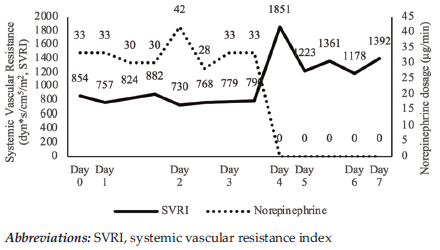
Figure 1.Patient’s Systemic Vascular Resistance Indexed To Body Surface Area, and Dosage of Norepinephrine in First Week Following Heart Transplant
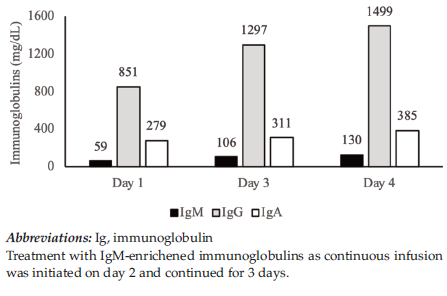
Figure 2.Immunoglobulin Levels