Volume: 22 Issue: 5 May 2024
FULL TEXT
Renal transplantation is the best modality of treatment for patients with end-stage renal disease. Donor shortage remains a substantial problem, for which different strategies are employed, including acceptance of marginal donors and donor kidneys with anatomic variations. We performed a successful kidney transplant of a donor kidney that had complete duplication of the ureter. After transplant, the recipient had no urinary complications.
Key words : Duplication of ureters, Neo-ureterocystostomy, Renal transplant
Introduction
Renal transplantation is the best treatment modality for patients with end-stage renal disease, not only in terms of cost effectiveness but also because of improved quality of life and survival.1 In Pakistan, because there is no provision for deceased donor kidneys, organ shortage remains an important limiting factor for transplantation.2 Organs previously rejected because of donor anatomy are now being considered to overcome this shortage. Kidneys with a duplex collecting system is one such anatomic variation that is generally not accepted for transplant because of the possibility of urological complications, such as infection, hydronephrosis, ureteral necrosis, and leakage.3-5 A double ureter is uncommon, with a reported incidence of 0.7% to 4%.6 A double ureter can be a complete duplication of the ureter with 2 separate openings in the bladder or ureters that merge into a single ureter before entering the bladder. We describe a donor kidney with 2 ureters that was transplanted without any urinary complications.
Case Report
A-30-year-old female patient with end-stage renal disease and past medical history of hypertension was on hemodialysis via the left arteriovenous fistula for 3 years. She also had a past history of having used a right femoral line for dialysis. Renal biopsy was not done because her kidneys were small and shrunken. Her body mass index (in kilograms divided by height in meters squared) was 22, and she had received 2 units of blood 2 years previously. She had 6 of 10 HLA mismatches, and her panel reactive antibody and complement-dependent cytotoxicity cross-match results were negative before transplant. The male donor was a 30-year-old maternal cousin of the patient, with weight of 77 kg, serum creatinine of 0.9 mg/dL, and creatinine clearance of 98 mL/min. A computerized tomography urogram revealed a visible left double ureter up to its distal part (Figure 1). At open donor nephrectomy, a complete duplex system was found, and both ureters were recovered in a single sheath (Figure 2A). On bench dissection, a single ostium was created by bringing together the adjacent edges of both ureters with 6-0 polydioxanone running suture (Figure 2B). This single ostium was then connected to the bladder by using an extravesicular Lich Gregoire neo-ureterocystostomy with stents in both ureters (Figure 3).
The recipient received induction with 1.5 mg/kg antithymocyte globulin and 500 mg methylpred-nisolone before reperfusion. The graft responded immediately, turning pink, and started producing urine, and the recipient had an uneventful posto-perative recovery. She received a total of 6 mg/kg antithymocyte globulin and 3 subsequent daily doses of methyl prednisolone of 500 mg, 250 mg, and 125 mg postoperatively. Her maintenance immunosup-pression was tacrolimus, mycophenolate mofetil, and prednisolone. After 12 hours, the recipient’s serum creatinine level had reduced by 50% and was normal by day 2. The Foley catheter was removed on day 5, and she was discharged home with a serum creatinine of 0.8 mg/dL. Both stents were removed at 3 weeks, and renal function was normal at 3 months.
Discussion
Radiology workup of donors, especially CT angiography and urography, is essential for preoperative diagnosis of anatomic variations, including duplication of ureters. Transplant teams should be confident to use donor kidneys with double ureters, as we and others have shown; such donor kidneys do not necessarily pose additional risks for urological complications.7 Care must be exercised during donor surgery, to ensure preservation of the ureteric blood supply by recovering the ureters within their sheath (Figure 2A). In the presence of 2 ureters, either a duplex system as in our patient or in cases of en bloc kidneys, surgeons have a choice of either implanting the ureters as a single ostium or separately.8 We performed a single neo-ureterocystostomy after creating a single ostium and stented both ureters. The presence of such anatomic variations requires careful dissection during recovery, during creation of a single ostium at bench surgery, and during implantation. The common ostium is naturally bigger in size and requires a larger anastomosis, requiring meticulous work to prevent a urine leak. The 2 factors most important for a good outcome in such cases are a good ureteric blood supply and unhurried meticulous surgery, if complications are to be avoided. Our case report showed successful transplant of a donor kidney with 2 ureters, without any surgical or urological complications. This report should encourage transplant teams to use such donor kidneys, which have been shown to have similar outcomes as kidneys with single ureters.
Conclusions
Donor kidney with double ureter is safe to transplant without any complication.
References:
- Jain D, Haddad DB, Goel N. Choice of dialysis modality prior to kidney transplantation: does it matter? World J Nephrol. 2019;8(1):1-10. doi:10.5527/wjn.v8.i1.1
CrossRef - PubMed - Ullah K, Dogar AW, Ochani S, Shoaib A, Shah HH, Ur Rehman ME. Obstacles to the deceased donor transplantation in Pakistan. BMJ Open Gastroenterol. 2023;10(1):e001101. doi:10.1136/bmjgast-2022-001101
CrossRef - PubMed - Johnston T, Reddy K, Mastrangelo M, Lucas B, Ranjan D. Multiple renal arteries do not pose an impediment to the routine use of laparoscopic donor nephrectomy. Clin Transplant. 2001;15(Suppl 6):62-65.
CrossRef - PubMed - Heidari M, Gharaati MR, Iran-Pour E, Simforoosh N, Zare S, Basiri A. Transplantation of kidneys with duplicated ureters. Scand J Urol Nephrol. 2010;44:337-340.
CrossRef - PubMed - Sulikowski T, Zietek Z, Ostrowski M, et al. Experiences in kidney transplantation with duplicated ureters. Transplant Proc. 2005;37(5):2096-2099. doi:10.1016/j.transproceed.2005.03.041
CrossRef - PubMed - Abdi H, Kaseb K, Rezaee H, Moradi M. Unilateral complete ureteral duplication with calculi obstructing both limbs of the left side. Urol Case Rep. 2018;18:91-93. doi:10.1016/j.eucr.2018.03.004
CrossRef - PubMed - Gupta SV, Aggarwal S, Vyas S. Transplantation of live allograft kidney with double ureter: a case report and review of literature. Indian J Urol. 2019;35(2):161-163. doi:10.4103/iju.IJU_365_1
CrossRef - PubMed - Toufeeq Khan TF, Kamal S, Koshaji B, Akhtar F. Urotoday Int J. 2013;6(4):art 45. doi:10.3834/uij.1944-5784.2013.08.04
CrossRef - PubMed

Volume : 22
Issue : 5
Pages : 396 - 398
DOI : 10.6002/ect.2024.0009
From the Department of Surgery, Kidney Transplant Program, Rehman Medical Institute, Peshawar, Pakistan
Acknowledgements: The authors have not received any funding or grants in support of the presented research or for the preparation of this work and have no declarations of potential conflicts of interest.
Corresponding author: Muneeb Hassan, Department of Surgery, Kidney Transplant Program, Rehman Medical Institute, Peshawar, Pakistan
E-mail: kmcite_3@hotmail.com
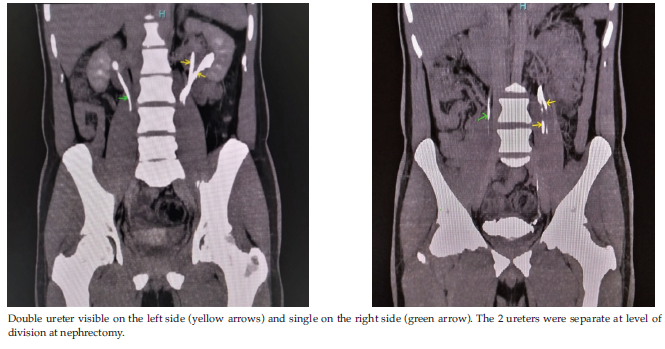
Figure 1. CT Urogram of Donor
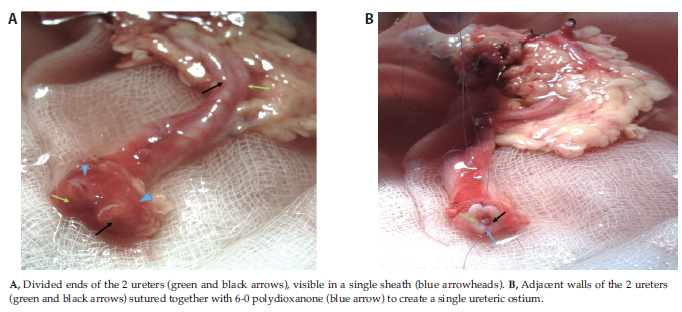
Figure 2. Bench Dissection of Donor Kidney
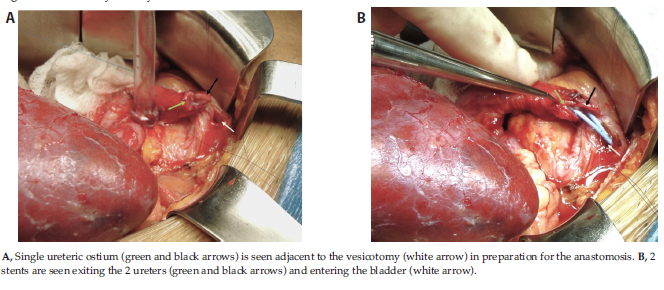
Figure 3. Neo-ureterocystostomy