Volume: 24 Issue: 3 March 2026
FULL TEXT
A Rare Case of Inadvertent Insertion of a Plastic Biliary Stent Into the Main Portal Vein: A Serious Endoscopic Retrograde Cholangiopancreatography Complication After Liver Transplant
Liver transplantation is the mainstay of treatment for end-stage liver disease. In this setting, endoscopic retrograde cholangiopancreatography is commonly used to assist T tube removal or to treat anastomotic biliary strictures. Iatrogenic portobiliary fistula is a rare but serious complication of endoscopic retrograde cholangiopancreatography, especially in the post-transplant setting. We describe the case of a 44-year-old male patient with an iatrogenic Iatrogenic portobiliary fistula after an endoscopic retrograde cholangiopancreatography-assisted T tube removal and plastic biliary stent insertion. The plastic biliary stent was inadvertently and unknowingly inserted within the portal vein. Once identified, given the high probability of catastrophic bleeding or portal vein thrombosis, a combined surgical and endoscopic approach was chosen. The stent was endoscopically removed under direct control in the operating room, and the fistulous tract between the portal vein and the common bile duct was ligated and divided. This case highlights the critical risks of posttransplant endoscopic maneuvers and suggests that, unlike spontaneous fistulas, iatrogenic vascular damage might require an immediate combined surgical-endoscopic approach to guarantee vascular control and a safe outcome.
Key words : Biliary stent, ERCP, Liver transplantation, Porto-biliary fistula, T tube
Introduction
Liver transplant is the mainstay for treatment of end-stage liver disease. In this setting, the use of a T tube to tutor the biliary anastomosis remains discretional,1 and endoscopic retrograde cholangiopancreatography (ERCP) could be useful to treat anastomotic biliary stricture or to assist T tube removal via the insertion of a plastic biliary stent.2 A few cases of porto-biliary fistula in the setting of liver transplant have been described previously in the available English literature, but most of these cases were due to a complicated posttransplant course with fistula formation3-5 rather than to an erroneous stent insertion.
We herein describe the case of a patient who underwent ERCP to replace the T tube with a plastic biliary stent that had been inadvertently inserted within the main trunk of the portal vein. Written informed consent was obtained from the patient.
Case Report
A 44-year-old male patient, who underwent urgent liver transplant from an unrelated brain death donor for acute-on-chronic liver failure due to alcoholic liver disease with T-tube duct-to-duct biliary anastomosis, had undergone ERCP-assisted T tube removal and plastic biliary stent insertion 3 months after liver transplant. During ERCP, after stent insertion, moderate bleeding from the papilla was observed, and hemostasis was obtained with epinephrine injection.
A month after the ERCP procedure, due to recur-rent anemia, the patient underwent a computed tomography scan that showed the biliary stent perforating the common bile duct (CBD) into the portal vein main trunk and right branch (Figure 1).
Findings were also confirmed by magnetic reso-nance imaging. He was urgently admitted to our ward, and surgery was scheduled. After relaparotomy, a difficult and careful adhesiolysis was performed, and hilar structures were identified and isolated. A fistulous tract between the portal vein and the CBD was found just behind pancreatic head. The portal vein was prepared proximally behind the head of the pancreas for vascular control (Figure 2). Biliary stent was endoscopically removed under direct control, and the fistula was ligated and divided. Intraoperative Doppler ultrasonography confirmed arterial and portal patency.
Discussion
Iatrogenic porto-biliary fistula is a rare although serious complication of ERCP, the consequences of which could be potentially catastrophic, especially in the setting of liver transplantation.3-5 In our case described here, the hypothesized pathogenetic mechanism identified an unconventional and exag-gerated curvature of the CBD within the pancreatic head as the reason for bile duct and portal vein perforation in a caudocranial and lateromedial fashion and final formation of a porto-biliary fistula. In this case, after multidisciplinary evaluation, with concern of potential catastrophic bleeding or portal vein thrombosis during endoscopic/interventional radiology procedures, we opted for a combined surgical and endoscopic approach to ensure total vascular control and facilitate complete division of the fistulous tract at the moment of stent extraction. Moreover, the surgical approach would allow a direct suture of the portal vein or a hepaticojejunal anastomosis, if needed.
At present, there are no available guidelines for the treatment of porto-biliary fistula, and therefore careful preoperative planning with assessment of available skills and expertise is mandatory to offer an uneventful recovery from such an event.
This case highlights the critical risks of post-transplant endoscopic maneuvers and suggests that, unlike spontaneous fistulas, iatrogenic vascular damage could require an immediate combined surgical and endoscopic approach.
References:
-
Pravisani R, De Simone P, Patrono D, et al. An Italian survey on the use of T-tube in liver transplantation: old habits die hard! Updates Surg. 2021;73(4):1381-1389. doi:10.1007/s13304-021-01019-1
CrossRef - PubMed -
Dumonceau JM, Tringali A, Papanikolaou I, et al. Endoscopic biliary stenting: indications, choice of stents, and results: European Society of Gastrointestinal Endoscopy (ESGE) Clinical Guideline: updated October 2017. Endoscopy. 2018;50(09):910-930. doi:10.1055/a-0659-9864
CrossRef - PubMed -
Murray F, Buetikofer S, Dutkowski P, Gubler C. Portobiliary fistula in a liver transplant recipient treated with an endoscopically deployed fully covered self-expandable biliary metal stent. ACG Case Rep J. 2019;6(5):e00077. doi:10.14309/crj.0000000000000077
CrossRef - PubMed -
Lorenz JM, Zangan SM, Leef JA, Van Ha TG. Iatrogenic portobiliary fistula treated by stent-graft placement. Cardiovasc Intervent Radiol. 2010;33(2):421-424. doi:10.1007/s00270-009-9642-3
CrossRef - PubMed -
Kasahara M, Sakamoto S, Fukuda A, et al. Posttransplant bilioportal fistula with portal vein thrombosis: a case report. Transplant Proc. 2010;42(9):3862-3864. doi:10.1016/j.transproceed.2010.08.054
CrossRef - PubMed

Volume : 24
Issue : 3
Pages : 282 - 284
DOI : 10.6002/ect.2025.0317
From the 1Unità Operativa Complessa Hepato-biliary Surgery and Liver Transplant Centre, General Surgery and Woman’s Health Department; and the 2Unità Operativa Complessa Hepatology, Polyspecialistic Medical Department, Azienda Ospedaliera di Rilievo Nazionale Antonio Cardarelli, Naples, Italy
Acknowledgements: The authors have not received any funding or grants in support of the presented research or for the preparation of this work and have no declarations of potential conflicts of interest.
Corresponding author: Ferraro Daniele, Via Antonio Cardarelli, 9 - 80131 Naples, Italy
Phone: +39 329 827 6313
E-mail: daniele.ferraro@aocardarelli.it;daniele.ferraro.md@gmail.com
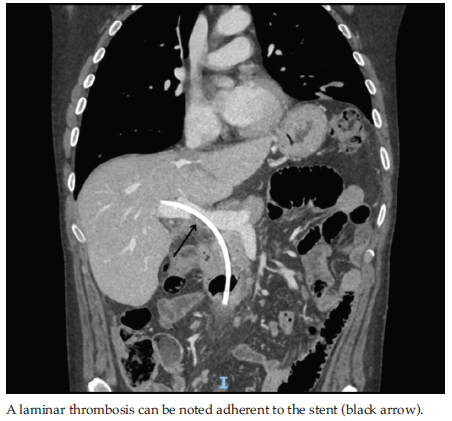
Figure 1. Triple-Phase Computed Tomography Scan Shows Plastic Biliary Stent Perforating From the Common Bile Duct Into the Main Trunk of the Portal Vein and Its Right Branch
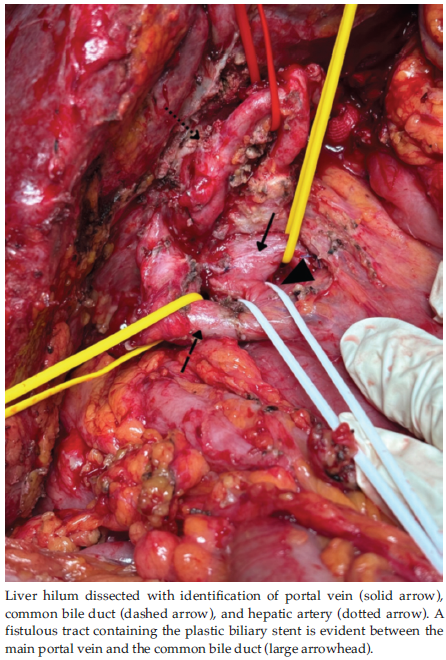
Figure 2. View of Portal Vein, Common Bile Duct, and Hepatic Artery, Including a Fistulous Tract Containing the Plastic Biliary Stent