Volume: 15 Issue: 1 February 2017
FULL TEXT
Objectives: Approximately 10 to 25 lung transplant procedures are performed annually in Finland, and 1-year survival has been 95% over the last 10 years. Our aim was to find associations between perioperative fluid replacement therapies and postoperative patient outcomes, with special emphasis on the use of colloids and blood products.
Materials and Methods: We retrospectively evaluated data from 100 patients who underwent lung transplant with cardiopulmonary bypass support in Finland from 2007 to 2013. Outcomes of interest were length of intensive care unit and hospital stays, time in ventilator, use of extracorporeal membrane oxygenation postoperatively, postoperative renal replacement therapy, postoperative graft failure, and 1-year mortality.
Results: Of 100 patients, 12 were on extracorporeal membrane oxygenation preoperatively. The 1-year mortality was 5/100 (5%), and the 3-year mortality was 7/100 (7%). Intraoperative fluid balance was positive (4762 ± 3018 mL) but fell significantly postoperatively (below +1000 mL on postoperative day 1). During postoperative days 2 to 7, net fluid balance continued decreasing and stayed negative. Intraoperative use of hydroxyethyl starch and fresh frozen plasma were significantly higher in patients who died during follow-up versus those who survived (P < .05). Intraoperative use of fresh frozen plasma, but not red blood cells or platelets, correlated with graft failure (P = .012). Postoperative use of colloids or blood products did not correlate with mortality or graft failure. Patients who were on extracorporeal membrane oxygenation preoperatively stayed longer on ventilators and had longer intensive care unit and hospital stays (P < .001). Eight patients needed postoperative renal replacement therapy.
Conclusions: Intraoperative use of fresh frozen plasma and hydroxyethyl starch is associated with increased mortality and graft failure. Postoperative use of colloids and red blood cells did not correlate with patient outcome. Use of extracorporeal membrane oxygenation preoperatively resulted in prolonged length of hospital stay.
Key words : Lung transplant, Colloids, Transfusions
Introduction
Lung transplant is an established therapy for patients with wide ranges of acute and chronic progressive end-stage lung diseases. In the past 20 years, advances in surgical technique and immunosuppression have led to significantly better outcomes and an increased number of lung transplants.1 Survival after lung transplant has steadily improved, with current expected median survival of 5.7 years.1
Approximately 10 to 25 lung transplant procedures are performed annually in Finland, and 1-year survival rate has been 95% during the past 10 years.1-3 Recently, 20% of patients have been bridged to lung transplant using ventilator or extracorporeal membrane oxygenation (ECMO).3
Perioperative fluid replacement therapy in this group of patients is challenging. Cardiopulmonary bypass during surgery often leads to fluid overload. In most cases, additional transfusion of blood products is also necessary.1 Fast recovery of the graft is crucial, even though lung function is temporarily impaired due to ischemia-reperfusion injury postoperatively.
There are few studies on the effects of fluid replacement therapy on postoperative complications in lung transplant patients. Earlier studies in patients scheduled for cardiac surgery have shown transfusion of red blood cells correlating with worse outcome.4
Our aim was to find associations between perioperative fluid replacement therapy and postoperative patient outcome and recovery time, with special emphasis on the use of colloids and blood products. Our hypothesis was that crystalloids and small perioperative fluid overload are beneficial after lung transplant.
Materials and Methods
Study design
This study is a single center retrospective cohort study that included 100 lung
transplant recipients in Finland from January 2007 to January 2013. Patients who
received bilateral, unilateral, and retransplant procedures were included.
Patients with combined organ transplants were excluded.
Variables examined and outcomes measured
Preoperative information included body mass index, primary diagnosis leading
to transplant, hemoglobin level, creatinine level, glomerular filtration rate
(GFR), and use of preoperative ECMO.
Intraoperatively, we recorded fluid balance, amount of crystalloids (Ringer and NaCl), colloids (hydroxyethyl starch, gelatin, albumin 4%, and albumin 20%), and blood products (red blood cells, fresh frozen plasma, and platelets) administered, intraoperative diuresis, and lowest intraoperative hemoglobin level.
Fluid balance and amount of crystalloids, colloids, and blood products administered, hemoglobin and creatinine concentrations, and urine output were recorded daily for the first postoperative week.
Outcomes of interest were 1-year mortality (cause of death), graft failure, length of stay in the intensive care unit and hospital ward, time on ventilator, postoperative fluid balance, need for postoperative renal replacement therapy, GFR 1 year after transplant, and use of ECMO postoperatively.
Statistical analyses
The results are presented as means ± standard deviation (when distribution
was normal with Kolmogorov-Smirnov test) or medians (25-75 percentiles) when
distribution was not normal. The t test or Wilcoxon test was used for
paired comparisons. Kruskal-Wallis test was used for repeated measurements.
Bivariate correlation with Spearman coefficient was calculated when appropriate.
Statistical analyses were performed with SPSS software (SPSS: An IBM Company,
version 19.0, IBM Corporation, Armonk, NY, USA). For all analyses, P <
.05 was considered statistically significant.
Results
Baseline characteristics for all patients are shown in Table 1; 100 patients were studied. Mean age at transplant was 51 ± 12.8 years. We found that 12 patients were supported with ECMO as a bridge to lung transplant. The most common cause for transplant in our center was pulmonary fibrosis (49%), followed by chronic obstructive pulmonary disease (16%) (Table 1).
One-year postoperative mortality was 5/100 (5%). Three-year mortality was 7/100 (7%). The median time (25-75 percentiles) on ventilator was 32 hours (20-138 h) after surgery, the median time in intensive care unit was 8 days (5-15 d), and median hospital stay time was 27.5 days (19-43 d).
Preoperative mean hemoglobin concentration was 137.8 ± 23.8 g/L. However, 80 patients (80%) required red blood cell transfusions intraoperatively. The rate for fresh frozen plasma transfusions was 59%, and the rate for platelets was 52%.
Intraoperative use of hydroxyethyl starch and fresh frozen plasma was significantly higher in patients who did not survive (1500 ± 707 and 2100 ± 707 mL) than in survivors (734 ± 393 and 973 ± 774 mL) (P < .05; Table 2). Intraoperative use of fresh frozen plasma, but not of red blood cells or platelet concentrates, correlated with graft failure (P = .012, with Spearman coefficient of 0.325). The postoperative use of blood products or colloids (calculated separately and together) did not correlate with mortality or postoperative graft failure (P < .05).
Mean fluid balance was positive on the day of surgery (4762 ± 3018 mL) but fell significantly postoperatively, being below +1000 mL on the first postoperative day. At 2 to 7 days after transplant, fluid balance continued decreasing and stayed negative (Figure 1).
The median preoperative serum creatinine level was 56.0 μmol/L (64-80 μmol/L), and mean GFR was 89.9 ± 23.6 mL/min. One year after transplant, GFR was 56.1 ± 14.1 mL/min (range 22.9-148.0 mL/min), and only 3 patients (3%) had GFR below 30 mL/min, but 40.4% of patients had GFR above 60 mL/min. Eight patients needed postoperative renal replacement therapy, and 1 patient underwent kidney transplant.
Patients treated with ECMO preoperatively stayed longer on ventilators, and their length of stays in the intensive care unit and hospital ward were longer compared with patients with no ECMO preoperatively (P < .001). Their creatinine levels were higher preoperatively and on the 1st, 2nd, 3rd, and 4th postoperative days (P < .05), but after that no statistically significant differences could be measured (Table 3).
Discussion
Our study reported a 1-year survival rate of 95%, thus confirming earlier results.1,2 A notable amount of patients (12%) needed preoperative ECMO support. Despite this, 1- and 3-year survival rates were rather high.
We found an association between the use of hydroxyethyl starch and fresh frozen plasma and increased mortality and postoperative graft failure. High weight molecules, including high-molecular-weight hydroxyethyl starch, are associated with severe adverse effects, including nephrotoxicity and coagulopathy, which persist for extended periods in patient tissues, influencing renal dysfunction.5 Modern generation low-molecular-weight hydroxyethyl starch solutions have been shown to be less likely to induce nephrotoxicity and coagulopathy.6 However, the use of hydroxyethyl starch, including low-molecular-weight hydroxyethyl starch, has significantly decreased recently because of inconclusive evidence in several studies in intensive care patients.7-10 However, there are no prospective studies presenting harm of synthetic colloids in surgical patients. Our retrospective investigation in sick patients (waiting for lung transplant) showed higher mortality in patients administered higher amounts of hydroxyethyl starch solutions and fresh frozen plasma. Surprisingly, use of red blood cells or platelets intraoperatively or postoperatively did not correlate with graft failure or worse patient outcome as shown in patients after cardiac surgery.4
Fluid balance was well on the positive side on the day of surgery but normalized quickly on the first postoperative day. In Finland, lung transplant procedures are performed under cardiopulmonary bypass, which inevitably leads to fluid overload intraoperatively. Well-planned fluid replacement therapy, especially for this complex procedure, is important to minimize fluid overload.
Impaired renal outcome is a common complication after lung transplant. Renal function declines progressively in most lung transplant recipients (> 90%).11 Chronic renal failure has been reported to be > 15% at 5 years after lung transplant.11 In our study, mean GFR at 1 year after transplant was more than 50 mL/min, with only 3% of patients having GFR lower than 30 mL/min.
Acute kidney injury is associated with increased morbidity and mortality.12 In this study, 8 patients (8%) needed postoperative renal replacement therapy, which is higher than what has been reported earlier.12 This finding might be due to the small number of patients included. Another explanation could be the different triggers to start renal replacement therapy in different centers. Again, in only 3 patients, GFR remained low (under 30 mL/min) for a longer time, and only 1 patient needed a renal transplant.
Extracorporeal membrane oxygenation is efficacious as a bridge to lung transplant, resulting in good postoperative outcomes. Our study detected that a rather high amount of patients (12%) needed ECMO preoperatively, which led to prolonged lengths of stay in both the intensive care unit and hospital ward. It is however not a surprise that preoperative ECMO causes more complicated and prolonged postoperative hospital stays. Earlier studies also showed prolonged lengths of stay in patients supported with ECMO as a bridge to lung transplant.13,14 On the other hand, in a critical situation, use of ECMO can ensure oxygen delivery and save a patient’s life. Outcomes after surgery are better when patients are stabilized before transplant.14
In patients on ECMO, creatinine levels were significantly higher preoperatively compared with those without ECMO. The difference in creatinine levels remained 4 days after transplant; however, after this, it became similar in all patients. This finding reflects rather rapid recovery of renal function in this group of patients.
Limitations of our study are its single center retrospective design and the relatively small amount of patients. This could limit the generalizability of our findings to other lung transplant populations.
In conclusion, intraoperative use of hydroxyethyl starch and fresh frozen plasma was associated with worse patient outcome. However, postoperative use of blood products or colloids did not affect patient outcomes.
References:
- Mahida RY, Wiscombe S, Fisher AJ. Current status of lung
transplantation. Chron Respir Dis. 2012;9(2):131-145.
CrossRef - PubMed - Tomaszek SC, Fibla JJ, Dierkhising RA, et al. Outcome of lung
transplantation in elderly recipients. Eur J Cardiothorac Surg.
2011;39(5):726-731.
CrossRef - PubMed - Hämmäinen P, Halme M. Lung transplantation today--modern treatment with excellent results. Suomen Lääkärilehti. 2011;66(33):2333-2338.
- Murphy GJ, Reeves BC, Rogers CA, Rizvi SI, Culliford L, Angelini GD.
Increased mortality, postoperative morbidity, and cost after red blood cell
transfusion in patients having cardiac surgery. Circulation.
2007;116(22):2544-2552.
CrossRef - PubMed - Hartog C, Reinhart K. CONTRA: Hydroxyethyl starch solutions are unsafe
in critically ill patients. Intensive Care Med. 2009;35(8):1337-1342.
CrossRef - PubMed - Piazza O, Scarpati G, Tufano R. Update on transfusion solutions during
surgery: Review of hydroxyethyl starches 130/0.4. Int J Gen Med.
2010;3:287-295.
CrossRef - PubMed - Bagshaw S, Chawla L. Hydroxyethyl starch for fluid resuscitation in
critically ill patients. Can J Anaesth. 2013;60(7):709-713.
CrossRef - PubMed - Myburgh JA, Finfer S, Bellomo R, et al. Hydroxyethyl starch or saline
for fluid resuscitation in intensive care. N Engl J Med.
2012;367(20):1901-1911.
CrossRef - PubMed - Serpa Neto A, Veelo DP, Peireira VG, et al. Fluid resuscitation with
hydroxyethyl starches in patients with sepsis is associated with an
increased incidence of acute kidney injury and use of renal replacement
therapy: A systematic review and meta-analysis of the literature. J Crit
Care. 2014;29(1):185.e1-185.e7.
CrossRef - PubMed - Mutter TC, Ruth CA, Dart AB. Hydroxyethyl starch (HES) versus other
fluid therapies: Effects on kidney function. Cochrane Database Syst Rev.
2013; (7):CD007594.
CrossRef - PubMed - Hellemons ME, Bakker SJ, Postmus D, et al. Incidence of impaired renal
function after lung transplantation. J Heart Lung Transplant.
2012;31(3):238-243.
CrossRef - PubMed - George TJ, Arnaoutakis GJ, Beaty CA, et al. Acute kidney injury
increases mortality after lung transplantation. Ann Thorac Surg.
2012;94(1):185-192.
CrossRef - PubMed - Toyoda Y, Bhama JK, Shigemura N, et al. Efficacy of extracorporeal
membrane oxygenation as a bridge to lung transplantation. J Thorac
Cardiovasc Surg. 2013;145(4):1065-1071.
CrossRef - PubMed - Bermudez CA, Norihisa S, Diana Z, et al. Contemporary outcomes of lung
transplantation using extracorporeal membrane oxygenation as bridge. J Heart
Lung Transplant. 2013;32(4):S266.
CrossRef -

Volume : 15
Issue : 1
Pages : 78 - 81
DOI : 10.6002/ect.2016.0033
From the 1University of Helsinki, the 2Department of
Cardiothoracic Surgery, and the 3Department of Anesthesiology,
Intensive Care and Pain Care, Helsinki University Hospital, Helsinki, Finland
Acknowledgements: The authors have no sources of funding for this study,
and they have no conflicts of interest to declare.
Corresponding author: Emil Björkbom, Ulvilantie 15 A 7, 00350 Helsinki,
Finland
Phone: +358 457 342 7724
E-mail: emil.bjorkbom@gmail.com
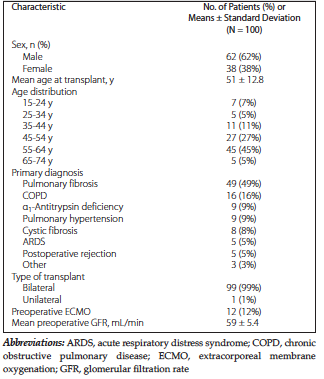
Table 1. Patient Characteristics
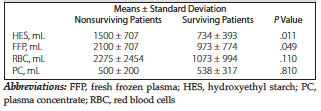
Table 2. Intraoperative Transfusion Levels in Nonsurviving Patients Versus Surviving Patients
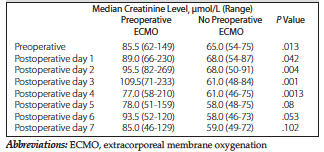
Table 3. Creatinine Levels in Patients on Versus Not on Preoperative Extracorporeal Membrane Oxygenation
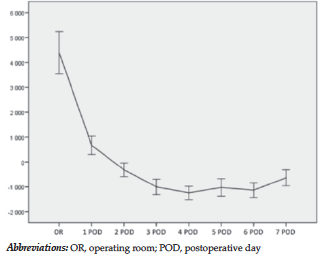
Figure 1. Daily Fluid Balance (mL): Intraoperative to Postoperative Day 7