Volume: 14 Issue: 5 October 2016
FULL TEXT
Elongation of the right renal vein with the inferior vena cava (caval patch) using a vascular stapler offers a safe means of extending the deceased-donor right renal vein, while minimizing the ischemic time of the kidney during preparatory dissection. The aortic patch of the right renal artery also can be preserved, which minimize the danger of arterial stenosis, kinking, and dissection.
Key words : Caval patch, Deceased donor, Ischemic time
Introduction
A major challenge in transplanting the right kidney involves the presence of a short renal vein.1,2 Technical problems associated with the venous anastomosis have been reported in 1% to 18% of all renal transplants2-4 and are related mainly to damage sustained during the retrieval or transplant and to anatomic variations (ie, multiple vessels).3,4
According to Bakir and associates,5 transplanting the right kidney is a significant independent risk factor for graft thrombosis. Reported anatomic risk factors are the disparate length between artery and vein (which may cause arterial kinking when the graft is placed in situ; the removal of the aortic patch to shorten the renal artery), with an increased risk of arterial complications (ie, dissection, stenosis).
To reduce this risk, many authors have described different methods to elongate the right renal vein. We report elongation of the renal with the vascular stapler ETS-FLEX-35 (Endoscopic articulator linear cutter, Ethicon Endo Surgery, LLC; Ethicon Inc., West Somerville, NJ, USA) using the inferior vena cava as a conduit.
Surgical technique of elongating the right renal vein
After an en bloc resection of the kidneys from the donor, and subsequent
separation of the organs, the left renal vein was taken approximately 3 to 4 mm
away from the vena cava. The right kidney usually was retrieved along with the
inferior vena cava. A conduit of the inferior vena cava was easily constructed
by stapling proximally and distally across the vena cava to the right renal vein
with the use of the vascular stapler (Figure 1).
After the venous anastomosis, the elongated vein was checked (Figure 2); eventual bleeding points along the staple lines can be fixed easily with Prolene stitches before reperfusion of the graft. We performed 49 kidney transplants, which necessitated elongation of the right renal vein; 15 of which had 2 or more arteries, and 34 had a single artery. In 40 cases, we preserved the aortic patch. In all cases, we performed an end-to-side anastomosis between the renal vein and the external iliac vein. The arterial anastomoses were performed on the external iliac artery. In all cases, the venous anastomoses were suc-cessfully performed. No cases of venous thrombosis or bleeding from the vein elongation during the early postoperative phase were reported to date.
Discussion
In renal transplant, the equal length between artery and vein facilitates the vascular anastomosis and the placement of the graft in the iliac fossa after reperfusion.6,7 This goal is difficult to achieve with the right kidney, which often presents disparity in length between artery and vein. In a recent analysis of 119 right kidneys, Janschek and associates4 found that the average length of the right renal vein to be almost one-half of the artery’s length (A/V mean ratio, 1.8).
Attempts to join a renal vein of inadequate length to the iliac vein are likely to result in an anastomosis that is angulated or under tension and consequent increased risk of renal vein thrombosis.4,5 This risk is minimized by elongating the right renal vein. Benedetti and associates,6 in their study, showed that the use of a vein extension had an effect on the outcome. Three hundred five deceased-daughter transplant recipients received a right kidney. Of these, 76 received a graft with vein extension. None experienced technical vascular complications; however, 5 of the 229 (2.2%) without vein extension did. There was no difference regarding graft survival at 2 years’ follow-up.
Right renal vein elongation with the inferior vena cava seems to be a better approach than other techniques described for elongation of renal vein, namely venous saphenous autograft, spiral gonadal vein, iliac and femoral cryopreserved grafts, bovine arterial heterograft and a vascular prosthesis.6-13 In addition, the donor team routinely provides the right kidney with the vena cava attached, as it does not interfere with the multiorgan procurement.1,10-18
Use of the vascular stapler to create a conduit with a caval patch offers an expeditious means of extending the right renal vein, while greatly minimizing the ischemic time of the kidney during the back table dissection. This technique eliminates extensive mobilization of the external iliac vein to gain additional length, and likelihood of lymphocele, haemorrhagia, or thrombosis. Similarly, dissection of the hilum of the donor kidney to lengthen the right renal vein is not needed (nor is it recommended) owing to the risk of parenchymal/hilar hemorrhages (difficult to control after reperfusion), and injury of the blood supply of the pelvis and ureter, which can cause necrosis or late ureteral stenosis (owing to ureteral ischemia and delayed ureteral fibrosis).3
The kidney can be placed above the iliac vessels even in case of anatomic variations of the graft (multiple vessels) or the recipient (large abdomen and/or deep pelvis). The aortic patch can be preserved, thereby reducing the risk of arterial graft kinking, renal transplant artery stenosis, and thrombosis. In addition, short vessels can significantly prolong the operative times and extend the length of the warm ischemia during the vascular anastomoses.
In conclusion, elongation of the renal vein with the contiguous inferior vena cava using the vascular stapler is a safe way to overcome technical problems faced in transplanting the right kidney.
References:
- Barry JM, Fuchs EF. Right renal vein extension in cadaver kidney
transplantation. Arch Surg. 1978;113(3):300.
CrossRef - PubMed - Novick AC, Straffon RA. Surgery of renal transplantation and complications. In: Novick AC, ed. Vascular Problems in Urologic Surgery. Philadelphia, Saunders. 1982;233-236.
- Salaman JR, Clarke AG, Crosby DL. The management of kidney transplants
damaged during their removal from the donor. Br J Urol. 1974;46(2):173-177.
CrossRef - PubMed - Janschek EC, Rothe AU, Hölzenbein TJ, et al. Anatomic basis of right
renal vein extension for cadaveric kidney transplantation. Urology.
2004;63(4):660-664.
CrossRef - PubMed - Bakir N, Sluiter WJ, Ploeg RJ, van Son WJ, Tegzess AM. Primary renal
graft thrombosis. Nephrol Dial Transplant. 1996;11(1):140-147.
CrossRef - PubMed - Benedetti E, Fryer J, Matas AJ, et al. Kidney transplant outcome with
and without right renal vein extension. Clin Transplant. 1994 ;8(4):416-417.
PubMed - Nerstrom B, Ladefoged J, Lund F. Vascular complications in 155
consecutive kidney transplantations. Scand J Urol Nephrol. 1972;6:(suppl
15):65-74.
CrossRef - PubMed - Santiago-Delpín EA, González Z. Successful renal vein reconstruction
with a polytetrafluoroethylene vascular graft in kidney transplantation. Am
J Surg. 1985;149(2):310-311.
CrossRef - PubMed - Spees EK Jr, Oakes DD, Light JA, Perloff LJ, Reckard CR. Successful
renal vein reconstruction with bovine arterial heterografts. Ann Surg.
1977;186(6):749-751.
CrossRef - PubMed - Nghiem DD. Spiral gonadal vein graft extension of right renal vein in
living renal transplantation. J Urol. 1989;142(6):1525.
PubMed - Hammoudi Y, Benoit G, Bensadoun H, et al. Benefits of vena cava removal
with the renal vein in cadaver kidney procurement: incidence of arterial
complications. Transplant Proc. 1988;20(5):762.
PubMed - Chin JL. Vena caval extension of right renal vein for cadaveric renal
transplants. J Urol. 1988;139(3):552-553.
PubMed - Goel MC, Flechner SM, El-Jack M, et al. Salvage of compromised renal
vessels in kidney transplantation using third-party cadaveric extenders:
impact on posttransplant anti-HLA antibody formation. Transplantation.
2004;77(12):1899-1902.
CrossRef - PubMed - Tan LC, Rahman AU, Walters AM, Sadek SA. The inferior vena caval
conduit--a neglected technique in transplantation of the right cadaveric
kidney? Transpl Int. 2000;13(suppl 1):S60-S63.
CrossRef - PubMed - Nakatani T, Takemoto Y, Kim T, et al. Results of cadaver kidney
transplantation with right renal vein extension. Urol Int.
2003;70(4):282-285.
CrossRef - PubMed - Fabian MA, Herrin MK, Baxter J, Ackermann JR. Extension of the right
renal vein in cadaveric renal transplants with use of the vena cava and the
TA-30 V3 surgical stapler. Surg Gynecol Obstet. 1991;173(3):233-234.
PubMed - Rosenthal JT, Shaw BW Jr, Hardesty RL, Griffith BP, Starzl TE, Hakala
TR. Principles of multiple organ procurement from cadaver donors. Ann Surg.
1983;198(5):617-621.
CrossRef - PubMed - Adamec M, Janouöek L, Toöenovský P, Lácha J. Renal transplantation
combined with aortofemoral bypass using a fresh arterial allograft. Transpl
Int. 2000;13(suppl 1):S56-S59.
CrossRef - PubMed

Volume : 14
Issue : 5
Pages : 564 - 566
DOI : 10.6002/ect.2014.0142
From the Imperial College Healthcare Trust, Renal and Transplant unit,
Hammersmith Hospital, London, W12 0HS, United Kingdom
Acknowledgements: The authors declare that they have no sources of
funding for this study, and they have no conflicts of interest to declare. The
paper is not based on a previous communication to a society or a meeting.
Corresponding author: Pierpaolo Di Cocco, MD, Imperial College Healthcare
NHS Trust, Fourth floor, Hammersmith House, Hammersmith Hospital, London, W12
0HS, United Kingdom
Phone: +44 0 74 4533 1474
Fax: +44 0 20 3313 5169
E-mail:
pierpaolodicocco@gmail.com
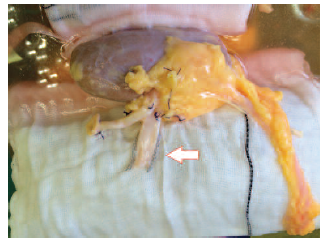
Figure 1. Renal Vein Elongation by Stapling Proximally and Distally Across the Vena Cava to the Right Renal Vein With the Use of the Vascular Stapler (Arrow)
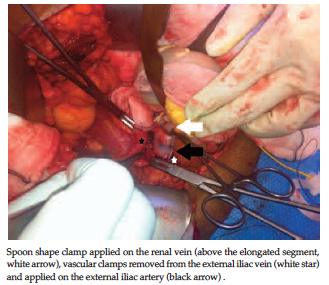
Figure 2. Check of the Venous Anastomosis (End-to-Side Between Renal Vein and External Iliac Vein)