Volume: 13 Issue: 3 June 2015
FULL TEXT
Objectives: Hepatitis E virus infection is increasingly reported as a cause of chronic hepatitis in organ transplant recipients. Besides reduction of immunosuppressive therapy or pegylated-interferon therapy, promising results have been reported for ribavirin monotherapy of hepatitis E virus after kidney transplant. To our knowledge, this is the first report of a successful ribavirin monotherapy for chronic hepatitis E virus infection after and orthotopic liver transplant.
Materials and Methods: This is a case report of a 55-year-old man with a diagnosis of chronic hepatitis E (genotype 3f) 26 months after an orthotopic liver transplant. A reduction of immunosuppressive therapy was not tolerated, and the patient did not qualify for pegylated-interferon therapy. Because of progressively elevated liver transaminases accom-panied by histologic changes in the liver allograft, ribavirin monotherapy was undertaken for 16 weeks.
Results: We saw a decrease in liver enzymes after 1 week of ribavirin monotherapy. Hepatitis E virus RNA anti-HEV-IgM were tested after 8 weeks of ribavirin therapy, and were both negative. Antiviral therapy was continued for 16 weeks, and hepatitis E virus RNA remained undetectable; there also was a significant decrease in liver transaminases levels to normal values. In the 8-week and 8-month follow-ups at the end of antiviral therapy, the patient presented with normal liver enzymes and no detectable hepatitis E virus RNA.
Conclusions: In conclusion, successful therapy of chronic hepatitis E after an orthotopic liver transplant may be achieved by ribavirin monotherapy and should be considered in patients who are sensitive to a reduction of immunosuppressive therapy or pegylated-interferon therapy.
Key words : Antiviral treatment, Viral hepatitis, Liver cirrhosis
Introduction
Hepatitis C virus (HEV) infection is characterized by an acute self-limiting clinical course with symptoms such as jaundice, nausea, and fever. In immunocompromised patients (ie, solid-organ transplant recipients), HEV infection may progress to chronic hepatitis E, which is defined as persistent serum HEV RNA and high levels of liver enzymes lasting more than 6 months.1-6 Consequences may be fatal with reported clinical courses of development to rapid liver cirrhosis, especially in patients with underlying chronic liver disease.6,7 Since 2008, an increasing number of chronic HEV infections have been described after allogeneic stem cell, kidney, and liver transplants in Europe.1,4,8
Treatment options for chronic HEV infection after solid-organ transplant are limited. Withdrawal or reduction of the immunosuppressive therapy is considered the first therapeutic option, and clearance of the virus may be achieved.9 Efficient treatment attempts with pegylated-interferon therapy also have been reported.10-11 However, not all patients tolerate modification of immunosuppressive therapy or are eligible for pegylated-interferon therapy. Recently, successful results have been reported for a ribavirin monotherapy in patients with chronic HEV-infection after kidney transplant.12,13 To our knowledge, this is the first report of a successful ribavirin monotherapy in a patient with chronic HEV infection after an orthotopic liver transplant (OLT).
Case Report
We report the case of a 55-year-old man who underwent an uneventful OLT for nutritive toxic liver cirrhosis in July 2010. The patient was discharged into ambulatory treatment on the thirty-seventh postoperative day with liver enzyme levels within normal ranges (aspartate aminotransferase [AST], 0.78 μkat/L; alanine aminotransferase [ALT], 0.78 μkat/L), and a mildly elevated serum bilirubin (35.91 μmol/L). Despite an uncomplicated rejection episode (I°) 4 months after OLT, the further postoperative course was uneventful.
Immunosuppression was performed with tacrolimus, mycophenolate mofetil (MMF), and steroids, and the patient presented with normal liver parameters (ALT, 0.75 μkat/L; AST, 0.55 μkat/L; bilirubin, 10.26 μmol/L) at 6 months after surgery (Figure 1). At 12 months follow-up, OLT liver enzymes were mildly elevated (ALT, 1.33 μkat/L; AST, 0.90 μkat/L; bilirubin 10.26 μmol/L) (Figure 1). A rejection episode was ruled out by liver biopsy, and the patient was aviremic for cytomegalovirus, hepatitis B virus, and hepatitis C virus. Over the next 6 months, laboratory findings were inconsistent with recurrent slight elevations of liver enzymes. In February 2012, another liver biopsy was performed because of repeated elevations of the patient’s liver enzymes (ALT, 2.67 μkat/L; AST, 1.80 μkat/L; bilirubin, 11.97 μmol/L) and again showed a rejection episode. Steroid pulse therapy was initiated and additionally, a broader differential diagnosis was undertaken. There was no evidence of alcohol abuse and the patient was still aviremic. However, testing for HEV returned positive for immunoglobulin G (IgG) and immunoglobulin M (IgM) and HEV RNA was detected by polymerase chain reaction (genotype 3f). Because of persistently elevated liver enzymes (ALT, 3.42 μkat/L; AST, 1.82 μkat/L; bilirubin, 10.26 μmol/L), an attempt to reduce immunosuppressive therapy was undertaken in March 2012 but had to be discontinued because of another rejection episode in April 2012. In August 2012, with continually elevated liver enzymes (Figure 1) repeatedly positive HEV polymerase chain reaction and histologic evidence of HEV infection in the liver biopsies (Figure 2) as per definition, chronic HEV infection was confirmed and treatment options were evaluated.
Because of pre-existing renal insufficiency of the patient (glomerular filtration rate, 1.10 mL/s/m2), we did not favor pegylated-interferon therapy and therefore instead began a ribavirin monotherapy at a daily dosage of 600 mg. Immunosuppressive therapy was unaltered before, during, or after ribavirin treatment. A decrease in liver enzymes was found after 1 week of ribavirin treatment (ALT, 70 U/L; AST, 115 U/L), and his liver enzymes decreased to normal levels (ALT, 42 U/L; AST, 67 U/L) after 2 weeks of treatment (Figure 1). Hepatitis E virus RNA and anti-HEV-IgM were tested after 8 weeks of ribavirin therapy and both were negative. The patient showed no adverse effects, in particular no hematologic adverse effects. Ribavirin therapy was stopped after 16 weeks of continuous treatment, with the patient’s liver enzymes still in the normal range and negative HEV RNA. Laboratory tests at 2, 4, 8 12, 24, and 36 weeks after the end of ribavirin therapy constantly revealed liver enzymes within normal ranges (Figure 1). Anti-HEV-IgM and HEV RNA were tested 8 weeks and again 8 months after therapy and both were found to be negative (Figure 1).
Discussion
Recent reports on an increasing incidence of HEV infections among immunocompromised patients have lead to a re-emerging debate on diagnostic and therapeutic guidelines for HEV infection in solid-organ transplant recipients. Especially in immuno-compromised patients, HEV infection may eventually evolve to chronic hepatitis, and thereby lead to severe clinical consequences including rapid progression to end-stage liver cirrhosis.5,6,14 Our patient developed chronic HEV infection within 25 months after OLT accompanied by clinical signs of liver damage, including elevated liver transaminases and histologic changes in the liver biopsy (Figure 2).
The route of HEV infection of our patient remains unclear. Our patient had not traveled outside of Germany, and an infection by the liver transplant—as reported earlier at our institution15—or blood transfusion was ruled out. An autochthonous foodborne transmission (as reported in other studies) appears to be most plausible in our case.16-18
Immunocompromised organ recipients appear to be at an increased risk of evolving to chronic HEV hepatitis from HEV infection. Kamar and associates systematically analyzed solid-organ recipients and found positive HEV RNA in 35 kidney-transplanted patients, of which 16 patients (45.7%) evolved to chronic hepatitis, with deaths occurring in 2 patients because of decompensated liver cirrhosis.13 In a retrospective multicenter analysis of 17 French transplant centers, 85 cases of HEV infection after solid-organ transplant were identified, of which 56 patients (66%) developed chronic hepatitis.1
A debate on therapy guidelines for chronic HEV infection seems necessary. A dosage reduction of the immunosuppressive therapy is considered the first step in treating HEV infection, allowing a more sufficient humoral and cellular immune response, with reported clearance rates from 25% to 31%.7,13,19 Pegylated-interferon therapy also has been reported as possible effective treatment for chronic HEV infection after solid-organ transplant.11,20
However, in our patient, a reduction of immunosuppressive therapy as a first therapeutic attempt after initial HEV diagnosis led to a rejection episode within 1 month and therefore was discontinued. In 2010, Kamar and associates reported 6 patients with chronic HEV infection after a kidney transplant who were successfully treated with ribavirin monotherapy with a sustained virologic response in 4 of the 6 patients and relapses in 2 after the initial clearance.13 Ribavirin, a guanosine analogue, interferes with RNA metabolism needed for viral replication. A possible benefit of ribavirin treatment for chronic HEV infection after OLT had, however, not yet been reported. Nevertheless, with additional promising results by Mallet and associates,12 we decided to attempt ribavirin monotherapy in our patient.
As a consequence of the 2 of 6 patients reported by Kamar and associates who experienced viral rebound after a 12-week ribavirin treatment, we extended the overall treatment duration to 16 weeks.13 Ribavirin is eliminated by renal filtration and is contraindicated when creatinine clearance is below 0.83 mL/s/m2.21 Because of the compromised renal function of our patient and in the absence of available data regarding the effect of ribavirin on HEV replication, we decided on a ribavirin administration of 3 separate doses of 200 mg to achieve an optimal daily ribavirin dosage. An initial decrease in liver parameters was observed within 1 week, and HEV RNA was negative in the first control after 4 weeks and maintained negative over the 16-week ribavirin treatment duration and 8 months follow-up, suggesting a sustained virologic response.
Our patient did not experience hematologic adverse effects (ie, anemia), which often are caused by a combined use of ribavirin and immuno-suppressants.22 Also, renal function was consistent over the treatment duration. A dosage adaption as described by other authors was not necessary in our patient.23
Besides a debate on therapeutic guidelines, a broader application of HEV diagnostic tools, especially in patients who show signs of hepatitis after solid-organ transplant, appears needed. False-negative results in detecting anti-HEV antibodies (anti-HEV-IgG and anti-HEV-IgM) because of delayed seroconversion (especially in immunocompromised patients) have been described.2,24,25 Thus, for the initial diagnosis and to measure the antiviral treatment response, immunocompromised patients should always be tested for HEV RNA in blood and/or stool samples.6
In conclusion, this case demonstrates that successful treatment of chronic hepatitis E after OLT may be achieved by ribavirin monotherapy. However, patients must be carefully evaluated and require individual therapeutic strategies. Further prospective trials should not just analyze treatment success rates, but also focus on optimal timing and duration of ribavirin monotherapy for patients with chronic hepatitis E after solid-organ transplant.
References:
- Kamar N, Garrouste C, Haagsma EB, et al. Factors associated with chronic
hepatitis in patients with hepatitis E virus infection who have received solid
organ transplants. Gastroenterology. 2011;140(5):1481-1489.
CrossRef - PubMed - Kaba M, Richet H, Ravaux I, et al. Hepatitis E virus infection in patients
infected with the human immunodeficiency virus. J Med Virol.
2011;83(10):1704–16.
CrossRef - PubMed 6 - Kamar N, Izopet J, Cintas P, et al. Hepatitis E virus-induced neurological
symptoms in a kidney-transplant patient with chronic hepatitis. Am J Transplant.
2010;10:1321-1324.
CrossRef - PubMed - Kamar N, Selves J, Mansuy J, et al. Hepatitis E virus and chronic hepatitis
in organ-transplant recipients. N Engl J Med. 2008;358:811-817.
CrossRef - PubMed - Haagsma EB, van den Berg AP, Porte RJ, et al. Chronic hepatitis E virus
infection in liver transplant recipients. Liver Transpl. 2008; 14:547-553.
CrossRef - PubMed - Wedemeyer H, Pischke S, Manns MP. Pathogenesis and treatment of hepatitis e
virus infection. Gastroenterology. 2012;142(6):1388-1397.e1. doi:
10.1053/j.gastro.2012.02.014.
CrossRef - PubMed - Gerolami R, Moal V, Colson P. Chronic hepatitis E with cirrhosis in a
kidney-transplant recipient. N Engl J Med. 2008;358:859-860.
CrossRef -PubMed - le Coutre P, Meisel H, Hofmann J, et al. Reactivation of hepatitis E
infection in a patient with acute lymphoblastic leukaemia after allogeneic stem
cell transplantation. Gut. 2009;58(5):699-702.
CrossRef -PubMed - Kamar N, Abravanel F, Selves J, et al. Influence of immunosuppressive therapy
on the natural history of genotype 3 hepatitis-E-virus infection after organ
transplantation. Transplantation. 2010;89:353-360.
CrossRef -PubMed - Haagsma EB, Riezebos-Brilman A, van den Berg AP, Porte RJ, Niesters HG.
Treatment of chronic hepatitis E in liver transplant recipients with pegylated
interferon alpha-2b. Liver Transpl. 2010;16:474-477.
PubMed - Kamar N, Rostaing L, Abravanel F, et al. Pegylated interferonalpha for
treating chronic hepatitis E virus infection after liver transplantation. Clin
Infect Dis. 2010;50:e30-e33.
CrossRef -PubMed - Mallet V, Nicand E, Sultanik P, et al. Brief communication: case reports of
ribavirin treatment for chronic hepatitis E. Ann Intern Med. 2010;153(2):85-89.
CrossRef -PubMed - Kamar N, Rostaing L, Abravanel F, et al. Ribavirin therapy inhibits viral
replication in patients with chronic hepatitis E virus infection.
Gastroenterology. 2010;139:1612-1618.
CrossRef -PubMed - Kamar N, Mansuy JM, Cointault O, et al. Hepatitis E virus-related cirrhosis
in kidney- and kidney-pancreas-transplant recipients. Am J Transplant.
2008;8:1744-1748.
CrossRef -PubMed - Schlosser B, Stein A, Neuhaus R, et al. Liver transplant from a donor with
occult HEV infection induced chronic hepatitis and cirrhosis in the recipient. J
Hepatol. 2012;56:500-502.
CrossRef -PubMed - Tei S, Kitajima N, Takahashi K, et al. Zoonotic transmission of hepatitis E
virus from deer to human beings. Lancet. 2003;362:371-373.
CrossRef -PubMed - Tomiyama D, Inoue E, Osawa Y, et al. Serological evidence of infection with
hepatitis E virus among wild Yezo-deer, Cervus nippon yesoensis, in Hokkaido,
Japan. J Viral Hepat. 2009;16:524-528.
CrossRef -PubMed - Said B, Ijaz S, Kafatos G, et al. Hepatitis E outbreak on cruise ship. Emerg
Infect Dis. 2009;15:1738-1744.
CrossRef -PubMed - Bihl F, Negro F. Chronic hepatitis E in the immunosuppressed: a new source
of trouble? J Hepatol. 2009 Feb;50(2):435-437.
CrossRef -PubMed - Alric L, Bonnet D, Laurent G, Kamar N, Izopet J. Chronic hepatitis E virus
infection: successful virologic response to pegylated interferon-{alpha}
therapy. Ann Intern Med. 2010;153:135-136.
CrossRef - PubMed - Kamar N, Chatelut E, Manolis E, Lafont T, Izopet J, Rostaing L. Ribavirin
pharmacokinetics in renal and liver transplant patients: evidence that it
depends on renal function. Am J Kidney Dis. 2004;43:140-146.
CrossRef -PubMed - Bräu N. Epoetin alfa treatment for acute anaemia during interferon plus
ribavirin combination therapy for chronic hepatitis C. J Viral Hepat.
2004;11:191-197.
CrossRef - PubMed - Bruchfeld A, Lindahl K, Schvarcz R, Stahle L. Dosage of ribavirin in
patients with hepatitis C should be based on renal function: a population
pharmacokinetic analysis. Ther Drug Monit. 2002;24:701-708.
CrossRef -PubMed - Herremans M, Bakker J, Duizer E, Vennema H, Koopmans MP. Use of serological
assays for diagnosis of hepatitis E virus genotype 1 and 3 infections in a
setting of low endemicity. Clin Vaccine Immunol. 2007;14:562-568.
CrossRef - PubMed - Drobeniuc J, Meng J, Reuter G, et al. Serologic assays specific to
immunoglobulin M antibodies against hepatitis E virus: pangenotypic evaluation
of performances. Clin Infect Dis. 2010;51:e24-e27. doi: 10.1086/654801.
CrossRef - PubMed

Volume : 13
Issue : 3
Pages : 283 - 286
DOI : 10.6002/ect.2013.0286
From the Department of 1General, Visceral and Transplantation Surgery, Charité
Campus Virchow, Institute of Medical Virology, Helmut-Ruska-Haus; the 2Labor
Berlin Charite-Vivantes GmbH, and the 3Department of Pathology, Charité Campus
Mitte, Charité Universitätsmedizin Berlin, Germany
Acknowledgements: FK collected the data and wrote the paper, RN designed and
performed the research, JH collected the data, BR collected the data, PN
designed and performed the research, and MB designed and performed the research.
No benefits in any form have been received, or will be received, from a
commercial party related directly or indirectly to this article. The authors
have no conflicts of interest.
Corresponding author: Dr. med. Fritz Klein, Department of General, Visceral, and
Transplantation Surgery, Charity – Campus Virchow, Augustenburger Platz 1, 13353
Berlin,
Germany
Phone: +49 30 450 652 033
Fax: +49 30 450 552 900
E-mail: zdh62@aliyum.com
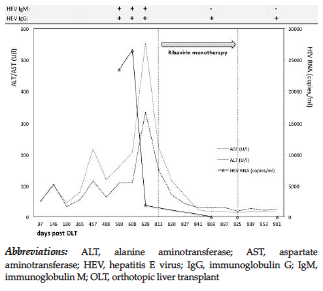
Figure 1. Course of Liver Enzymes (ALT, AST), HEV-RNA, and HEVAntibodies (IgM, IgG) Before, During, and After Ribavirin Monotherapy for Chronic HEV Infection After OLT
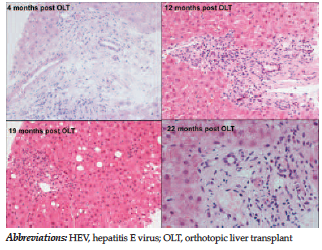
Figure 2. Development of Histologic Changes in the Liver Allograft Owing to Chronic HEV Infection After OLT (4, 12, 19, and 22 mo After OLT)