Volume: 13 Issue: 2 April 2015
FULL TEXT
The war in Syria that started in March 2011 has destroyed much of the country's infrastructure including many hospitals. The total number of kidney transplants performed in Syria in 2010 was 385 transplants before the number gradually declined to 154 transplants in 2013, a decrease of 60%. In addition, the number of operational kidney transplant centers has decreased from 8 to 4 centers. Unrelated-donor kidney transplant decreased from 70% during the years that preceded the crisis to 47% in 2013. More than 50% of physicians and surgeons involved in kidney transplant are not practicing transplant currently in their centers. Difficulties in the provision of immunosuppressive drugs for all patients in all provinces constitute a major challenge for the health authorities and transplant patients, especially patients who cannot arrange an alternate source. The project to initiate liver transplant came to a halt because foreign trainers could not visit Syria. The autologous bone marrow transplant program continued to function, but in a smaller and irregular manner. The commitment of transplant teams despite the large challenges was, and still is, extraordinary. In conclusion, all aspects of organ transplant have been affected, paralyzing new projects and negatively affecting existing programs.
Key words : War, Humans, Kidney transplant, Liver transplant, Bone marrow transplant
Introduction
Patients with established renal failure who live in developing countries face many obstacles including lack of access to transplant centers, quality issues, and safety issues.1 The conflict in Syria which began in March 2011 has caused the Syrians to face daily hazards because of war-related violence, threats to health, and lack of access to health services including organ transplant medicine. Many of the country's health care facilities, including clinics and transplant centers that had been established by the government, have been completely demolished or become nonoperational. The aim of this study is to highlight the effect of the Syrian crisis on the organ transplant in Syria.
Organ transplant in Syria
The first kidney transplant in Syria was performed in 1979. Currently,
kidney, bone marrow, and cornea are the only organs or tissues that could be
transplanted in Syria.2 A few heart transplants were performed in the
early 1990s. A deceased-donor program still is not available in Syria. The
Syrian government has taken steps to initiate liver transplant in the country.
Kidney transplant is the main transplant activity in Syria and relies
exclusively on living donors. Since the enactment of the new transplant law in
2003 that authorized recovery of organs from both deceased and unrelated donors,3
the kidney transplant rate has remarkably increased from 7 kidney transplants
per million population (pmp) in 2002 to 17 pmp in 2007.4 This rate
was maintained during the next few years until 2010, the year that preceded the
crisis, when 385 transplants (17 pmp) were performed.5 There have
been 4287 kidney transplants performed in Syria by the end of 2013.
The years that preceded the current war in Syria were marked by the delay in establishing the deceased-donor program and the exclusive reliance on living donors. The absence of growth of kidney transplant activity was multifactorial. The limited resources and small number of organized teams of transplant surgeons and nephrologists, and the lack of public awareness, education, and motivation for organ donation, had played a major role in delaying the start of a national deceased-donor program that could increase transplant from other organs and alleviate the burden from living kidney donors. Although prohibited by law, the practice of renal commerce was a major hurdle in establishing a deceased-donor program because it negatively affected the reputation of organ transplant. This model of organ commercialism is considered to be in violation of the Istanbul Declaration.6
The effect of war on kidney transplant activity
Kidney transplant is the main transplant activity in Syria and relies on
living-related and unrelated donors. The total number of kidney transplants
performed in Syria in 2010, the year that preceded the crisis, was 385
transplants (17 pmp). This rate has gradually declined during the following
years to 363 transplants in 2011; 257 transplants in 2012; and 154 transplants
in 2013 (6 pmp) (Figure 1), which was a reduction of 60% fewer kidney
transplants over several years, or an average annual decrease of 20%. There are
no available data regarding the number and outcome of dialysis patients who were
forced to leave the country during the crisis. However, only few patients
appeared in the central pharmacy of the Ministry of Health seeking
immunosuppressive drugs after being transplanted abroad. In addition, the number
of operational kidney transplant centers has decreased from 8 centers in 3
cities (6 in Damascus, 1 in Aleppo, and 1 in Homs) before the crisis to only 4
centers, all in Damascus.
Unrelated-donor kidney transplant also has decreased from 70% during the years that preceded the crisis to 61% by the end of 2011 and 47% in 2013 (72 of 154 transplants) (Figure 2). There is no known reason that could explain such a decline of kidney selling practice during the war. However, it is possible that the potential unrelated (paid) kidney donors who were seeking remuneration in exchange for the kidney may have found better alternate ways to obtain money during the war.
The war has affected kidney transplant activity in Syria because of several other factors such as the substantial decrease in the number of physicians and surgeons involved in kidney transplant; > 50% of them currently are not practicing in their centers, either because they left the country (29%) or their centers are not operational (22%). The availability of immunosuppressive drugs is another major issue that the health authorities and transplant patients are facing all over the country during the war, which has been marked by frequent interruption in the timely supply of these drugs, including free drugs, for all patients from different parts of the country. This has led to adverse medical consequences on patients who could not arrange an alternate source, in addition to the effect of newly imported drugs with unknown safety and efficacy profiles.
The effect of the war on other organ or tissue transplant activities
By the beginning of 2011, the government of Syria was taking steps to initiate
liver transplant in the country. For that purpose, efforts were made in several
directions including cooperation with well-known Brazilian and Iranian liver
transplant centers, where specialized teams were sent for training. However, the
trainers from those countries could not visit Syria because of the war, and the
project came to a halt.
The autologous bone marrow transplant prog-ram, which was a new program that was started before the crisis, continued to function at a smaller and irregular rate, and remained restricted to the Damascus area.
The commitment and dedication of transplant teams who still are doing their jobs in this very difficult and challenging situation are extraordinary, and these teams deserve to receive support from the international community. When the Syrian crisis ends, the Ministry of Health must address the restoration of the infrastructure of organ transplant centers and development of the long-awaited deceased-donor program. This may require necessary reforms in the judicial system and a solution for renal commerce by alleviating poverty and increasing awareness, education, and motivation for organ donation. These are difficult measures to implement in a developing country such as Syria.7,8
Conclusion
The war in Syria has severely affected patients and health services in Syria. All aspects of organ transplant have been affected, paralyzing new projects and negatively affecting existing programs. This has deprived this nation services that already had been achieved.
References:
- Akoh JA. Renal transplantation in developing countries. Saudi J Kidney
Dis Transpl. 2011;22(4):637-650.
PubMed - Saeed B, Derani R, Hajibrahim M, et al. Organ failure in Syria:
initiating a national deceased donation program. Saudi J Kidney Dis
Transplant. 2007;18(2):270-276.
PubMed - Saeed B, Derani R, Hajibrahim M, et al. Volume of organ failure in Syria
and obstacles to initiate a national cadaver donation program. Iran J Kidney
Dis. 2008;2(2):65-71.
PubMed - Saeed B. Current challenges of organ donation programs in Syria. Int J
Organ Transplant Med. 2010;1(1):35-39.
PubMed - Saeed B. Development of solid organ transplantation in Syria. Int J
Organ Transplant Med 2011;2(1):40-46.
PubMed - Participants in the International Summit on Transplant Tourism and Organ
Trafficking Convened by The Transplantation Society and International
Society of Nephrology in Istanbul, Turkey, April 30 through May 2, 2008. The
Declaration of Istanbul on Organ Trafficking and Transplant Tourism. Clin J
Am Soc Nephrol. 2008;3(5):1227-1231.
PubMed - Spasovski G, Stathakis C, Basci A. A struggle for kidney transplantation in a developing world? BANTAO Journal. 2007;5(2):2.
- Rizvi SA, Naqvi SA, Hussain Z, et al. Renal transplantation in
developing countries. Kidney Int Suppl. 2003;83:S96-S100.
CrossRef - PubMed
Volume : 13
Issue : 2
Pages : 206 - 208
DOI : 10.6002/ect.2014.0287
From the Pediatric Nephrology Department, Surgical Kidney Hospital, Damascus,
Syria
Acknowledgements: The author thanks Dr. Rania Derani, Dr. Ayham Mulhem,
Dr. Mahmoud Darweesh, Dr. Ammar Raei, Dr. Nabil Rajeh, Dr. Zahira Fahad, and Dr.
Najieh Ramadan for their collaboration. The author declares no conflicts of
interest. No funding was received for this study.
Corresponding author: Dr. Bassam Saeed, P.O. Box 8292, Damascus, Syria
Phone: +963 11 4462800
Fax: +963 11 4462820
E-mail: bmsaeed2000@yahoo.com
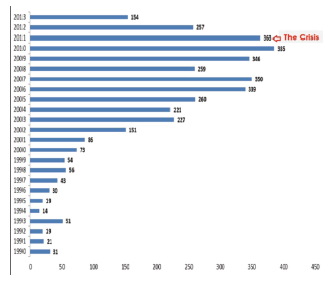
Figure 1. The Total Number of Kidney Transplants in Syria (1990 to 2013)
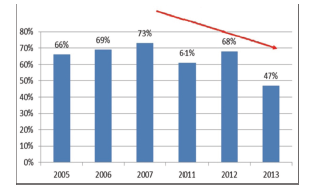
Figure 2. Unrelated Kidney Donors as a Percentage of All Living Donors Before and After the Crisis in Syria