Volume: 12 Issue: 4 August 2014
FULL TEXT
Objectives: Acute antibody-mediated rejection is an important cause of acute and chronic kidney allograft dysfunction and graft loss. The purpose of the present study was to evaluate our experience using plasmapheresis and intravenous immuno-globulin in treating patients who had acute antibody-mediated rejection after kidney transplant.
Materials and Methods: A retrospective review of 13 patients who had biopsy proven antibody-mediated rejection was performed to determine the efficacy of plasmapheresis and intravenous immuno-globulin with or without bortezomib.
Results: All 13 patients were treated with plasmapheresis (5-18 sessions) with intravenous immunoglobulin (2 ± 1 g/kg) during and/or after plasmapheresis; 6 patients also received bortezomib. Mean age was 43 ± 10 years and median time from transplant to rejection was 4.5 months (interquartile range, 1.25-20 mo). Most patients (11 patients [85%]) had serum creatinine level return to within 20% baseline serum creatinine level before rejection. In all 13 patients, mean hospital length of stay was 27 ± 14 days. Frequency of recurrence of antibody-mediated rejection was 31%, and 1 patient resumed dialysis 7 months after treatment. Mean serum creatinine level was greater before (217 ± 111 μmol/L) than after treatment (141 ± 59 μmol/L; P ≤ .03).
Conclusions: The combination of intensive plasma-pheresis and intravenous immunoglobulin is effective treatment for antibody-mediated rejection after kidney transplant. Long-term, prospective studies are justified to determine the effect of this regimen on graft survival.
Key words : Bortezomib, End-stage kidney disease, Outcome, Survival
Introduction
Acute antibody-mediated rejection (ABMR) after kidney transplant has high associated risk of early graft loss (50% to 85%) and is the main cause of graft failure.1-3 The incidence of ABMR ranges from 6% to 30%, and ABMR may occur with acute cellular rejection. The increased awareness and recognition of ABMR has caused physicians and investigators to evaluate new therapies. There is no drug that currently is approved by the United States Food and Drug Administration for the treatment of acute ABMR. Most transplant centers use the Best Practice Approach, which is usually defined as plasmapheresis and the use of intravenous immunoglobulin (IVIG) (with or without bortezomib and/or rituximab) to treat the patients who have ABMR.
The purpose of the present study was to evaluate our experience using plasmapheresis and intravenous immunoglobulin in treating patients who had acute ABMR.
Materials and Methods
Subjects
This was a retrospective study of outpatients who were treated at the renal
transplant clinic from October 1, 2004 to April 30, 2013. All recipient charts
were reviewed for baseline clinical and laboratory data, immunosuppressive
regimens, and the time of biopsy-proven ABMR at diagnosis of ABMR. In Thailand,
all deceased-donor kidneys were allocated by the National Organ Donation Center
of the Thai Red Cross Society. Donors were screened with antihuman globulin
enhanced complement-dependent cytotoxicity crossmatch assay. In addition, panel
reactive antibody assay for human leukocyte antigen antibody testing was
performed by the fluorescent bead method. The study was approved by the ethics
committee in our hospital. This study was approved by our hospital’s Human
Research Ethics Committee, and all protocols conformed with the ethical
guidelines of the 1975 Helsinki Declaration. All subjects gave written informed
consent.
Evaluation
The diagnosis of ABMR was based on the Banff 1997 working classification of
renal allograft pathology. Serum creatinine and estimated glomerular filtration
rate (GFR) calculated with the Chronic Kidney Disease Epidemiology Collaboration
formula were determined before and after treatment for ABMR.4 The severity of
rejection was determined by reviewing the histologic findings in allograft
biopsy specimens including the Banff scoring of peritubular capillaritis (ptc),
the percentage of PTC involvement (the number of PTC-containing neutrophils per
100 capillaries), the presence of glomerulitis, and glomerulitis score.5,6
The patient and graft outcomes including serious adverse events were identified
after treatment.
Treatment
Patients who had ABMR were treated with plasmapheresis for ≥ 5 sessions and
IVIG. Cyclosporine was replaced with tacrolimus and azathioprine was replaced
with mycophenolate mofetil. Plasma volume was estimated using the formula:
Plasma volume = (0.65 × body weight [kg]) × (1 - hematocrit), and the volume exchanged was titrated between 1 and 2 plasma volumes, depending on patient tolerance and clinical response. Plasmapheresis with intravenous albumin solution was performed daily in all patients. Treatment was continued until recovery of renal function was observed. Treatment was terminated when extensive tubular atrophy and interstitial fibrosis were documented in the second allograft biopsy. Concomitant acute cellular rejection was treated with methylprednisolone pulses.
Statistical analyses
Statistical analyses were performed with SPSS software (SPSS: An IBM Company,
version 12.0, IBM Corporation, Chicago, IL, USA). For continuous variables,
results are presented as mean ± SD. Statistical differences in variables were
compared using one-way analysis of variance (ANOVA) and unpaired t test for
normally distributed variables and Kruskal-Wallis test for non-normally
distributed variables. Categorical variables were recorded as frequency counts,
and intergroup comparisons were analyzed by chi-square test. Statistical
significance was defined by P ≤ .05.
Results
There were 13 patients (8 men, 5 women; mean age, 43 ± 10 y) who were diagnosed as having ABMR on the basis of findings on a kidney biopsy (Table 1). There were 10 patients who had diffusely positive PTC C4d staining (> 50% PTC stained) and another patient who had positive donor-specific antibody titer; the other 2 patients had negative PTC C4d staining and the test for donor-specific antibody was not available. There was concurrent acute cellular rejection in 5 patients. All patients had a negative antihuman globulin enhanced complement-dependent cytotoxicity crossmatch before kidney transplant, with mean panel reactive antibody 8% ± 16% (range, 0%-55%). Median human leukocyte antigen mismatch was 3 (interquartile range, 3-5). All patients had their first kidney transplant, and 8 patients received living-related kidney transplant. Induction immunosuppressive therapy was basiliximab in 7 patients, rabbit anti-thymocyte globulin in 2 patients, daclizumab in 2 patients, and none in 2 patients. All patients were maintained on a calcineurin inhibitor (tacrolimus or cyclosporine), antimetabolite (mycophenolate mofetil, mycophenolic acid, or azathioprine), and steroid (Table 1). Delayed graft function occurred in 2 patients (15%).
Median time from transplant to rejection was 4.5 months (interquartile range, 1.25-20 mo). In 12 of 13 patients, initial treatment for ABMR included plasmapheresis and IVIG (mean IVIG dose, 2 ± 1 g/kg during and after plasmapheresis) (Table 2); the other patient (patient number 13) received plasmapheresis followed by 1 dose of rituximab (500 mg). Patients who did not have prompt response to the initial 3 sessions of plasmapheresis received bortezomib and/or rituximab. The median number of plasma-pheresis sessions per patient was 8 sessions (range, 5-18 sessions) and mean total plasma volume was 16 ± 7 plasma volumes per patient.
There were 5 patients who had Banff PTC score 3 (cortical PTC with >10 luminal inflammatory cells) and the other 8 patients had Banff PTC score 2 (cortical PTC with 5-10 luminal inflammatory cells). The patients who had Banff PTC score 3 received more plasmapheresis sessions (median, 14 sessions; interquartile range, 11-17 sessions) and total plasma volume (median, 19 plasma volumes; interquartile range, 18-28 plasma volumes) than patients who had Banff PTC score 2 (median, 7 sessions; interquartile range, 7-9 sessions; P ≤ .007) (median, 11 plasma volumes; interquartile range, 9-13 plasma volumes; P ≤ .03). There was a significant correlation between the number of plasmapheresis sessions and percentage of PTC involvement (P ≤ .009) and between total plasma volume of treatment and percentage of PTC involvement (P ≤ .02).
In the 13 patients, 10 patients had glomerulitis score g3 (glomerulitis in >
75% glomeruli) and only 3 patients had glomerulitis score g2 (glomerulitis in
25%-75% glomeruli). The number of plasmapheresis sessions was not significantly
different for patients who had glomerulitis score g3 (median, 10.5 sessions;
interquartile range, 7-14 sessions) and g2 (median, 7 sessions; interquartile
range, 5-8 sessions).
Bortezomib was given to 6 patients and rituximab was given to 3 patients (Table
2). There were 2 patients (patient Nos. 1 and 8) who had 3 allograft biopsies
(at the time of ABMR diagnosis and during plasma-pheresis treatment) that showed
progressive decrease of peritubular capillaritis and glomerulitis.
Mean serum creatinine level was greater before (217 ± 111 μmol/L) than after treatment (141 ± 59 μmol/L; P ≤ .03) (Table 2 and Figure 1). Mean estimated GFR was lower before (33 ± 11 mL/min/1.73 m2) than after treatment (57 ± 25 mL/min/1.73 m2; P = .002). Most patients (11 patients [85%]) had serum creatinine level return to within 20% baseline serum creatinine level before ABMR. Subgroup analysis showed that the patients who developed ABMR within 3 months after transplant had significant decrease in serum creatinine and increase in estimated GFR after treatment, but patients who developed ABMR > 3 months after transplant did not have any significant change in serum creatinine or estimated GFR after treatment (Table 3). In all 13 patients, mean hospital length of stay was 27 ± 14 days. Frequency of recurrence of ABMR was 4 out of 13 patients (31%), and 1 patient resumed dialysis 7 months after treatment. After median follow-up 8.7 months (interquartile range, 6.4-21 mo), Kaplan-Meier method showed patient survival 100% and graft survival 92%.
Complications included serious infection in 6 patients including BK virus nephropathy alone in 2 patients; BK virus nephropathy and cytomegalovirus nephritis in 1 patient at 1 month after ABMR treatment; Pneumocystis jirovecii pneumonia in 1 patient at 18 months after ABMR treatment followed by pulmonary aspergillosis 1 month later that was successfully treated with voriconazole; cytomegalovirus pneumonitis in 1 patient at 1 month after ABMR treatment; and cytomegalovirus viremia in 1 patient at 1 month after ABMR treatment.
Adverse effects of bortezomib included peripheral neuropathy that resolved spontaneously in 4 patients and diarrhea that resolved with supportive care in 2 patients.
Discussion
The present short-term outcome study showed successful treatment of acute ABMR after kidney transplant. Most patients (85%) had serum creatinine level after treatment returned to within 20% baseline serum creatinine before AMBR. At median follow-up 8.7 months (interquartile range, 6.4-21 mo), treatment resulted in high patient and graft survival.
Treatment options for ABMR are directed at antibody reduction and inhibition of complement activation and injury. These treatments may include plasma exchange, IVIG, and bortezomib or rituximab for antibody reduction. No standardized treatment has been approved for the treatment of ABMR. A systematic review of the treatment of acute ABMR in kidney transplant recipients showed that in 10 388 citations, there were only 4 studies that evaluated plasmapheresis and only 1 study that suggested benefit from plasmapheresis.7 The effective dosage and regimen of any current treatment option was unknown.7
The present study showed that the median number of plasmapheresis sessions was 8 sessions (range, 5-18 sessions) with mean 16 ± 7 plasma volumes per patient. Intensive plasmapheresis may remove previously secreted antibodies and increase the metabolic demand on memory B cells and plasma cells that may make them susceptible to proteasome inhibition. The present IVIG regimen was given for a total dose 2 ± 1 g/kg body weight. The IVIG regimen may neutralize autoantibodies and alloantibodies, down-regulate antibody production, inhibit complement activation, and induce inhibitory Fcγ receptor IIB.8
The present outcomes were similar to the previously reported frequency of successful treatment (83%) after 10 plasma exchange sessions per patient (range, 5-17 sessions) and IVIG.9 In contrast, another study showed that 3 of 7 patients who developed ABMR did not respond to 5 plasmapheresis sessions and IVIG, and 2 patients had graft loss.10 Another study showed that patient survival was 100% and graft survival was 50% at mean follow-up 10 months in patients who were treated with 2 to 6 plasmapheresis sessions with IVIG.11 Rebound synthesis of alloantibodies may occur and may cause poor response to treatment.12
Treatment of ABMR with bortezomib in addition to conventional therapy (usually defined as plasma-pheresis and use of IVIG) was partially effective.13-15 In the present patients who did not have prompt response to the initial 3 sessions of plasmapheresis, additional treatment included bortezomib and/or rituximab, but there was no significant difference in clinical outcome between patients who received or did not receive bortezomib. This may have been caused by the small sample size and selection bias because bortezomib was given only to patients who had refractory ABMR.
Subgroup analysis showed that patients who had early ABMR (≤ 3 mo after transplant) responded well to treatment, but patients who had later ABMR did not have a significant change in serum creatinine or estimated GFR from before to after treatment (Table 3). We could not identify different characteristics of patients between the subgroups. Therefore, ABMR that develops late after transplant may be an important contributor to late kidney allograft loss, as previously noted in the Banff 2011 meeting report.16
Limitations of the present study included the retrospective design and small number of subjects. We introduced the use of bortezomib and/or rituximab in few refractory cases. Therefore, the efficacy of bortezomib could not be determined because of selection bias and the small sample size. In addition, donor-specific antibody tests were performed only in 3 patients because of financial limitations. Although the pathologic diagnosis of acute ABMR was made in all 13 patients, positive PTC C4d staining was observed in 10 patients and positive donor-specific antibody titer was noted in another patient; there were 2 patients who had negative peritubular capillary C4d staining, but donor-specific antibody tests were not done in these patients. Previous studies reported that C4d staining had high specificity (93%-96%) but low sensitivity (31%-95%).12 The existence of C4d-negative ABMR has been accepted at the eleventh Banff meeting and in the Banff 2013 meeting report.16,17
In summary, intensive plasmapheresis and IVIG may improve renal function and may reverse histologic markers of rejection in patients who have ABMR. However, aggressive treatment of rejection may be complicated by opportunistic infection. Long-term, prospective follow-up studies are justified to determine the effect of this regimen on donor antibody removal, histologic changes, and graft survival.
References:
- Pascual M, Saidman S, Tolkoff-Rubin N, et al. Plasma exchange and
tacrolimus-mycophenolate rescue for acute humoral rejection in kidney
transplantation. Transplantation. 1998;66(11):1460-1464.
CrossRef - PubMed - Sellarés J, de Freitas DG, Mengel M, et al. Understanding the causes of
kidney transplant failure: the dominant role of antibody-mediated rejection
and nonadherence. Am J Transplant. 2012;12(2):388-399.
CrossRef - PubMed - Gaston RS, Cecka JM, Kasiske BL, et al. Evidence for antibody-mediated
injury as a major determinant of late kidney allograft failure.
Transplantation. 2010;90(1):68-74.
CrossRef - PubMed - Levey AS, Stevens LA, Schmid CH, et al. A new equation to estimate
glomerular filtration rate. Ann Intern Med. 2009;150(9):604-612.
CrossRef - PubMed - Racusen LC, Halloran PF, Solez K. Banff 2003 meeting report: new
diagnostic insights and standards. Am J Transplant.2004;4(10):1562-1566.
CrossRef - PubMed - Racusen LC, Solez K, Colvin RB, et al. The Banff 97 working
classification of renal allograft pathology. Kidney Int.1999;55(2):713-723.
CrossRef - PubMed - Roberts DM, Jiang SH, Chadban SJ. The treatment of acute
antibody-mediated rejection in kidney transplant recipients - a systematic
review. Transplantation. 2012;94(8):775-783.
CrossRef - PubMed - Singh N, Pirsch J, Samaniego M. Antibody-mediated rejection: treatment
alternatives and outcomes. Transplant Rev (Orlando). 2009;23(1):34-46.
CrossRef - PubMed - Gubensek J, Buturovic-Ponikvar J, Kandus A, et al. Plasma exchange and
intravenous immunoglobulin in the treatment of antibody-mediated rejection
after kidney transplantation: a single-center historic cohort study.
Transplant Proc. 2013;45(4):1524-1527.
CrossRef - PubMed - Gulleroglu K, Baskin E, Bayrakci US, et al. Antibody-mediated rejection
and treatment in pediatric patients: one center’s experience. Exp Clin
Transplant. 2013;11(5):404-407.
CrossRef - PubMed - Rodríguez Ferrero M, Rincón A, Bucalo L, Rementería A, Anaya F.
Treatment of acute antibody-mediated rejection: a single-center experience.
Transplant Proc. 2010;42(8):2848-2850.
CrossRef - PubMed - Blume OR, Yost SE, Kaplan B. Antibody-mediated rejection: pathogenesis, prevention, treatment, and outcomes. J Transplant. 2012;2012:201754.
- Everly MJ, Everly JJ, Susskind B, et al. Bortezomib provides effective
therapy for antibody- and cell-mediated acute rejection. Transplantation.
2008;86(12):1754-1761.
CrossRef - PubMed - Walsh RC, Alloway RR, Girnita A, Woodle ES. Proteasome inhibitor-based
therapy for antibody-mediated rejection. Kidney Int. 2012;81(11):1067-1074.
CrossRef - PubMed - Walsh RC, Everly JJ, Brailey P, et al. Proteasome inhibitor-based
primary therapy for antibody-mediated renal allograft rejection.
Transplantation. 2010;89(3):277-284.
CrossRef - PubMed - Mengel M, Sis B, Haas M, et al. Banff 2011 meeting report: new concepts
in antibody-mediated rejection. Am J Transplant. 2012;12(3):563-570.
CrossRef - PubMed - Haas M, Sis B, Racusen LC, et al. Banff 2013 meeting report: inclusion
of C4d-negative antibody-mediated rejection and antibody-associated arterial
lesions. Am J Transplant 2014;14(2):272-283.
CrossRef - PubMed

Volume : 12
Issue : 4
Pages : 328 - 333
DOI : 10.6002/ect.2013.0296
From the 1Division of Nephrology, Department of Medicine, and
2Department of Pathology, Phramongkutklao Hospital and College of
Medicine, Bangkok, Thailand
Acknowledgements: The authors have no competing interests to declare. The
present study was supported by Phramongkutklao Hospital and College of Medicine.
Corresponding author: Prajej Ruangkanchanasetr, MD, Division of
Nephrology, Department of Medicine, Phramongkutklao Hospital, 315 Rajavithi
Road, Rajathevi, Bangkok 10400, Thailand
Phone: +66 2 644 4676
Fax: +66 2 644 4676
E-mail: prajej@gmail.com
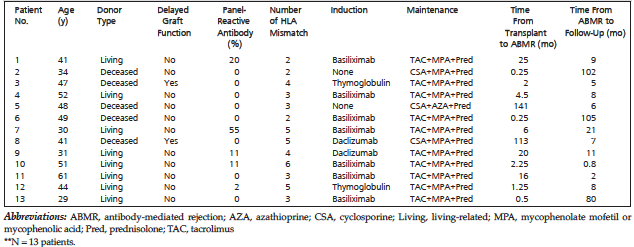
Table 1. Clinical Characteristics of Patients Who Had Antibody-Mediated Rejection After Kidney Transplant*
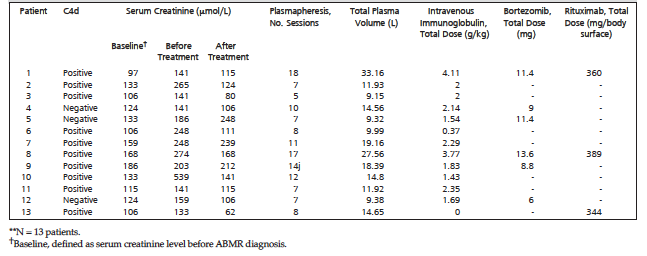
Table 2. Evaluation and Treatment of Patients Who Had Antibody-Mediated Rejection After Kidney Transplant*

Table 3. Serum Creatinine and Estimated Glomerular Filtration Rate in Patients Who Had Antibody-Mediated Rejection After Kidney Transplant*
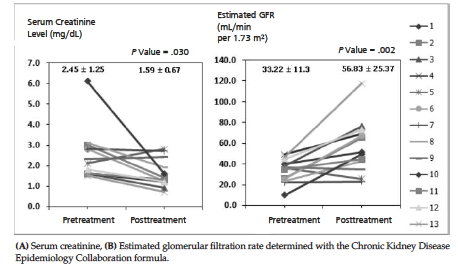
Figure 1. Parameters of Kidney Function at Diagnosis of Antibody-Mediated Rejection and After Treatment (N = 13 Patients)