Volume: 11 Issue: 6 December 2013
FULL TEXT
Objectives: Hearing impairment is a frequent problem that can easily influence the quality of life for the individual. It may affect one's social and academic life. Knowledge regarding hearing impairment after renal transplant is sparse. It has been suggested that renal transplant improves hearing function. Potential ototoxic side effects may be related to immuno-suppression with calcineurin inhibitors. In pediatric renal transplanted patients, we do not have enough information about this subject. We report 2 cases that developed sudden hearing loss after a renal transplant that was associated with high serum levels of tacrolimus.
Case Reports: Two renal transplanted children (a 15-year-old boy and a 17-year-old girl), in the fourth year of their follow-up after transplant, developed symptomatic bilateral sudden hearing loss. There was a marked hearing impairment for the higher frequencies between 4000 and 8000 Hz in pure-tone audiometry evaluation. Also, a decrease of speech understanding was found, but the patients were not conscious of this problem. Hearing loss in these patients was not associated with any known risk factors such as chronic renal disease, ototoxic drugs, or acoustic trauma. Sudden hearing loss occurred under high serum levels of tacrolimus, and after dosage correction of tacrolimus pure-tone audiometry ruled out hearing loss progression for each patient.
Conclusions: Awareness of this potential complication of tacrolimus may be helpful for early recognition and treatment.
Key words : Hearing loss, Quality of life, Calcineurin inhibitors, Tacrolimus, Pediatric renal transplant
Introduction
Hearing impairment is a major factor in the subjective perception of health status. Knowledge about hearing impairment after renal transplant is limited. It has been suggested that renal transplant improves hearing function.1 The cause of sensorineural hearing impairment is usually the combined result of many factors. Potential ototoxic side effects (sensorineural hearing impairment) may be related to immuno-suppression with calcineurin inhibitors. One of the major side effects seen with the use of calcineurin inhibitors is neurotoxicity. Calcineurin plays such an extensive role in the rapid functioning of neurons. Neurotoxicity likely is due to the inhibition of calcineurin within nerve cells.2 These neurotoxic side effects could be involved in development of hearing impairment after transplant. Recent studies in adult patients show that immunosuppressive treatments, especially with high serum levels of tacrolimus after transplant, can affect hearing and also mention reversible hearing impairment.3
In pediatric renal transplanted patients, there is a paucity of information on this subject, and we report 2 cases that developed sudden hearing loss after a renal transplant that was associated with high serum levels of tacrolimus.
Case Reports
Patient 1
Patient 1 was 15-year-old boy, with a cause of renal failure that was
nephronophythisis. After transplant, he received tacrolimus (0.1 mg/kg/d),
mycophenolate mofetil (600 mg/m2/d), and oral prednisolone (0.5
mg/kg/d). Serum tacrolimus levels were measured during follow-up for dosage
adjustment at each visit. He had normal graft function during follow-up
(creatinine 70.72 μmol/L). During the fourth year of his follow-up, he developed
symptomatic bilateral sudden hearing loss and tinnitus. Other symptoms such as
vertigo and dizziness were not present. An otoscopy revealed normal tympanic
membranes. Pure-tone audiometry was used to evaluate quantitatively the
perception of hearing loss, measuring sound frequencies varying from 250 to 8000
Hz. Hearing impairment occurs when auditory loss is greater than 25 dB in any of
the aforementioned frequencies.
The patient had a marked hearing impairment for the higher frequencies between 4000 and 8000 Hz (Table 1). Hearing aids were necessary. Also, a decrease of speech understanding was found, but the patient was not conscious of this problem. Results of a cranial magnetic resonance imaging scan were within the normal ranges. Hearing loss in this patient was not associated with known risk factors such as chronic renal disease, ototoxic drugs, or acoustic trauma. During long-term follow-up, the patient had no infections like meningococcal or cryptococcal meningitis, mumps, measles, and rubella. Blood tests for toxoplasmosis, cytomegalovirus, herpes simplex virus type 1, and human immunodeficiency virus were negative. Sudden hearing loss occurred under high serum levels of tacrolimus. A serum level of tacrolimus at the time of hearing loss was 22.01 nmol/L (Table 1). After immediate dosage correction of tacrolimus, pure-tone audiometry ruled out hearing loss progression. The patient did not have tinnitus anymore. During follow-up, hearing loss was not repeated, but decrease of speech understanding was continued.
Patient 2
Patient 2 was 17-year-old girl with renal failure and vesicoureteral reflux.
After transplant, she received tacrolimus (0.1 mg/kg/d), mycophenolate mofetil
(600 mg/m2/d), and oral prednisolone (0.5 mg/kg/d). Serum tacrolimus
levels were measured during follow-up for dosage adjustment at each visit. She
had normal graft function during follow-up (creatinine 61.88 μmol/L). During the
fourth year of her follow-up after transplant she developed symptomatic
bilateral sudden hearing loss. Other symptoms such as tinnitus, vertigo, and
dizziness were not accompanied with hearing loss. An otoscopy revealed normal
tympanic membranes. Pure-tone audiometry is used to evaluate quantitatively the
perception of hearing loss, measuring sound frequencies varying from 250 to 8000
Hz. Hearing impairment occur when auditory loss is greater than 25 dB in any of
the aforementioned frequencies. There was a marked hearing impairment at the
higher frequencies, between 4000 and 8000 Hz (Table 1). Hearing aids also were
necessary. Also, a decrease of speech understanding was found, but the patient
was not conscious of this problem. A cranial magnetic resonance imaging scan was
within the normal ranges. Hearing loss in this patient was not associated with
known risk factors such as chronic renal disease, ototoxic drugs, or acoustic
trauma. During long-term follow-up, the patient had no infections like
meningococcal or cryptococcal meningitis, mumps, measles, and rubella. Blood
tests for toxoplasmosis, cytomegalovirus, herpes simplex virus type 1,
and human immunodeficiency virus were negative. Sudden hearing loss occurred
under high serum levels of tacrolimus. A serum level of tacrolimus at the time
of hearing loss was 29.97 nmol/L (Table 1). After an immediate dosage correction
of tacrolimus, pure-tone audiometry ruled out hearing loss progression. During
follow-up, hearing loss was not repeated, but a decrease of speech understanding
continued.
Discussion
Hearing loss is a disorder that may influence a patient’s quality of life. Although many side effects of calcineurin inhibitors are well known, few published studies mention information about effect on hearing. The cause of sensorineural hearing impairment usually is the combined result of many factors such as acoustic trauma, Ménière disease, congenital and genetic diseases (which are concurrent with the onset of the hearing impairment), thromboembolic events, insufficient graft function, hypertension, infection, or drug ototoxicity. Depending on the mechanism of action of the specific agent, hearing loss may be temporary or permanent.4 In most cases, hearing loss is irreversible and results in the need for a hearing aid.3
Potential ototoxic side effects may be related to immunosuppression with tacrolimus. Tacrolimus is a macrolide immunosuppressive agent frequently used in human transplants. Erythromycin, clarithromycin, and azithromycin also are macrolide antibiotics known to produce detectable, dose- and time-dependent hearing loss.5 Hearing loss has been reported after administration of various immunosuppressive drugs, including tacrolimus.5 It has been suggested that it is a dose-dependent mechanism such as neurotoxicity.3 Sudden hearing loss occurred in our patients under high serum levels of tacrolimus. Drug monitoring was done for these 2 patients during their 4 years of follow-up, but they never had high tacrolimus levels before.
Four years after the transplants, the serum tacrolimus levels may have increased after a change in the rate of tacrolimus metabolism. It is difficult to explain which cause is responsible for this change. It may be related to an interaction with other drugs, such as an NSAID, antifungal agents, macrolide antibiotic, or simply drinking too much grapefruit juice. Our patients used NSAIDs for grippal infection. There is evidence that calcineurin inhibitor-related neurotoxicity is caused by endothelial damage and vasculopathy disturbing the blood-brain barrier. Regarding hearing impairment, vascular damage of capillary endothelial cells of the inner ear disturbing the blood-inner ear barrier may be hypothesized.6 Association of sudden hearing loss with high levels of calcineurin inhibitors has been reported. In all these cases, hearing loss was halted or even reversed after dosage correction. This suggests a dose-dependent toxicity, which is typical for calcineurin inhibitor-related neurotoxicity.3 Although Rifai and associates reported 5 patients with calcineurin inhibitor-related chronic hearing loss.5 In accord with this report, in our cases, hearing did not get worse, but it did not reach the normal range for higher frequencies between 4000 and 8000 Hz, and hearing aids were necessary. Decrease of speech understanding was not resolved.
Hearing loss is not in the focus of the clinical care for pediatric renal transplants. The effect of hearing loss on a person’s quality of life should be remembered. Awareness of this potential complication of tacrolimus may be helpful for early recognition and treatment. Periodic audiological assessments may be indicated in transplanted patients who undergo long-term treatment with calcineurin inhibitors.
References:
- Mitschke H, Schmidt P, Zazgornik J, Kopsa H, Pils P. Effect of renal
transplantation on uremic deafness: a long-term study. Audiology.
1977;16(6):530-534.
CrossRef - PubMed - Tan TC, Robinson PJ. Mechanisms of calcineurin inhibitor-induced
neurotoxicity. Transplantation Reviews. 2006;20(1):49-60.
CrossRef - Rifai K, Bahr MJ, Cantz T, Klempnauer J, Manns MP, Strassburg CP. Severe
hearing loss after liver transplantation. Transplant Proc.
2005;37(4):1918-1919.
CrossRef - PubMed - Marioni G, Perin N, Tregnaghi A, Bellemo B, Staffieri A, de Filippis C.
Progressive bilateral sensorineural hearing loss probably induced by chronic
cyclosporin A treatment after renal transplantation for focal
glomerulosclerosis. Acta Otolaryngol. 2004;124(5):603-607.
CrossRef - PubMed - Fortes ME, Marroni CA, Coser PL, de los Santos CA. Audiometric changes
in patients undergoing liver transplantation using distinct
immunosuppressive protocols. Liver Transpl. 2008;14(4):509-511.
CrossRef - PubMed - Zhang ZJ, Saito T, Kimura Y, Sugimoto C, Ohtsubo T, Saito H. Disruption
of mdr1a p-glycoprotein gene results in dysfunction of blood-inner ear
barrier in mice. Brain Res. 2000;852(1):116-126.
CrossRef - PubMed

Volume : 11
Issue : 6
Pages : 562 - 564
DOI : 10.6002/ect.2012.0241
From the Departments of 1Pediatric Nephrology; 2Otorhinolaryngology;
and 3General Surgery, Baskent University, Ankara, Turkey
Acknowledgements: The authors report no conflicts of interest.
Corresponding author: Kaan Gulleroglu, MD, Baskent University Pediatric
Nephrology Department, 54. Cadde No: 72/3, Bahcelievler Cankaya 06490 Ankara,
Turkey
Phone: +90 532 647 2268
Fax: +90 312 215 7597
E-mail:
kaangulleroglu@yahoo.com
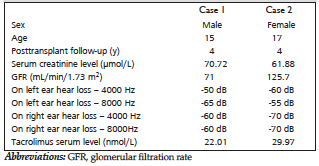
Table 1. Demographic, Laboratory Data, and Hearing Assessment Results