Volume: 11 Issue: 6 December 2013
FULL TEXT
Objectives: To evaluate the outcome of renal transplants using donor grafts with complete ureteral duplication.
Materials and Methods: Between 1999 and 2011, we performed 1368 kidney transplant procedures, including 87 dual kidney transplants. There were 12 transplants with donor kidneys that had complete ureteral duplication, including 2 patients who had grafts with ureteral duplication that were used to perform a dual kidney transplant. In 11 patients with ureteral duplication, the 2 ureters were anastomosed separately to the bladder with a double Lich-Gregoir technique; in 1 patient, a ureteroureteral terminolateral anastomosis and single ureteroneocystostomy were performed.
Results: Urinary tract infections were noted during the first year after transplant in 7 patients (58%) that had kidney grafts with duplicated ureters (4 patients with 1 infection each; 3 patients with 2 infections each), but none developed pyelonephritis, functional impairment, or graft loss. There were no other urologic or renal complications observed in recipients of grafts with ureteral duplication.
Conclusions: Donor kidneys with ureteral duplication may be used in renal transplant. The double Lich-Gregoir technique may provide excellent results.
Key words : Anatomic variation, End-stage renal disease, Urinary tract infection, Surgical technique
Introduction
Although living-donor or deceased-donor kidney transplant is the best treatment available for chronic renal disease, kidneys from deceased donors are limited in quantity. The shortage of donor organs has prompted efforts to broaden the donation pool and lower the threshold for kidney donation. Transplant surgeons may use all compatible donor organs, including organs with anatomic variants such as ureteral duplication, which is the most common congenital malformation of the upper urinary tract in the general population (prevalence, 0.6% to 1%).1,2
The technique for completely duplicated ureters in transplant donor kidneys is difficult. Kidney transplant surgeons previously had been reluctant to consider donor kidneys with ureteral duplication. Transplants with donor kidneys having ureteral duplication may have a high risk of complications because of limited blood supply to the distal segment of the ureters. Nevertheless, these kidneys are used presently despite inadequate ureteral vascularization and limited experience with the technique of ureteroneocystostomy.3-6 Ureteral complications are a major cause of morbidity associated with renal transplant, and most of these complications are caused by ureteroneocystostomy.
This study sought to evaluate outcomes of kidney transplant with donor grafts that had complete ureteral duplication, including patient and graft survival and urologic complications.
Materials and Methods
Between 1999 and 2011, we performed 1368 renal transplants from 79 living and 1289 deceased donors), including 87 dual kidney transplants (total, 1455 functional grafts). A retrospective analysis of the clinical database was done. There were 12 transplanted grafts (0.8%) that had complete ureteral duplication, including 2 kidneys from living donors (excised with a laparoscopic procedure from 1 man and 1 woman) and 10 kidneys from deceased donors (5 men and 5 women; median age, 56.8 y; age range, 36-71 y) (cold ischemia time: median, 21 h; range, 17-25 h). The recipients of kidneys with ureteral duplication included 10 men and 2 women (median age, 54.5 y; age range, 36-71 y). In 2 patients, a dual kidney transplant was performed after graft biopsy (score 5). All protocols were approved by the ethics committee of the institution before the study began, and the protocols conformed with the ethical guidelines of the 1975 Helsinki Declaration.
In 11 kidneys with ureteral duplication, the 2 ureters were anastomosed
separately to the bladder with a double Lich-Gregoir technique (Figure 1). In 1
transplant recipient who had a small bladder with very low compliance because of
prolonged anuria time, transplant was done with a ureteroureteral terminolateral
anastomosis and a single ureterocystoneostomy. A ureteral double J stent
(4.8 Fr; length, 12 cm), with an antireflux valve, was placed during the
transplant and removed at 4 to 6 weeks after transplant. There were 2 patients
who had dual kidney transplants with 3 different ureterocystostomies and 3
ureteral stents (Figure 2). Postoperative treatment was the same as in patients
without duplicated ureters, including urethral catheter removal on the seventh
postoperative day and ureteral stent removal at 4 to 6 weeks after the
transplant.
Results
There were no recipients that had postoperative fever, acute renal failure, acute transplant rejection resulting in graft loss, urinary leak, ureteral obstruction, excessive bleeding, major hematuria, or other complications early after transplant. Mean serum creatinine clearance at discharge from hospital was 0.65 mL/s/m2 (range 1.02-0.51 mL/s/m2), and this was unchanged at 12 months after transplant, also in case of dual kidney transplants.
No change in the immunosuppressive protocol was necessary in patients with transplanted kidneys that had duplicated compared with nonduplicated ureters. Late urologic complications such as ureteral stenosis, ureterolithiasis, or reflux nephropathy were not observed.
Urinary tract infections were noted during the first year after transplant in 7 patients (58%) that had kidney grafts with duplicated ureters (4 patients with 1 infection each; 3 patients with 2 infections each), but none developed pyelonephritis, functional impairment, or graft loss. At follow-up (range, 12 mo-11 y), there were no other differences between transplant recipients of kidneys with duplicated or single ureters.
Discussion
The present study showed good safety and results of kidney transplant with donor kidneys having ureteral duplication, consistent with the results of other studies.5,7 There have been few reports about kidney transplants with donor kidneys that have complete ureteral duplication. The technique of ureteroneocystostomy is not well established, and other techniques have shown excellent outcomes, such as spatulating the distal tract of the 2 ureters from the medial surface (suturing side to side), performing single ureteroneocystostomy,8 or performing 2 different anastomoses with 1 or 2 myotomy incisions.4,9,10
In the present patients, the Lich-Gregoir technique gave excellent results, comparable to the results of transplant with 1 ureter. This technique included 2 separate tunnels that were protected by a small caliber double J ureteral stent. A previous report showed that this technique had good outcome with 2 separate extravesical anastomoses in 19 patients.4 The present patients had good outcomes despite the use of deceased donor grafts after prolonged cold ischemia time. In addition, 2 patients had satisfactory results despite bioptical score of the renal parenchyma and dual kidney transplant because of suboptimal organ structure that could have affected ureteral tissue.
Limitations of the present study include the retrospective design and the limited number of patients. Nevertheless, the results of the kidney transplants were satisfactory despite the presence of ureteral duplication from donor kidneys. The Lich-Gregoir ureteroneocystostomy protected with a double J stent is feasible and provides excellent results. The present results provide justification for further study of the use of donor kidneys with ureteral duplication in kidney transplant.
References:
- Campbell MF. Anomalies of the ureter. In: Campbell MF, Harrison JH, eds. Urology. Third edition. Philadelphia, PA: WB Saunders; 1970:1477-1670.
- Pollak R, Prusak BF, Mozes MF. Anatomic abnormalities of cadaver kidneys
procured for purposes of transplantation. Am Surg. 1986;52(5):233-235.
PubMed - Neulander E, Kaneti J. Salvage of renal transplant allograft with
complete duplication of collectory system by end-to-end and end-to-side
pyelo-ureterostomy. Scand J Urol Nephrol. 1996;30(5):411-413.
CrossRef - PubMed - Haferkamp A, Dörsam J, Möhring K, Wiesel M, Straehler G. Ureteral
complications in renal transplantation with more than one donor ureter.
Nephrol Dial Transplant. 1999;14(6):1521-1524.
CrossRef - PubMed - Nagashima N, Saitoh N, Arai T, Watanabe T, Koyama I. Double
ureteroneocystostomy for duplicated allograft ureters in renal
transplantation. Transplant Proc. 2003;35(1):334-336.
CrossRef - PubMed - Uchida J, Naganuma T, Machida Y, et al. Modified extravesical
ureteroneocystostomy for completely duplicated ureters in renal
transplantation. Urol Int. 2006;77(2):104-106.
CrossRef - PubMed - Sulikowski T, Zietek Z, Ostrowski M, et al. Experiences in kidney
transplantation with duplicated ureters. Transplant Proc.
2005;37(5):2096-2099.
CrossRef - PubMed - Heidari M, Gharaati MR, Iran-Pour E, Simforoosh N, Zare S, Basiri A.
Transplantation of kidneys with duplicated ureters. Scand J Urol Nephrol.
2010;44(5):337-340.
CrossRef - PubMed - Nghiem DD. Single tunnel extravesical ureterocystostomy in pediatric
en-bloc kidney transplantation. Transpl Int. 1991;4(4):250.
CrossRef - PubMed - Merkel FK, Matalon TA. An en bloc method for use of small pediatric
cadaver kidneys in adult recipients. Transplant Proc. 1990;22(2):405-406.
PubMed

Volume : 11
Issue : 6
Pages : 507 - 509
DOI : 10.6002/ect.2013.0065
From the Department of Urology, Città della Salute e della
Scienza Molinette Hospital, Turin, Italy
Acknowledgements: No financial support was received. The authors have no
conflicts of interest to declare.
Corresponding author: Ettore Dalmasso, Department of Urology, Città della
Salute e della Scienza Molinette Hospital, C.so Bramante 88, Turin, Italy
Phone: +30 011 633 5707
Fax: +39 011 633 6577
E-mail:
ettore.dalmasso@gmail.com
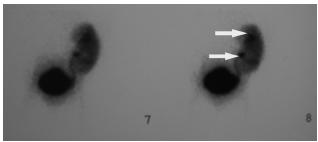
Figure 1. Renogram Showing a Transplanted Kidney With Complete Ureteral Duplication and Anastomosis Done With a Double Lich-Gregoir Technique
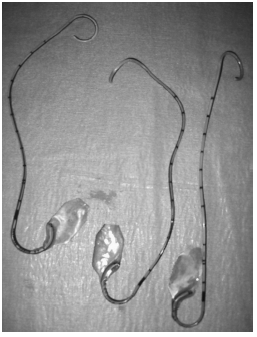
Figure 2. Removal of 3 Stents From a Dual Kidney Transplant With a Kidney Graft That Had a Complete Ureteral Duplication