Volume: 24 Issue: 9 September 2026
FULL TEXT
Beyond Body Mass Index Cutoffs: Donor Quality and Ischemic Burden Shape Kidney Transplant Outcomes in Recipients With Severe Obesity: An Analysis of the Scientific Registry of Transplant Recipients Dataset
Objectives: Obesity remains a common barrier to kidney transplant access, but the clinical relevance of severe obesity depends on donor and ischemic risk.
Materials and Methods: We analyzed Scientific Registry of Transplant Recipients aggregate summary tables for deceased donor kidney transplants performed in the United States from January 1, 2014, to December 31, 2024, stratified by recipient body mass index (calculated as weight in kilograms divided by height in meters squared) of <35, 35 to 40, and >40. Primary outcomes measured were graft survival and delayed graft function. We compared delayed graft function across body mass index groups using X2 test and evaluated graft and patient survival by using Kaplan-Meier estimates from the Scientific Registry of Transplant Recipients.
Results: Among 180,849 transplants (131,379 dona-tion after brain death recipients and 49,470 donation after circulatory death recipients), delayed graft function increased stepwise across the body mass index groups (29.3%, 37.8%, and 42.4%; P < .001). Compared with body mass index <35, the 35 to 40 (odds ratio 1.46; 95% CI, 1.42-1.51) and >40 (odds ratio 1.77; 95% CI, 1.65-1.90) body mass index groups were associated with higher odds of delayed graft function. In donation after brain death recipients, 5-year graft survival declined from 77.51% to 74.33% and to 70.03% across ascending body mass index strata. Lower graft survival with higher body mass index persisted across Kidney Donor Profile Index, donor age, and cold ischemia time.
Conclusions: Higher recipient body mass index was associated with substantially increased risk of delayed graft function and decreased graft survival after deceased donor kidney transplant. The adverse associ-ation appeared strongest when obesity coexisted with less favorable donor or ischemic characteristics, sup-porting individualized donor-recipient risk stratification rather than stand-alone body mass index exclusion thresholds.
Key words : Cold ischemia time, Delayed graft function, Graft survival
Introduction
Obesity is increasingly common among patients with end-stage kidney disease and among candidates evaluated for kidney transplant. Although obesity has long been associated with technical complexity, wound complications, delayed graft function (DGF), and inferior graft outcomes after kidney transplant, the clinical significance of obesity remains debated, particularly in recipients with severe obesity.1-5
Prior studies have suggested that the association between obesity and transplant outcomes is not uniform. Registry analyses have shown that the effect of body mass index (BMI, calculated as weight in kilograms divided by height in meters squared) may vary according to recipient characteristics such as age, race, and comorbidity burden and may also be modified by donor factors.5-7 At the same time, transplant programs remain cautious for candidates with BMI >35, and some centers continue to use BMI-based thresholds in listing or organ acceptance decisions.8,9 As a result, contemporary data on recipients with BMI >40 are limited.
This issue is clinically important because a rigid BMI cutoff may oversimplify risk. Reviews and recent observational studies have emphasized that obesity should be interpreted within the broader clinical context of donor quality, surgical risk, frailty, and center experience rather than as an isolated contraindication.4,8,10 Moreover, transplant may still provide benefit over continued dialysis in selected patients with elevated BMI, even if posttransplant risks are increased.11
The present study used the Scientific Registry of Transplant Recipients (SRTR) aggregate summary data to evaluate deceased donor kidney transplant outcomes across recipient BMI strata. We sought to describe the relationship between recipient BMI and DGF, patient survival, and graft survival, with particular attention to whether the adverse association of obesity is more apparent in the setting of unfa-vorable donor quality or greater ischemic burden. We also sought to characterize outcomes in recipients with BMI >40, a small but clinically important subgroup that remains underrepresented in the literature.8,9
Materials and Methods
Study design and data source
This retrospective study used aggregate kidney transplant outcome data provided by the SRTR to analyze deidentified data. The SRTR performed the requested analyses and returned summary results in an Excel workbook. The workbook contained tabu-lated recipient, donor, and transplant characteristics and SRTR-generated outcome estimates stratified by recipient BMI category and selected donor and transplant variables. Accordingly, this study represents an analysis of SRTR-provided aggregate data rather than an independent reanalysis of raw registry records. The SRTR is a national registry that collects data on all solid organ donors, waitlisted candidates, and transplant recipients in the United States and is widely used for transplant outcomes research.
Study population
The study cohort included adult deceased donor kidney transplant recipients represented in SRTR summary tables for transplants performed in the United States between January 1, 2014, and December 31, 2024. This study interval was chosen to capture a contemporary era of deceased donor kidney transplant while allowing sufficient follow-up for intermediate-term outcomes. This interval also reflects current donor allocation and recipient selection practices. The overall cohort included 180,849 recipients. Because BMI was not available for all recipients in the SRTR summary tables, the BMI-stratified analytic cohort was slightly smaller, at 180,796 recipients (Table 1). In addition, denomi-nators varied slightly across analyses because some outcome and covariate fields had incomplete data. We compared outcomes according to the following recipient BMI categories: BMI <35 (which included recipients with normal BMI, overweight, and BMI 30-34.9), BMI 35 to 40, and BMI >40. Because SRTR provided aggregate data rather than raw patient-level data, formal inclusion and exclusion criteria were determined by the SRTR data request and the returned tables.
Outcomes
The primary outcomes were graft survival, patient survival, and DGF. Patient and graft survival results were available as SRTR-reported Kaplan-Meier time-to-event estimates measured from the date of transplant. Patient survival reflected time from transplant to death from any cause, whereas graft survival reflected SRTR-reported graft failure outcomes from the date of transplant. Delayed graft function was defined as dialysis requirement within the first 7 days posttransplant, which is the most commonly accepted definition.12 We reported DGF as counts and proportions.
We used the covariates of Kidney Donor Profile Index (KDPI) (grouped as 0 to <20%, 20% to 35%, >35% to 85%, and >85%); donor age (grouped as 18-34, 35-54, 55-64, 65-69, >70 years); cold ischemia time (CIT) (grouped as <24, 24-36, >36 hours); and warm ischemic time (WIT) (grouped as <30, 30-45, >45 minutes), where available, for donation after circu-latory death (DCD) kidneys, for stratified analyses.
Statistical analyses
We summarized recipient, donor, and transplant characteristics by BMI category using counts and percentages. Because the SRTR workbook included actual event counts for DGF, we made comparisons in DGF rates across BMI groups by using Pearson χ2 test. We summarized the association between obesity levels and DGF with odds ratio (OR) and 95% CI. Patient and graft survival outcomes were available only as SRTR-generated Kaplan-Meier summary estimates with 95% CIs. We reported patient and graft survival at prespecified posttransplant time points, including 1, 3, and 5 years, along with 95% CIs where available. We computed patient and graft survival estimates by BMI group within donor age, KDPI, CIT, and WIT subgroups.
We cautiously interpreted subgroup findings involving recipients with BMI >40 and combinations of high-risk donor or ischemic characteristics because of limited sample size and reduced precision. We presented these results as descriptive estimates, and these results should be regarded only as hypothesis-generating.
Ethical considerations
This study used SRTR-provided aggregate summary data without access to individual-level patient identifiers.
Results
The SRTR summary tables represented 180,849 adult deceased donor kidney transplants (131,379 dona-tion after brain death [DBD] and 49,470 DCD recipients) performed in the United States between January 1, 2014, and December 31, 2024. Average age of transplant recipients was 52 years, with 39.9% females, with average time from diagnosis to transplant of 1622 days, and a CPRA score of 28. Most recipients had BMI <35 (n = 158,157; 87.5%), followed by BMI 35 to 40 (n = 19,436; 10.8%) and BMI >40 (n = 3203; 1.8%) (Table 1). Most recipients received DBD kidneys (72.6%), had KDPI >35% (43.9%), and CIT <24 hours (77.4%). Across all BMI groups, DBD transplants predominated, with DBD counts of 115,275, 13,812, and 2243 and DCD counts of 42,882, 5624, and 960 in the BMI <35, 35 to 40, and >40 groups, respectively.
Across BMI groups, DGF showed a stepwise increase, with DGF occurring in 46,409 of 158,141 recipients (29.3%) with BMI <35, in 7346 of 19,436 recipients (37.8%) with BMI 35 to 40, and in 1357 of 3202 recipients (42.4%) with BMI >40 (Table 1). This difference between groups was statistically signi-ficant (P < .001). Compared with recipients in BMI group <35, recipients in BMI group 35 to 40 (OR = 1.46; 95% CI, 1.42-1.51) and BMI group >40 (OR = 1.77; 95% CI, 1.65-1.90) had higher odds of DGF. Delayed graft function also increased with worsening donor quality and longer CIT, increasing from 20.9% in kidneys with KDPI 0 to <20% to 39.9% in those with KDPI >85% and from 28.3% in those with CIT <24 hours to 40.9% in those with CIT >36 hours.
Overall, patient and graft survival estimates were available for 150,253 recipients in the SRTR summary tables. Graft survival showed clearer separation by BMI category (Figure 1). In DBD recipients, 1-year graft survival was 94.56% for those in BMI group <35, 93.52% for those in BMI group 35 to 40, and 91.76% for in those in BMI group >40. By 3 years, graft survival declined to 86.72%, 84.44%, and 81.83% and by 5 years to 77.51%, 74.33%, and 70.03%, respectively. In DCD recipients, 1-year graft survival rate was 93.12%, 91.74%, and 91.27%; 3-year graft survival was 85.02%, 82.20%, and 82.20%; and 5-year graft survival was 75.80%, 74.13%, and 77.27%, respectively; DCD estimates in the BMI group >40 should be interpreted cautiously because of the smaller subgroup size (Table 2).
Patient survival declined gradually over time. Among DBD recipients, 1-year patient survival was 97.76%, 97.63%, and 96.67% for the BMI <35, 35 to 40, and >40 groups, respectively, and corresponding 5-year survival was 83.95%, 81.94%, and 79.12%. Among DCD recipients, 1-year patient survival was 97.17%, 96.86%, and 96.64%, respectively, and 5-year survival was 82.80%, 80.74%, and 81.64%. Overall, differences in patient survival by BMI were present but were smaller and less consistent than differences in graft survival.
Recipients with BMI >40, although representing only 1.8% of the transplant cohort, generally had the least favorable outcomes across most examined strata. This group had the highest rate of DGF (42.4%) and, in most subgroup analyses, the lowest graft survival estimates. Among DBD recipients, graft survival in the BMI >40 group was 91.76% at 1 year, 81.83% at 3 years, and 70.03% at 5 years. Across KDPI strata, recipients in the BMI >40 group generally had the lowest graft survival, including 77.53% at 5 years for KDPI 0 to <20%, 74.10% for KDPI 20% to 35%, and 65.68% for KDPI >35% to 85%.
A similar pattern was observed across donor age strata and CIT strata, although several subgroup estimates should be interpreted cautiously because of limited sample size. When stratified by KDPI, the adverse association between high BMI and graft survival persisted across donor quality strata and appeared more pronounced with increasing donor risk. In the KDPI 0 to <20% group, 5-year graft survival was 83.34% for those in the BMI <35 group, 80.59% for those in the BMI 35 to 40 group, and 77.53% for those in the BMI >40 group. In the KDPI 20% to 35% group, corresponding 5-year graft survival was 78.56%, 75.58%, and 74.10%. In the KDPI >35% to 85% group, 5-year graft survival declined further to 71.89%, 68.42%, and 65.68%, respectively, across BMI groups. The KDPI >85% subgroup showed lower graft survival overall, but the BMI >40 stratum was small and is best inter-preted descriptively. A similar pattern was observed across donor age strata, with 5-year graft survival of 77.46%, 70.28%, and 61.72% for recipients in the BMI >40 group who received kidneys from donors aged 18 to 34, 35 to 54, and 55 to 64 years, respectively (Table 2).
Cold ischemia time further stratified graft outcomes (Figure 2). Among recipients with CIT <24 hours, 5-year graft survival was 77.88% for those in the BMI <35 group, 74.61% for those in the BMI 35 to 40 group, and 72.48% for those in the BMI >40 group. In the CIT subgroup of 24 to 36 hours, corresponding 5-year survival was 74.99%, 73.81%, and 68.86%, respectively. The poorest outcomes were observed in the CIT subgroup of >36 hours, in which 1-year graft survival fell to 91.39% for those in the BMI <35 group, 89.86% for those in the BMI 35 to 40 group, and 82.87% for those in the BMI >40 group; 3-year graft survival in these groups was 82.18%, 78.76%, and 74.39%, respectively (Table 2). These findings suggest that prolonged CIT may accentuate the adverse association between higher BMI and graft survival, with the effect appearing most pronounced in recipients with BMI >40.
Among DCD transplants with available WIT data, graft survival generally remained lower in recipients with higher BMI, although the pattern was less uniform than in the KDPI, donor age, and CIT analyses. Because several WIT-based BMI subgroups, particularly those involving BMI >40, were small, these findings are best considered descriptive.
Overall, higher recipient BMI was associated with a marked increase in DGF and lower graft survival after deceased donor kidney transplant. Separation in graft outcomes by BMI was modest at 1 year but became more pronounced at 3 and 5 years, particularly among recipients of DBD kidneys and among transplants involving higher-risk donor characteristics, including higher KDPI, older donor age, and prolonged CIT. The BMI >40 group consistently demonstrated the least favorable outcomes, particu-larly among DBD recipients and in strata defined by donor age >35 years, KDPI >35%, and CIT >24 hours, although the relatively small number of transplanted recipients in this category limits precision and sup-ports cautious interpretation.
Discussion
In this SRTR-based aggregate analysis of deceased donor kidney transplant recipients, higher recipient BMI was associated with a stepwise increase in DGF and with lower graft survival, particularly at longer follow-up. The most statistically secure finding was the marked increase in DGF across BMI categories, from 29.3% in recipients with BMI <35 to 42.4% in recipients with BMI >40 (P < .001). Graft survival differences were more modest at 1 year but widened by 3 and 5 years, especially among DBD recipients and in transplants involving higher-risk donor or ischemic characteristics. These findings are consistent with prior literature showing higher perioperative risk, greater DGF, and less favorable longer-term outcomes among recipients with obesity.1,2,4,5
The present analysis extends prior work by emphasizing the interaction between recipient BMI and donor risk. Five-year graft survival declined across BMI strata within each major KDPI category and across donor age strata, and the poorest outcomes were observed when higher BMI was combined with prolonged CIT. Of note, recipients with BMI >40 and CIT >36 hours had especially poor graft outcomes, with 1-year graft survival of 82.87% and 3-year graft survival of 74.39%. These findings support prior reports suggesting that the effect of obesity is not uniform across transplant recipients and may be modified by recipient and donor characteristics.5-7 Findings also aligned with prior observations that higher recipient BMI is strongly associated with DGF and adverse early graft performance.1,3
An important strength of this study is the inclu-sion of recipients with BMI >40, a population that remains underrepresented in the transplant literature and is often the focus of candidacy debates. Although this group accounted for only 1.8% of the transplanted cohort, recipients with BMI >40 consistently had the highest DGF rates and generally the lowest graft survival estimates across most examined strata. The small number of transplanted recipients in this BMI range limits statistical precision and makes several subgroup estimates difficult to interpret definitively. This limitation also reflects the clinical reality that many transplant programs remain cautious about transplanting candidates with BMI >40, making contemporary national outcome data in this group inherently difficult to assemble.8,9 Within that context, the present SRTR analysis may represent some of the few available contemporary national descriptive data on outcomes in recipients with BMI >40, particularly when donor quality and ischemic burden are considered together.
Our findings are also relevant to the ongoing debate over rigid BMI-based eligibility thresholds. Prior work has shown that obesity is associated with adverse transplant outcomes, but the magnitude of risk varies by population and may not justify a uniform exclusion policy.2-7 Reviews and contemporary observational studies have emphasized that obesity should be interpreted within a broader clinical context that includes surgical risk, donor quality, frailty, and center experience rather than as an isolated eligibility cutoff.8-10 Our results support that view. In this cohort, the most clinically meaningful pattern was not simply that BMI was associated with worse outcomes but that the combination of BMI >40 with less favorable donor quality or prolonged ischemia identified the setting in which graft outcomes were least favorable.
These findings should not be interpreted to mean that transplantation lacks a benefit in patients with severe obesity. Prior studies have suggested that, despite increased perioperative and graft-related risk, kidney transplant may still provide a survival advantage over remaining on dialysis for many patients with elevated BMI.11 Likewise, more recent analyses of recipients with obesity, including mate-kidney and single-center studies, suggest that, although risk is higher, outcomes may still be acceptable in selected patients and should be interpreted with attention to confounding, selection bias, and center practice patterns.7,9,13 In our analyses, we did not directly address transplant-versus-waitlist survival because waitlist mortality estimates in the data were not stratified by BMI. Nonetheless, the data argued against relying solely on BMI >40 as an absolute exclusion threshold and instead supported individualized decision-making that considers recipient obesity in the context of donor quality, ischemic burden, and overall transplant candidacy.
Several limitations should be acknowledged. First, the SRTR data used in our study contained aggregate rather than patient-level data, which precluded multivariable adjustment, formal Cox modeling, or log-rank testing of survival curves. As a result, survival comparisons were descriptive and should not be interpreted as evidence that BMI is an independent predictor of graft loss or death. Second, the BMI >40 group was relatively small, and some subgroup estimates in this category were based on limited numbers, particularly at longer follow-up and in higher-risk donor strata. Third, BMI is an imperfect measure of adiposity and does not capture body composition, central obesity, frailty, or functional status, all of which may influence transplant outcomes.5,8,10 Fourth, because the available waitlist data were not stratified by BMI, this study could not evaluate transplant-versus-waitlist survival tradeoffs in recipients with severe obesity. Finally, because SRTR provided aggregate analytic outputs rather than raw patient-level data, additional adjustment for center practices, recipient comorbidity, and organ accep-tance selection could not be performed.
Conclusions
Our SRTR analysis demonstrated that higher reci-pient BMI was associated with substantially higher DGF and generally lower graft survival after deceased donor kidney transplant. The adverse association was most evident when obesity coexisted with less favorable donor or ischemic characteristics. Recipients with BMI >40 appeared to have the least favorable outcomes across most examined strata, although the limited number of such transplants requires cautious interpretation. These findings support individualized candidate assessment and suggest that BMI >40 may be most appropriately interpreted within a broader donor-recipient risk model rather than as a stand-alone eligibility threshold.
References:
- Cannon RM, Jones CM, Hughes MG, Eng M, Marvin MR. The impact of recipient obesity on outcomes after renal transplantation. Ann Surg. 2013;257(5):978-984. doi:10.1097/SLA.0b013e318275a6cb
CrossRef - PubMed - Kwan JM, Hajjiri Z, Metwally A, Finn PW, Perkins DL. Effect of the obesity epidemic on kidney transplantation: obesity is independent of diabetes as a risk factor for adverse renal transplant outcomes. PLoS One. 2016;11(11):e0165712. doi:10.1371/journal.pone.0165712
CrossRef - PubMed - Molnar MZ, Kovesdy CP, Mucsi I, et al. Higher recipient body mass index is associated with post-transplant delayed kidney graft function. Kidney Int. 2011;80(2):218-224. doi:10.1038/ki.2011.114
CrossRef - PubMed - Prudhomme T, Bento L, Frontczak A, Timsit MO, Boissier R; Transplant Committee from the French Association of Urology. Effect of recipient body mass index on kidney transplantation outcomes: a systematic review and meta-analysis by the Transplant Committee from the French Association of Urology. Eur Urol Focus. 2024;10(4):551-563. doi:10.1016/j.euf.2023.11.003
CrossRef - PubMed - Schold JD, Augustine JJ, Huml AM, et al. Effects of body mass index on kidney transplant outcomes are significantly modified by patient characteristics. Am J Transplant. 2021;21(2):751-765. doi:10.1111/ajt.16196
CrossRef - PubMed - Jarrar F, Tennankore K, Vinson A. Recipient race modifies the association between obesity and long-term graft outcomes after kidney transplantation. Am J Transplant. 2023;23(8):1159-1170. doi:10.1016/j.ajt.2023.04.025
CrossRef - PubMed - Sureshkumar KK, Chopra B, Josephson MA, Shah PB, McGill RL. Recipient obesity and kidney transplant outcomes: a mate-kidney analysis. Am J Kidney Dis. 2021;78(4):501-510.e1. doi:10.1053/j.ajkd.2021.02.332
CrossRef - PubMed - Gillespie H, O'Neill S, Curtis RMK, Callaghan C, Courtney AE. When there is no guidance from the guidelines: renal transplantation in recipients with class III obesity. Transpl Int. 2023;36:11428. doi:10.3389/ti.2023.11428
CrossRef - PubMed - Tsapepas D, Sandra V, Dale LA, et al. Retrospective analysis of the impact of severe obesity on kidney transplant outcomes. Nephrol Dial Transplant. 2023;38(2):472-480. doi:10.1093/ndt/gfac169
CrossRef - PubMed - Vranic G, Cooper M. But why weight: understanding the implications of obesity in kidney transplant. Semin Nephrol. 2021;41(4):380-391. doi:10.1016/j.semnephrol.2021.06.009
CrossRef - PubMed - Glanton CW, Kao TC, Cruess D, Agodoa LY, Abbott KC. Impact of renal transplantation on survival in end-stage renal disease patients with elevated body mass index. Kidney Int. 2003;63(2):647-653. doi:10.1046/j.1523-1755.2003.00761.x
CrossRef - PubMed - Decruyenaere P, Decruyenaere A, Peeters P, Vermassen F. A single-center comparison of 22 competing definitions of delayed graft function after kidney transplantation. Ann Transplant. 2016;21:152-159. doi:10.12659/aot.896117
CrossRef - PubMed - Scheuermann U, Babel J, Pietsch UC, et al. Recipient obesity as a risk factor in kidney transplantation. BMC Nephrol. 2022;23(1):37. doi:10.1186/s12882-022-02668-z
CrossRef - PubMed

Volume : 24
Issue : 9
Pages : 676 - 682
DOI : 10.6002/ect.2026.0093
From the 1Department of Surgery, West Virginia University School of Medicine, Morgantown, West Virginia; and the 2Center for Integrated Biostatistics and Epidemiology, University of Missouri School of Medicine, Columbia, Missouri, USA
Acknowledgements: The authors acknowledge the Scientific Registry of Transplant Recipients for providing the aggregate data tables used in this study and for performing the requested tabulations. The interpretation and reporting of these data are the responsibility of the authors and should not be seen as an official policy of or interpretation by the Scientific Registry of Transplant Recipients or the US Government. The authors received funding in support of the presented research from the Department of Surgery, West Virginia University School of Medicine. The authors have no declarations of potential conflicts of interest.
Corresponding author: Rajeev Sharma, Department of Surgery, West Virginia University School of Medicine, 1 Medical Center Drive, Morgantown, WV 26506, USA
Phone: +304 293 0583 E-mail:Rajeev.Sharma@hsc.wvu.edu
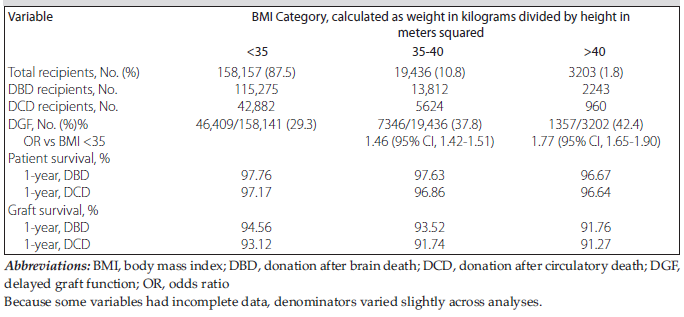
Table 1. Cohort Size, Donor Type Distribution, and Early Posttransplant Outcomes by Recipient Body Mass Index Category
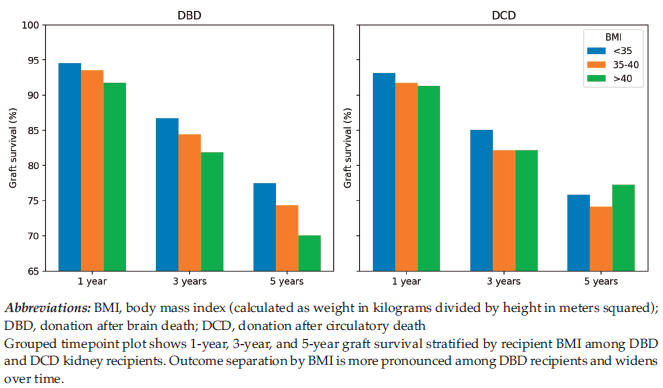
Figure 1. Graft Survival by Recipient Body Mass Index and Donor Type
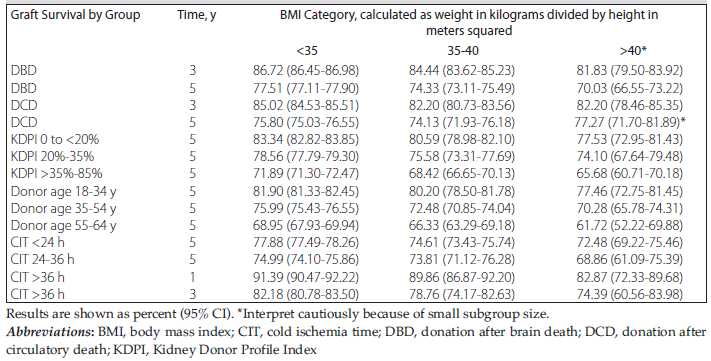
Table 2. Graft Survival by Recipient Body Mass Index Across Donor and Ischemic Risk Strata
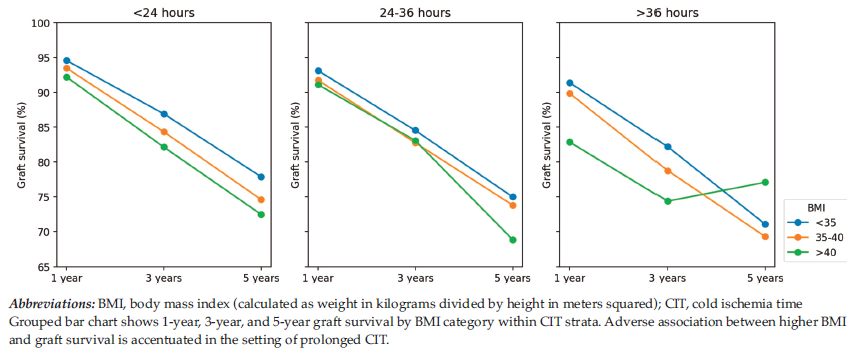
Figure 2. Graft Survival by Recipient Body Mass Index and Cold Ischemia Time