Volume: 22 Issue: 5 May 2024
FULL TEXT
Venomous Snakebite Encounters in Liver Transplant Recipients: A Case Report and Review of Relevant Literature
Envenomation of humans by snakes, a global health challenge, is poorly studied in liver transplant recipients. We report a case of rattlesnake enve-nomation in a 52-year-old female patient who had previously received a liver transplant to treat nonalcoholic steatohepatitis cirrhosis. Despite stable graft function since her transplant, she exhibited elevated liver enzymes on admission, with a mixed hepatocellular and cholestatic pattern. Treatment included CroFab Crotalidae polyvalent immune Fab (ovine) antivenom and close monitoring, with continuation of her standard immunosuppression regimen. Inpatient observation showed reduced swelling and pain but persistently elevated enzymes. Imaging indicated fatty infiltration with patent hepatic vasculature. Her liver enzymes improved spontaneously, and she was discharged after 5 days, with complete normalization of her liver enzyme levels as shown by repeated laboratory test results 1 month later. Our case emphasizes the risk of graft injury in liver transplant recipients, as well as the need for vigilant monitoring and early antivenom administration. We urge further research to establish guidelines for optimal care in this unique population.
Key words : Antivenom administration, Graft injury, Immunosuppression regimen, Liver transplant recipients, Snake envenomation
Introduction
Snake envenomation presents a substantial health challenge in various regions worldwide and contributes to significant levels of morbidity and mortality.1,2 Although liver transplant recipients represent a susceptible group due to altered immune responses, literature on snakebite envenomation in this population remains scarce. This report aims to shed light on this infrequent encounter and its potential effect on posttransplant management.
Case Report
We present the case of a 52-year-old female patient with a significant medical history of decompensated nonalcoholic steatohepatitis cirrhosis for which she had received a deceased donor liver transplant 5 years prior to the presentation we describe here. She presently remains under monotherapy with tacrolimus at a dose of 2 mg twice daily, with stable liver graft function, and is under regular follow-up by a transplant hepatologist.
The patient was admitted due to rattlesnake envenomation at the dorsal aspect of the third digit of her right hand, which had resulted in marked swelling and severe pain during the initial evaluation (Figure 1). Her laboratory panel results were unremarkable. She received 4 vials of CroFab Crotalidae polyvalent immune Fab (ovine) antivenom and was closely monitored. On the first day after admission, her liver enzyme levels were elevated in a mixed pattern of hepatocellular and cholestatic injury (Table 1). Her tacrolimus levels upon admission were 2.3 ng/mL. Her transplant hepatologist was consulted and decided to admit the patient for further observation and to monitor liver function and maintain her standard immunosuppression regimen.
Throughout her hospital stay, the patient expe-rienced a substantial reduction in swelling and pain, but her elevated liver enzyme levels persisted. The results of abdominal Doppler ultrasonography were notable for hyperechoic hepatic echogenicity consistent with fatty infiltration, with patent appropriately directed vascular structures. Consequently, the patient was discharged after a 5-day hospitalization, with plans for close follow-up by her hepatologist and continued monitoring of her liver enzyme levels. Approximately 1 week later, her liver function tests had nearly returned to baseline, and follow-up laboratory results at 1 month showed complete restoration of graft function (Table 1).
Discussion
Snakebite envenomation induces significant disturbances in hepatic function that are primarily attributed to venom-mediated effects on liver mitochondria and hepatocytes. This process triggers the release of interleukin 6, which results in systemic activation of Kupffer cells. Furthermore, various venom constituents, including phospholipase A2, metalloproteinases, 3-finger toxins, and L-amino acid oxidase, contribute to oxidative damage.3 Histopathological evaluation of affected livers reveals a diverse spectrum of changes, including hepatocyte architectural distortion, pyknosis, karyorrhexis, cytoplasmic vacuolation, necrosis accompanied by amyloid deposition, fatty degeneration, portal vein thrombosis, and hepatocyte atrophy.4 Microscopic analysis consistently demonstrates evidence of sinusoidal and Kupffer cell activation, as well as mitochondrial injury and glycogen depletion.5
The clinical presentations following snake enve-nomation are notably heterogeneous and contingent upon various factors, including the snake species, the quantity of venom administered, and the accessibility of antivenom treatment. The various bioactive molecules in the venom can cause diverse clinical effects, including local tissue injuries and systemic manifestations (neurotoxicity, cardiotoxicity, bleeding, acute kidney injury, and rhabdomyolysis).6,7 For example, in cases of Bothrops envenomation in South America, patients have exhibited patterns of injury characterized by hepatic hematoma and shock,8,9 whereas Russell’s viper bites have manifested as severe fatty changes and hepatocellular necrosis.10 Furthermore, cerebral hemorrhages and ischemic infarcts have been documented as consequences of Russell’s viper envenomation, alongside ventricular tachycardia, all of which demonstrate the wide array of clinical presentations associated with snakebite envenomation.11-13
Our case report emphasizes the significant risk of snake envenomation to contribute to graft injury and potential graft loss in liver transplant recipients. This vulnerable population requires heightened vigilance, including close monitoring of graft function and timely administration of antivenom when necessary. However, it is crucial to note that the management of snake envenomation in this specific patient group lacks well-established guidelines, and there remains an urgent need for further research and the development of evidence-based protocols to facilitate optimal care from health care providers for these patients. This case is a compelling reminder of these clinical challenges and the importance of future collaborative efforts to improve outcomes for liver transplant recipients who may encounter snake envenomation.
References:
-
Seifert SA, Armitage JO, Sanchez EE. Snake envenomation. N Engl J Med. 2022;386(1):68-78.
CrossRef, PubMed -
Gold BS, Dart RC, Barish RA. Bites of venomous snakes. N Engl J Med. 2002;347(5):347-356.
CrossRef, PubMed -
Resiere D, Mehdaoui H, Neviere R. Inflammation and oxidative stress in snakebite envenomation: a brief descriptive review and clinical implications. Toxins (Basel). 2022;14(11):802.
CrossRef, PubMed -
Jarrar BM. Histological alterations and biochemical changes in the liver of sheep following Echis coloratus envenomation. Saudi J Biol Sci. 2011;18(2):169-174.
CrossRef, PubMed -
Paliwal G, Prakash S, Kashif AW. Renal and hepatic changes in a case of envenomation by snake bite: case report and review of literature. Indian J Pathol Microbiol. 2022;65(4):934-937.
CrossRef, PubMed -
Ahlstrom NG, Luginbuhl W, Tisher CC. Acute anuric renal failure after pigmy rattlesnake bite. South Med J. 1991;84(6):783-785.
CrossRef, PubMed -
Sachetto ATA, Jensen JR, Santoro ML. Liver gene regulation of hemostasis-related factors is altered by experimental snake envenomation in mice. PLoS Negl Trop Dis. 2020;14(6):e0008379.
CrossRef, PubMed -
Cunha FC, Heerdt M, Torrez PP, et al. First report of hepatic hematoma after presumed Bothrops envenomation. Rev Soc Bras Med Trop. 2015;48(5):633-635.
CrossRef, PubMed -
Freire de Carvalho J, Quispe Torrez PP. Bothrops envenomation and liver hematoma. Eur Rev Med Pharmacol Sci. 2021;25(22):6920-6923.
CrossRef, PubMed -
de Silva HJ, Ratnatunga N, de Silva U, Kularatne WN, Wijewickrema R. Severe fatty change with hepatocellular necrosis following bite by a Russell’s viper. Trans R Soc Trop Med Hyg. 1992;86(5):565.
CrossRef, PubMed -
Chattopadhyay M, Bhattacharya D. Extensive spontaneous cerebral haemorrhage after Russell’s viper bite. BMJ Case Rep. 2020;13(6).
CrossRef, PubMed -
Narang SK, Paleti S, Azeez Asad MA, Samina T. Acute ischemic infarct in the middle cerebral artery territory following a Russell’s viper bite. Neurol India. 2009;57(4):479-480.
CrossRef, PubMed -
Thewjitcharoen Y, Poopitaya S. Ventricular tachycardia, a rare manifestation of Russell’s viper bite: case report. J Med Assoc Thai. 2005;88(12):1931-1933.
PubMed

Volume : 22
Issue : 5
Pages : 399 - 401
DOI : 10.6002/ect.2023.0323
From the Annette C. and Harold C. Simmons Transplant Institute at Baylor University Medical Center, Dallas, Texas, USA
Acknowledgements: The authors have not received funding or grants in support of the presented research or for the preparation of this work and have no declaration of potential conflicts of interest.
Corresponding author: Bashar Fteiha, Annette C. and Harold C. Simmons Transplant Institute at Baylor University Medical Center, Dallas, Texas, USA
E-mail: Bashar.Fteiha@BSWhealth.org
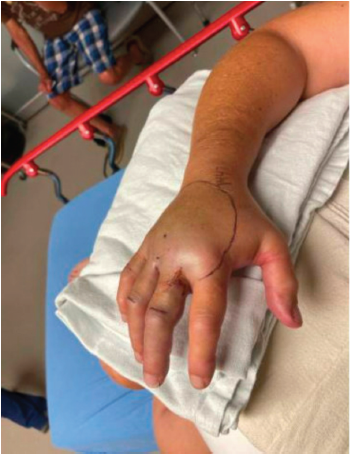
Figure 1.Substantial Swelling of the Hand at the Site of the Envenomation and Swelling of the Arm Above the Site
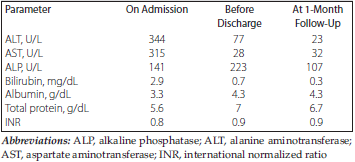
Table 1.Laboratory Parameters at Admission, Before Discharge, and at 1 Month Clinical Follow-Up Parameter On